Doha, Qatar: At the beginning of the year, the US economy was on a path of steady growth and moderating inflation. Price pressures continued to ease from their post-Covid pandemic peak, with consumer inflation declining from around 9% in mid-2022, steadily converging back to the 2% target of the Federal Reserve.
However, this trajectory was abruptly disrupted by the escalation of the conflict between Israel and the US with Iran in late February, QNB said in its economic commentary.
Following the US-Israeli military campaign against Iran, launched on February 28th, Tehran retaliated by effectively closing the Strait of Hormuz – the waterway through which approximately 20% of the world’s oil and liquefied natural gas (LNG) normally flows. The resulting surge in energy prices has partially reversed the disinflation process, raising inflation to close to 4%, nearly double the 2% target of monetary policy, triggering a reassessment of the outlook.
Furthermore, the consensus forecasts for inflation for this year have increased significantly, from 2.6% in February before the conflict, to 3.3% in recent estimates, signalling a renewed phase of price pressures.
What had previously been shaping up as a year of gradual easing by the Federal Reserve is now clouded by heightened uncertainty, as policymakers reassess the persistence and depth of the new price pressures.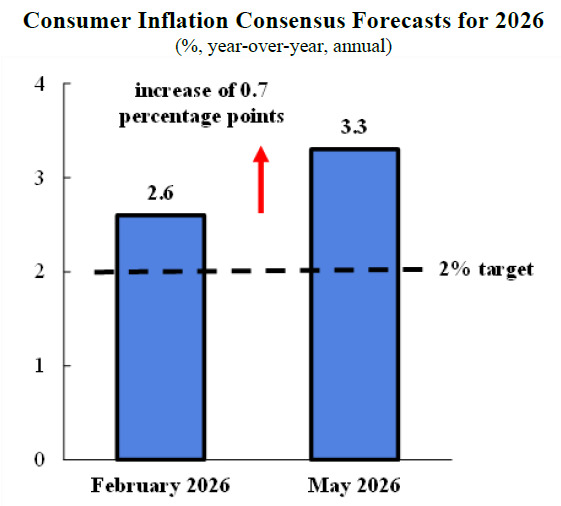 First, the primary driver of the recent increase in inflation has been the sharp rise in energy prices following the escalation of the conflict.
Brent crude prices surged by more than 25% in the weeks that followed the onset of hostilities, reaching above USD 120 per barrel at their peak, before moderating to still-elevated levels, while gasoline prices rose above $4 per gallon from around $3 per gallon previous to the conflict.
The increase in oil and gas prices has rapidly translated into higher gasoline, electricity, and transportation costs, exerting upward pressure on overall inflation. The energy component of consumer prices rose by 17.9% year-over-year in April. Beyond this direct impact, the shock is propagating through second-round effects as higher energy costs feed into production, logistics, and distribution expenses, lifting prices across a broader range of goods and services.
The transmission of cost pressures raises the risk of more persistent inflation, posing a challenge for monetary policy.
Second, trade policy has emerged as an important source of inflationary pressure. Higher tariffs imposed by the US since 2025 have increased the cost of imported goods, reversing part of the disinflation observed over the past year.
Third, domestic demand conditions remain firm, reinforcing underlying price pressures. Private consumption continues to expand at a solid pace, supported by real income growth and elevated household wealth. US household net worth remains near record highs, at around USD 180 trillion, supported by strong equity market performance and resilient house prices. The labour market, while gradually cooling, remains tight by historical standards, with the unemployment rate still close to 4.5%.
All in all, the US inflation outlook has become more challenging, shaped by the recent increase in energy prices, ongoing tariff pressures, and resilient domestic demand. Taken together, these dynamics suggest that inflation is likely to remain above target for longer, complicating the Federal Reserve’s path toward policy normalisation.