File photo
Doha, Qatar: Qatar’s education system recorded a tangible improvement in students’ academic achievement in 2026, with overall performance rates ranging from 80% to 96% across subjects, while the number of government schools achieving performance levels above 70% also increased.
Assistant Undersecretary for Educational Affairs at the Ministry of Education and Higher Education Maha Zayed Al Qaqaa Al Ruwaili affirmed that the Ministry is leading a comprehensive development trajectory aimed at enhancing the quality of education, improving the efficiency of educational practices, and building a more inclusive, innovative, and future-responsive educational system.
Speaking to Qatar News Agency (QNA), Al Ruwaili said that, with the start of the new academic year, these efforts stem from a vision centered on placing students at the heart of the educational process, empowering national cadres, utilizing technology, and building effective partnerships. She noted that these efforts reflect Qatar National Vision 2030 and the country’s direction toward establishing a world-class education system.
Regarding the quality of education system and academic achievements, Al Ruwaili revealed that the year 2026 witnessed a tangible increase in students’ overall academic achievement rates, ranging from 80% to 96% depending on the subject, along with a noticeable rise in the percentage of government schools that achieved performance levels exceeding 70% across all subjects. As an additional effort to promote inclusive education, a package of projects to support non-Arabic-speaking students at the primary stage was implemented in 12 schools, benefiting 476 students.
Regarding teaching faculty, 412 professional development sessions were delivered for teachers in the academic year 2025/2026, alongside 112 lesson observation sessions aimed at exchanging expertise and utilizing a comprehensive database to tailor training needs, rather than offering a uniform training approach for all teaching and non-teaching staff.
With regard to early education, the state of Qatar expanded opportunities by offering enrollment in government kindergartens for children from the age of 3 within the formal education system, with “Kindergarten 1” introduced in 12 government schools, and 3 new nurseries opening during the 2025/2026 academic year. She also emphasized the importance of the School Readiness Scale to assess children’s developmental readiness for school.
She also highlighted the ministry’s program aimed at enhancing early childhood education, launched under the strategic Sunrise program, which included a major awareness event titled “From Here... the Story Begins” to raise community and parental awareness of the importance of this stage.
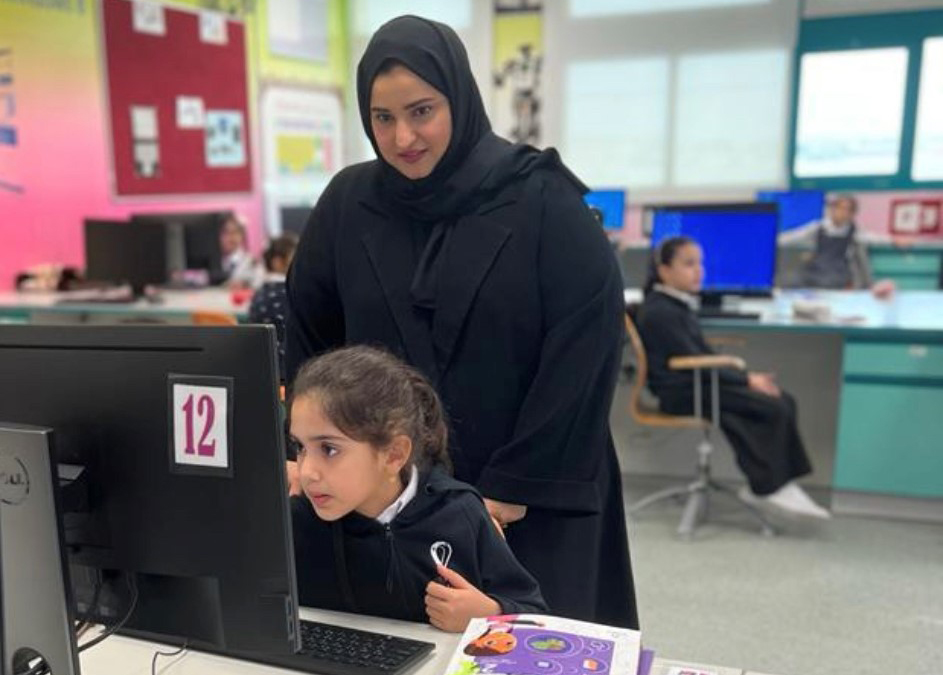
Regarding digital transformation, Al Ruwaili revealed that the ministry’s official educational platforms benefit more than 129,000 students, 15,000 teachers, and 92,000 parents, in addition to the launch of 110 digital innovation clubs and the implementation of specialized cybersecurity programs across 140 schools at various educational levels.
She also noted the launch of a digital citizenship classroom as a pilot project in 10 primary schools, the publication of 7,700 model lessons on official educational platforms, and the development of question banks comprising 1,575 questions. In addition, eight new policies governing e-learning were adopted, including policies on AI integration, digital safety, and digital equity.