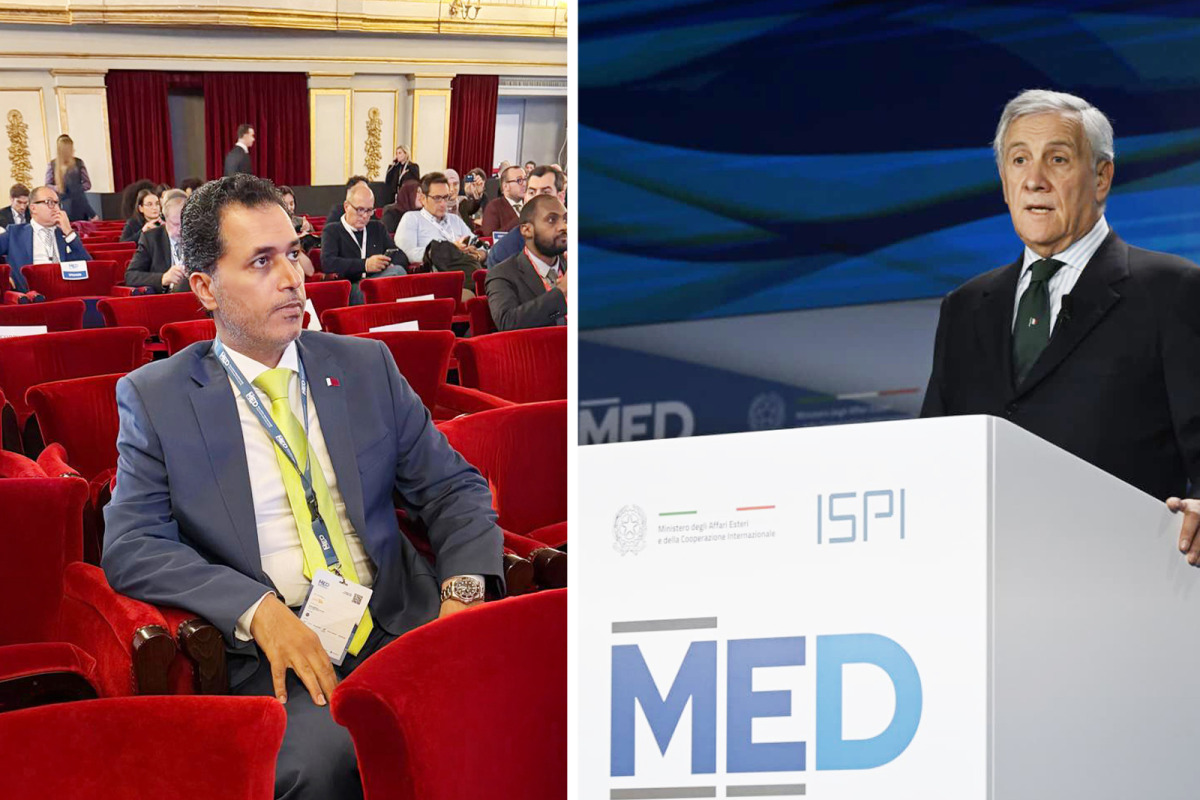
Italian Deputy Prime Minister and Minister of Foreign Affairs and International Cooperation H E Antonio Tajani addressing the opening session of MED 2026. (Left) The Peninsula's Editor-in-Chief, Prof. Khalid Mubarak Al-Shafi, attending the session.
Naples, Italy: The 12th edition of the Mediterranean Dialogues (MED 2026) opened at the historic Royal Palace in Naples on Thursday, November 19, with Italian leaders calling for renewed diplomatic efforts to resolve regional conflicts, strengthen international cooperation and promote economic prosperity across the Mediterranean.
The three-day international forum, held from November 19 to 21, brought together senior government officials, ministers, diplomats, policymakers, business leaders and international experts to discuss pressing geopolitical challenges, regional security, humanitarian crises and opportunities for sustainable economic development.
The opening session featured a message from Italian President H E Sergio Mattarella, followed by an address from Deputy Prime Minister and Minister of Foreign Affairs and International Cooperation H E Antonio Tajani, who emphasised the importance of diplomacy, respect for international law and stronger partnerships between Europe, the Middle East and Africa.
The Peninsula’s Editor-in-Chief, Prof. Khalid Mubarak Al-Shafi attended the 12th edition of the Mediterranean Dialogues, marking his third consecutive year of participation in the international forum. His attendance reflected the newspaper’s continued engagement with international discussions on regional diplomacy, geopolitical developments and economic cooperation.
Organised by Italy’s Ministry of Foreign Affairs and International Cooperation in collaboration with the Italian Institute for International Political Studies (ISPI), MED 2026 brought together more than 2,000 participants and over 300 experts, with approximately 60 sessions addressing issues shaping the future of the Mediterranean and neighbouring regions.
The discussions centred on four principal pillars: shared security, shared prosperity, the human dimension, and civil society and culture, reflecting the forum’s emphasis on cooperation in addressing interconnected political, economic and social challenges.
In his message to the opening session, President Mattarella highlighted the Mediterranean’s historic role as a crossroads of civilisations, trade and cultural exchange, connecting Europe, Africa and Asia through centuries of interaction and shared development.
He cautioned against viewing the Global North and Global South as opposing worlds, stressing that the Mediterranean demonstrates their deep interdependence and shared responsibility for peace, stability and prosperity.
Mattarella warned that armed conflicts, disruptions to energy and food supplies, and growing threats to international commerce had made multilateral cooperation increasingly important. He underscored the need to uphold international law, safeguard freedom of navigation and strengthen coordinated action among governments, international institutions, businesses and civil society.
The Italian President also emphasised that lasting peace requires more than diplomatic agreements, highlighting the importance of sustainable development, economic opportunities and improved prospects for younger generations.
Addressing the gathering, Deputy Prime Minister and Minister of Foreign Affairs and International Cooperation Antonio Tajani reaffirmed Italy’s commitment to promoting the Mediterranean as a region of dialogue, cooperation and shared prosperity rather than confrontation and instability.
He highlighted Naples’s historic position as a centre of Mediterranean commerce and cultural exchange, describing the city as a fitting venue for discussions on the region’s future. Tajani stressed that peace and economic development are closely interconnected, warning that prolonged conflicts threaten international trade, investment, food security and the livelihoods of millions of people.
He called for intensified diplomatic engagement to address conflicts in the Middle East and Ukraine, while emphasising the importance of protecting strategic maritime routes, particularly the Strait of Hormuz and the Red Sea, which are vital to global trade and energy supplies. The humanitarian situation in Gaza featured prominently in the Italian Foreign Minister’s address.
Tajani described the crisis as unacceptable and reiterated Italy’s commitment to humanitarian assistance and international efforts aimed at achieving lasting peace.
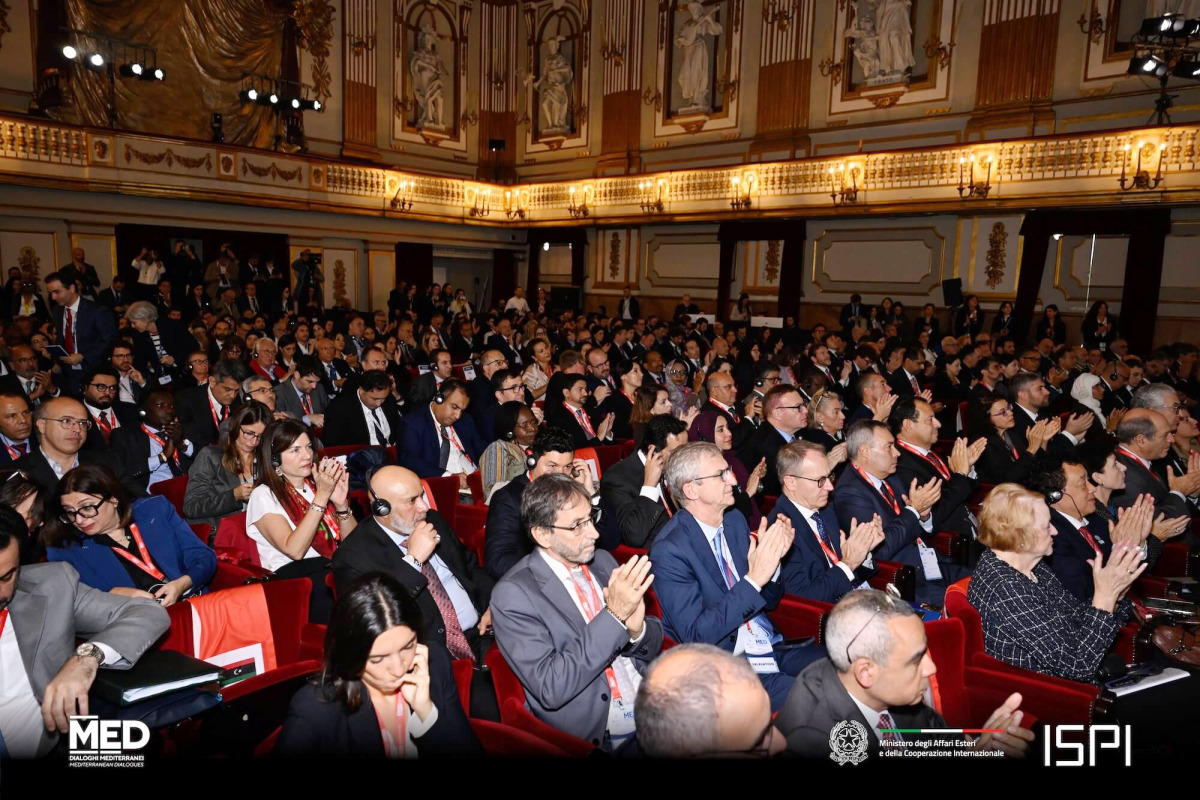 Participants and dignitaries attend a session during MED 2026 in Naples, Italy.
He emphasised the importance of strengthening the Palestinian Authority and creating conditions that would enable Israelis and Palestinians to coexist peacefully.
The Foreign Minister also condemned attacks by Israeli settlers against Palestinian communities, including Christian communities, warning that such violence could undermine prospects for a two-state solution.
Outlining Italy’s humanitarian commitments, Tajani referred to the allocation of €5m for first-aid initiatives and highlighted Italian involvement in relief operations, assistance to the Palestinian Authority and efforts concerning the Rafah crossing.
He stressed the need to maintain humanitarian corridors and ensure continued international assistance to civilians affected by conflict and deteriorating living conditions. Turning to Sudan, Tajani expressed deep concern over the country’s devastating humanitarian crisis, which has displaced millions of people and severely affected civilian populations. He highlighted Italian relief initiatives involving approximately 130 tonnes of humanitarian supplies and outlined plans for further assistance through operations originating from Brindisi.
The Foreign Minister reaffirmed Italy’s commitment to strengthening relations with African countries through development partnerships, investment, infrastructure projects and humanitarian programmes.
He stressed that Europe’s future prosperity is closely linked to Africa’s economic development and called for cooperation based on mutual interests, sustainable growth and shared opportunities. In this context, Tajani highlighted Italy’s Mattei Plan for Africa as an important framework for promoting investment, economic growth and long-term development partnerships across the continent.
Food security was another major issue raised during his address, particularly the impact of international conflicts on grain and fertiliser supplies. Tajani warned that prolonged disruptions to agricultural supply chains could aggravate humanitarian conditions in vulnerable countries and contribute to increased migration pressures towards Europe.
He emphasised the importance of international cooperation to safeguard essential commodity supplies and maintain the movement of food and agricultural products.
Economic connectivity and infrastructure development also emerged as central themes of the opening session, with Tajani highlighting the strategic importance of strengthening commercial links between the Mediterranean, the Gulf, Asia and Europe.
He identified the proposed India–Middle East–Europe Economic Corridor (IMEC) as a significant opportunity to expand trade, improve supply-chain resilience and strengthen economic integration between participating regions.
Tajani called for coordinated efforts to transform the initiative into an operational infrastructure network capable of generating economic benefits and facilitating international commerce.
He highlighted the potential role of Mediterranean ports, including Trieste, Marseille, Naples and Salerno, in supporting regional trade, investment and tourism.
The Foreign Minister also advocated stronger transport connections involving the Western Balkans, the Adriatic Sea and the Black Sea, noting that improved infrastructure and connectivity could contribute to greater economic integration and regional development.
Beyond diplomatic and economic priorities, the forum placed emphasis on the role of culture, research, innovation and civil society in promoting dialogue and mutual understanding among Mediterranean communities.
The conference provided a platform for policymakers, journalists, academics, business representatives and international experts to exchange perspectives on emerging regional challenges and explore opportunities for closer cooperation.
Against a backdrop of continuing geopolitical tensions, humanitarian emergencies and economic uncertainty, the opening session of MED 2026 highlighted the importance of collective diplomatic engagement, international solidarity and practical economic partnerships.
The messages delivered by President Mattarella and Foreign Minister Tajani underscored a common theme: lasting peace and prosperity across the Mediterranean depend on sustained dialogue, respect for international law, humanitarian cooperation and stronger political and economic ties among countries sharing common regional interests.