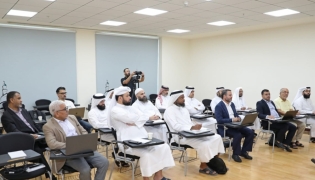
Participants in the workshop.
DOHA: Qatar Red Crescent (QRC) held a regional workshop on strengthening the facilitation and regulation of international humanitarian response in the Middle East and North Africa (Mena) Region.
The two-day workshop was held in coordination with the International Federation of Red Cross and Red Crescent Societies (IFRC) and the participation of representatives from the UN Office for the Coordination of Humanitarian Affairs (OCHA), the General Secretariat of the League of Arab States, and national societies across the region.
The workshop focused on the importance of supporting efforts aimed at facilitating and regulating international relief in the MENA region and discussing the most important challenges that are usually encountered with regulatory issues in international humanitarian response.
The participants discussed areas of concern in potential future crises in addition to the weakest aspects of the global and regional legal frameworks. They also evaluated how well do legal frameworks connect with each other as well as the potential need to further develop the global or regional legal framework. “It is a very important workshop for us. QRC has been very active in providing us with advice in how to develop this area of law. It is something that really new to many people, even people who have been working in the field of disaster management for years and years are not aware of existing particularly international rules that are out there, or even their own national laws,” David Fisher, Coordinator, International Disaster Response Laws, IFRC, said. “We spent five years in consultation and research. We did case studies in several countries about what were their experiences in handling big disasters in light of a lot of international actors coming in. We found that there are a lot of the same kinds of barriers such as visas, customs, tax, transport permissions, registration and bank accounts.”
The Peninsula