By Sachin Kumar
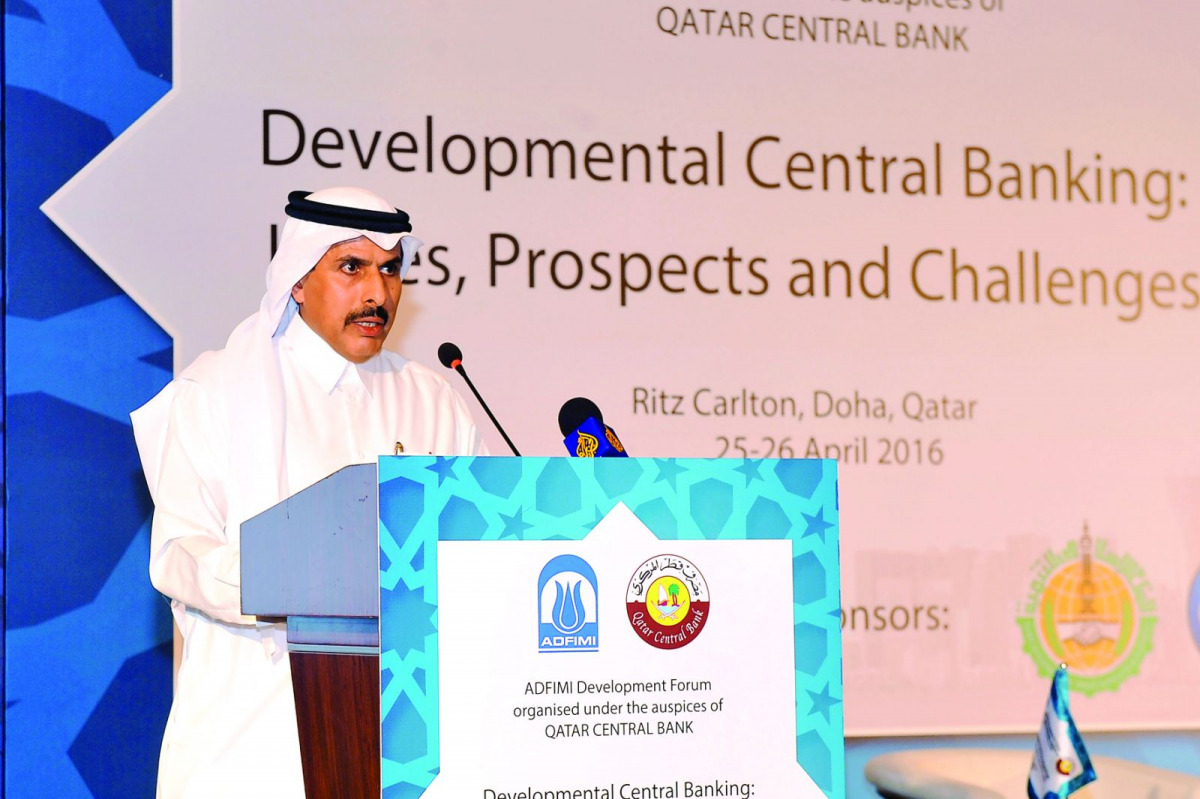
DOHA: At a time when the global financial system is staring at a liquidity shortage, Qatar Central Bank’s (QCB) prudent steps have ensured that there is enough liquidity in the banking system. QCB is working for further developing the infrastructure of the country’s financial sector, said QCB Governor H E Sheikh Abdullah bin Saoud Al Thani yesterday, speaking at ADFIMI Development Forum at Ritz Carlton here.
Organised under the auspices of QCB, experts in the two-day forum are discussing monetary policy strategies adopted by various central banks in the aftermath of global financial crisis and the role of development finance institutions in improving the effectiveness of monetary transmission channels. ADFIMI stands for Association of National Development Finance Institutions (DFIs).
Delivering inaugural speech, H E Sheikh Abdullah said QCB’s monetary policy has remained coherent and has managed liquidity in a way that ensured sufficient funds for the market. We review the financial regulations and policies with aim of enhancing financial stability. We are working on the development of the infrastructure of the financial sector along with payment and settlement system, he said.
The central bank has established Qatar Centre for Credit Information and Qatar central deposit company for security and also launched the first regional centre for clearing of Chines currency renminbi . The central governor said that in order to ensure financial stability and help financial sector to play its role in economic development, QCB is implementing Basel -III standards for financial regulations, in addition to implementing collective cautious policies.
He added that the role of QCB in supporting economic development is driven by Qatar National Vision 2030. QCB in collaboration with the regulating authorities at Qatar Financial Centre and Qatar Financial Markets Authority has set a strategic plan 2013-2016 for economic development. The plan is based on major goals such as improvement of regulatory standards, strengthening monitoring system, strengthening market infrastructure, protection of consumers and investors and building human capital.
Governor said Qatar’s experience in supporting Small and Medium Enterprises (SMEs) is one of the leading and ideal in the region. QCB has set up incubator facility for SMEs, provides wide range of products and services to them and has provided several options to meet their funding needs.
He added that QCB has organsied many consultation activities, conducted workshops and training programmes for them. The central bank set up Qatar Business incubation centre in 2014 which has become one of the largest centre in MENA region. Two batches of entrepreneurs have graduated from the cetnre and it has incubated 33 local companies and trained more than 100 entrepreneurs in 2014.
“During the response to the economic and financial crisis of 2008, central banks played a major role alongside governments. Collectively central bank policies, since the outbreak of the crisis have made a crucial contribution to restoring financial stability,” said M Emin Ozcan, Chariman, ADFIMI. “In 2016, nine years after the eruption of the crisis, the central banking community still faces many difficulties and challenges as it seeks possible exit strategies form their current policy stances and struggles with possible medium-term impacts,” he added.
The Peninsula