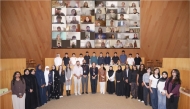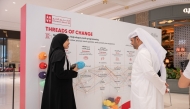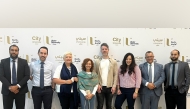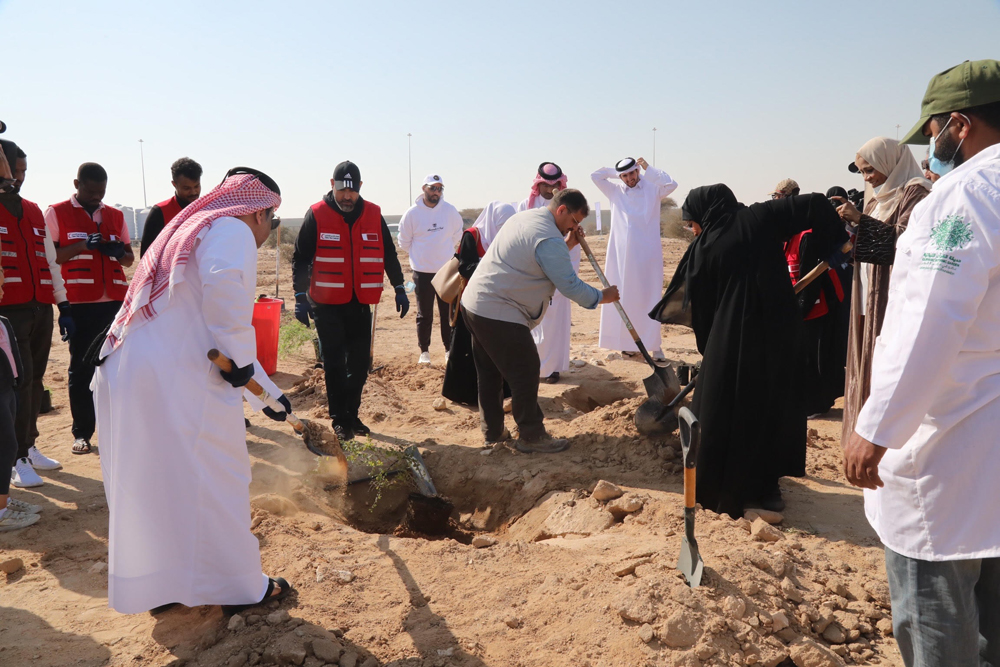
QBG officials during a wild desert tree restoration event at Rawdat Al Faras in Al Nasraniya.
Doha: The Quranic Botanic Garden (QBG), the first garden in the world to exhibit all the plant species mentioned in the Holy Quran, Hadith, and Sunnah, marked Qatar Environment Day 2022 with a wild desert tree restoration event at Rawdat Al Faras in Al Nasraniya.
The event was held in close collaboration with Qatar Red Crescent Society (QRCS), the Department of Protection and Wildlife at the Ministry of Environment and Climate Change, which allocated the Rawdat Al Faras area to be rehabilitated by QBG with the assistance of QRCS’ volunteers.
Entity representatives and volunteers from the QRCS, Dukhan Independent School for Boys, Dukhan Independent Preparatory Secondary School for Girls, the Qatar National Commission for Education, Culture and Science and the Qatar Financial Centre Regulatory Authority, joined in to help preserve and restore 300 Umbrella (Samor), Acacia ehrenbergiana (Salam), Sidra and Leptadenia (Marakh) trees and shrubs in the area, which are native to Qatar and the Arabian Peninsula.
These environmental protection efforts were made within the framework of the State of Qatar’s bid to support key components of the United Nations (UN) Decade for Ecosystem Restoration (2021-2030), such as the UN Environment Programme and the Food and Agricultural Organization, which aims to halt the deterioration of ecosystems and restore them in line with the UN’s sustainable development goals.
Fatima Al Khulaifi, Director, QBG, said: “Qatar Environment Day is a very special occasion for our garden and a reminder of the importance of taking conscious decisions today that protect our planet and keep it healthy for the generations to come. Working together with the community to take care of our environment is at the heart of everything we do at QBG.
“In previous years, QBG has also helped restore the Rawdat Al Faras area by planting wild plants and our environmental specialists provided detailed explanations of the types of wild plants, insects, and reptiles inhabiting the area, and their important role in preserving the ecosystem. We are pleased to once again work with our partners all over the country, including the Department of Protection and Wildlife at the Ministry of Environment and Climate Change, to bring awareness to this indispensable topic.”
Ali Saleh Al Marri, Head of the Wildlife Section, Protection and Wildlife Department, Ministry of Environment and Climate Change, said: “The Ministry of Environment and Climate Change places among its priorities the protection and conservation of local plants, the rehabilitation of endangered species in the country, the conservation and preservation of local vegetation cover and the resettlement of endangered flora and fauna. I am pleased to take this occasion on Qatar Environment Day to thank the QBG for its tireless efforts and constructive cooperation with the administration in rehabilitating the Qatari ecosystem and providing us with large quantities of wild seedlings to revive plant nurseries in Qatar.”
Muna Fadel Al Sulaiti, Executive Director of Volunteering and Local Development, QRCS, said climate change is one of the most serious global challenges: “Humanitarian work is harnessed to mitigate the negative impacts on the present or future, adapt to challenges, build knowledge and awareness and create effective partnerships with diverse stakeholders in government, civil society organisations, the private sectors and local communities in accordance with the Climate and Environment Charter for Humanitarian Organizations, of which QRCS is a signatory.
“The partnership between QBG and QRCS is aimed at protecting the environment, with Qatar Environment Day being a perfect embodiment of that. All of these environmental conservation efforts, programmes and initiatives exemplify Qatar’s keenness towards sustainable development and protection of the environment in line with Qatar National Vision 2030.”
Environmental experts and researchers present at the event provided detailed explanations of the types of wild plants, insects, and reptiles inhabiting the area, and their important role in preserving the ecosystem.