
DOHA: The markets may have overdone in their response to Federal Reserve’s dovish surprise on March 16 and they could have set themselves up for a hawkish surprise down the line, QNB noted in its weekly ‘economic commentary’ yesterday.
According to the research note, as long as there are no more shocks to economic growth and global financial markets, more than two Fed rate hikes could still be on the cards this year, which could lead to a stronger dollar and tighter monetary policy in emerging markets.
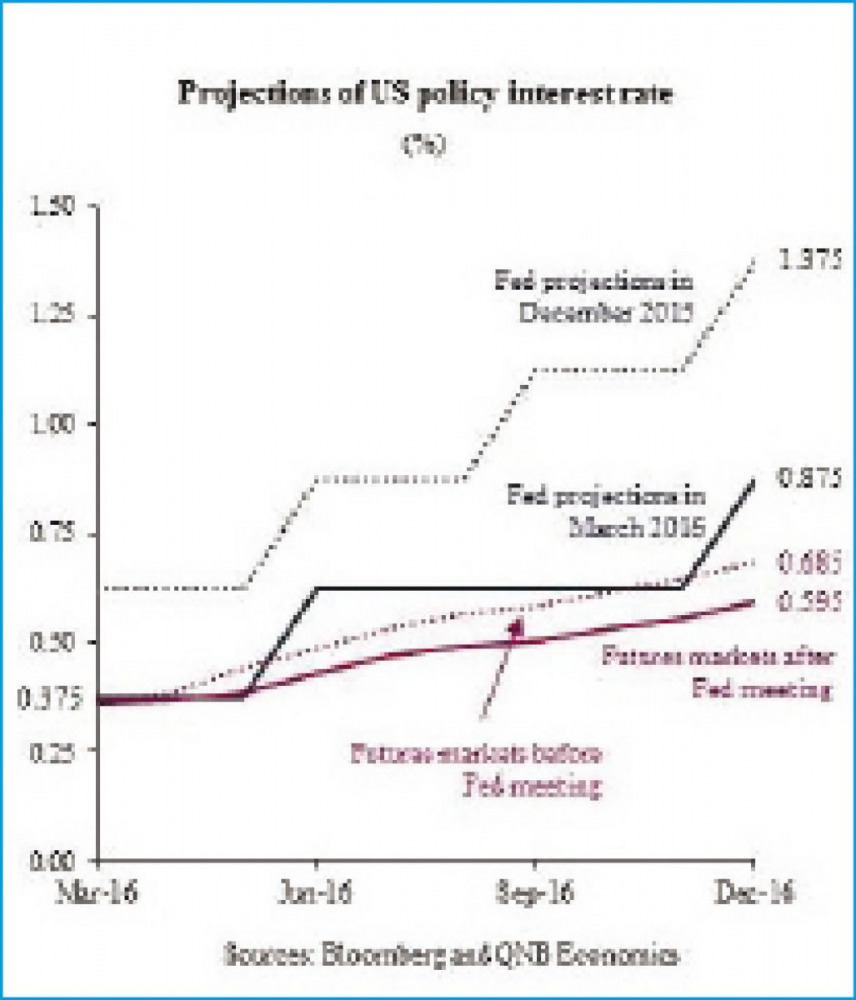
The Fed revised down its projections for the policy rate in 2016 from four hikes to two hikes of 25 basis points each. The move was a bigger downward revision than expected and led to lower market interest rates in the US and a weaker dollar. This provided a reprieve to central banks around the world, freeing up space for easier monetary policy. However, there are a number of reasons to believe that markets may have overreacted to the Fed’s dovish messages and a more hawkish surprise could be in store down the road.
After its March meeting, the Fed kept its main interest rate target unchanged at 0.25 percent-0.5 percent, as expected. However, it lowered its projections for policy rates at the end of 2016 from 1.375 percent in December to 0.875 percent currently. It is possible to decipher four main reasons for this downward revision, QNB analysts said.
First, the Fed stated that global economic and financial developments pose risks to the economic outlook. The start of 2016 has been plagued by severe volatility in global financial markets. This has prompted the Fed to become more cautious about raising rates.
Second, weak US economic data early in the year has led to a small downward revision to the Fed’s real GDP projections. The Fed now expects the economy to expand by 2.2 percent in 2016 compared with a forecast of 2.4 percent in December.
Third, the Fed has revised down its estimate of the long-run unemployment rate from 4.9 percent in December to 4.8 percent.
Finally, the Fed has revised down its projections for headline inflation at the end of the year from 1.6 percent in December to 1.2 percent, as a result of lower oil prices. This is well below the Fed’s target of 2 percent. Lower US interest rates could be beneficial for the world economy by easing monetary policy at a time when other major central banks may be running out of options to spur growth.
The policy interest rates of the two other major global central banks, the Bank of Japan and the European Central Bank, are sinking deeper into negative territory and their quantitative easing programmes are losing efficacy.
In emerging markets, lower US interest rates and a weaker dollar provide more room for central banks to cut rates without instigating capital flight and weaker exchange rates. A number of emerging market central banks have already lowered rates since the Fed’s meeting, such as Bank Indonesia and, reportedly, the People’s Bank of China.
However, the stimulus from easier monetary policy by a dovish Fed may not last. There are a number of reasons to believe that there are upside risks to the Fed’s central projection of two hikes this year.
First, the global economy appears to be getting back on track after a rough start to the year and global financial markets have recovered.
Second, the jobs market in the US remains strong and the economy could soon rise above full employment, increasing the likelihood that the Fed would raise interest rates.
Third, the Fed’s projection of two hikes is based on the median of forecasts generated by the participants in Fed meetings. However, a significant proportion of participants still expect more than two hikes. Out of 17 participants, nine project two hikes this year, seven project more than two hikes and only one projects a single hike. This suggests that it would not take a significant improvement in US economic data to tip the Fed back towards a higher number of rate increases.
Finally, the Fed’s forecasts for inflation could be too low. Core inflation unexpectedly rose to 1.7 percent in January from 1.5 percent in December, rapidly approaching the Fed’s 2 percent target. The Fed expects this measure of inflation to ease during 2016 and is forecasting 1.6 percent, in line with its projection in December 2015. However, markets and a number of commentators expect core inflation to remain persistently higher.
Therefore, as long as there are no more shocks to economic growth and global financial markets, more than two Fed rate hikes could still be on the cards this year, QNB analysts said.The Peninsula