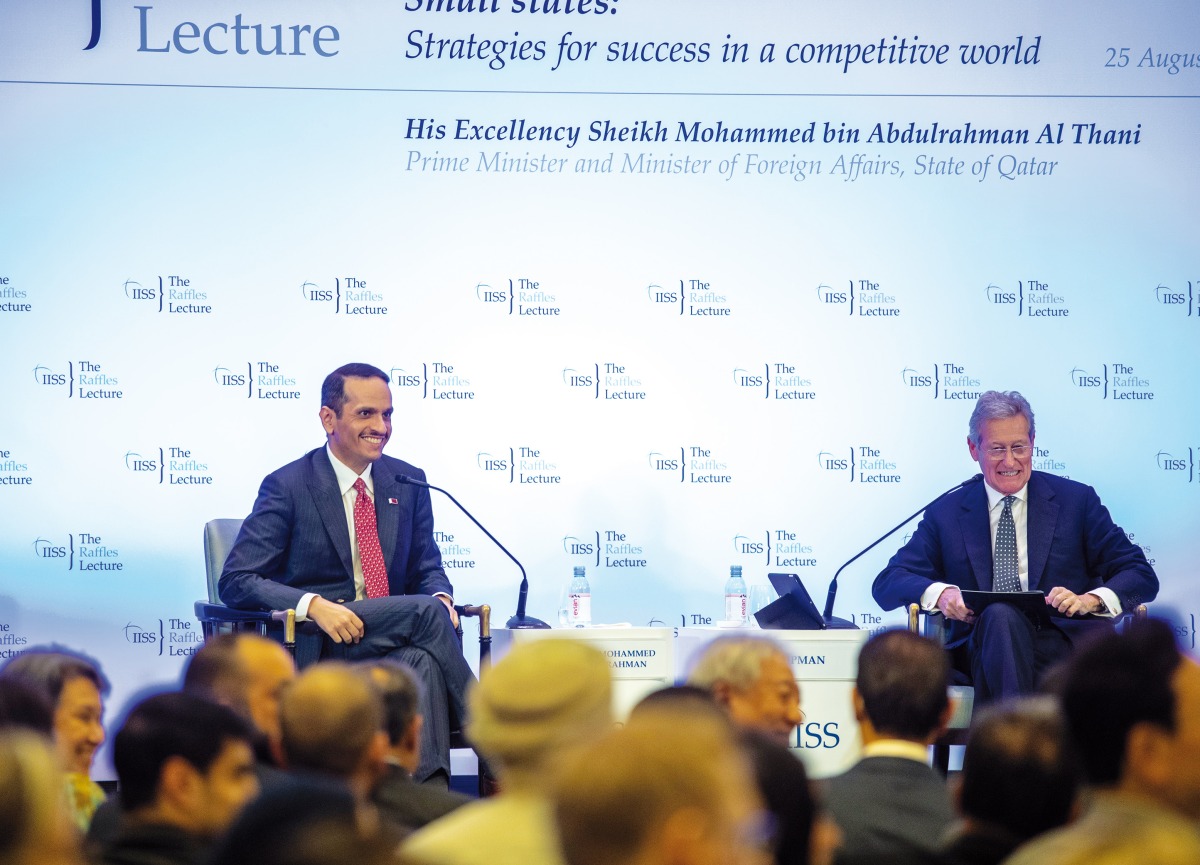
Prime Minister and the Minister of Foreign Affairs H E Sheikh Mohammed bin Abdulrahman bin Jassim Al Thani with Director-General and Chief Executive of the International Institute for Strategic Studies Sir John Chipman during a panel discussion in Singapore.
Singapore: Prime Minister and the Minister of Foreign Affairs H E Sheikh Mohammed bin Abdulrahman bin Jassim Al Thani on Friday participated with Director-General and Chief Executive of the International Institute for Strategic Studies (IISS) Sir John Chipman in a panel discussion on small countries and strategies for success in a competitive world. The function was held at the Ruffles Hotel, Singapore.
Their Excellencies members of the official delegation accompanying H E the Prime Minister and the Minister of Foreign Affairs attended the lecture along with a lineup of Singaporean ministers senior officials, scholars and business people.
During the session, Prime Minister and the Minister of Foreign Affairs Sheikh Mohammed bin Abdulrahman bin Jassim Al Thani delivered the inaugural lecture of the IISS Raffles Lectures series, organised by IISS.
He touched on the vision of the State of Qatar on the challenges facing small and medium-sized countries, and ways to enhance and develop security cooperation in order to achieve comprehensive and sustainable security, especially in the security, defence, political, economic and investment, innovative ways of using modern technology, environmental sustainability and collective action, in addition to promoting peaceful solutions and diplomatic initiatives to resolve various conflicts and wars in the region and the world.
At the outset of his lecture, he spoke about Qatar-Singapore relations, pointing that the two countries have a lot in common. “Small states have an important role to play,” he said.
The Prime Minister went on saying; “In our world, which has undergone great transformations in the past few years, we are witnessing the emergence of multiple centres of influence, each with its own political, economic, and technological strengths.
“New conflicts and major confrontations between big power blocs put the international order in real jeopardy. These interconnected threats impact billions of us.”
Talking about the current challenges in the world, he said: “ The war in Ukraine, which has shaken global energy markets, and caused widespread food insecurity, political polarisations in the Americas, political instability in Africa, ongoing conflicts in the Middle East, and the ongoing rivalry between the US and China, with repercussions on the global supply chain and international commerce we are all concerned about this rivalry, particularly in this region.”
“I am often asked about how Qatar has been able to balance between these two big powers as a small state,” he said pointing that Qatar believes in the interdependence of the international community. “This conviction makes it possible for us to have a strong commercial partnership with China, while maintaining our strategic alliance with the United States,” he explained.
“In the same year we were designated a non-NATO ally to the US, we also signed three new energy deals with China. Our ability to navigate our relations with China and the US is grounded in our adaptability, diplomatic engagement, and pursuit of mutually beneficial interests. This not only serves Qatar’s own national interests, but also contributes to regional and global stability as well,” he added.
He went on saying: “The many conflicts we witness in every region can at times tempt small states to be complacent and think they do not have a role to play strictly due to their size. It is quite the opposite. Small states are at times better positioned to play a critical role in resolving conflict.
“Because small states are often more affected by geostrategic competition, heightened tensions, and economic insecurity, we must be resilient and positively engage whenever and wherever possible.
“Leaders of small states must be prepared to face these challenges, not as passive onlookers, but as active participants in building peace and stability, as facilitators of dialogue, and as agile mediators in global conflicts.
“Qatar succeeds in such engagements by focusing our efforts on three main areas: alliance building and multilateralism, peace facilitation, and investment in economic growth for future generations.”
The Prime Minister and the Minister of Foreign Affairs outlined that for Qatar, as a small state in a turbulent neighbourhood, alliance- building and multilateralism is key. “It is at the center of our foreign policy to try to preserve and empower multilateral frameworks and to fully embrace and advocate for a rules based international order. Qatar has maintained effective cooperation with international and regional bodies, and has been an active member in various international initiatives,” he stressed.
“Last year, we signed the instrument of accession to the Treaty of Amity and Cooperation in Southeast Asia (TAC), stemming from our common will to create a safe and stable area for the promotion of sustainable economic development,” he said, stressing “Our relations with the Asean countries are of paramount importance to us, and we are keen to continue to strengthen our ties with them and with the Asian continent in general.”
Sheikh Mohammed bin Abdulrahman bin Jassim Al Thani stressed that Qatar has also become a regional hub for multilateralism by opening numerous UN offices in Doha. “We launched the United Nations House last March, which includes 12 UN offices.”
“Qatar also focuses on peace facilitation to strengthen international peace and security. This has been one of the key pillars of our foreign policy for more than 25 years. Just like Singapore, being a small country gives us a lot of advantages in agility, mobility, and building networks. Small states can open reliable channels of communication between countries which can serve as an opportunity to strengthen strategic partnerships with major powers in the international community, resulting in vital ceasefires, dialogues, and peace and security arrangements,” he said.
He said: “With Iran, we reached an agreement with the US, becoming a key mediator in the recent prisoner swap deal, and in opening a financial channel for humanitarian purposes that will help resolve long lasting issues - a step that we hope will lead to wider dialogue on the Iranian nuclear issue.”
He went on saying: “Before this, in August 2021, we succeeded in mediating between the Taliban and the United States, which resulted in the end of a war that spanned more than two decades. Qatar played a critical role in one of the biggest humanitarian airlifts in history, successfully evacuating more than 80,000 individuals through Qatar.”
The Prime Minister and Minister of Foreign Affairs added: “Using the wealth we generated, we invested in our country and our people. We invested in education and infrastructure, establishing a state-of-the-art airline, airport, and seaport, while becoming experts in logistics, technology, and professional services. We also established Qatar Investment Authority, which plans on investing in Qatar’s future through projects that are diversified, spanning across major global markets, sectors, and geographies.”
His Excellency pointed that Qatar has set up its own Qatar Investment Authority regional hub here in Singapore. “Currently, our investments in Singapore are in the real estate, sports, and healthcare sectors, and we look forward to exploring potential investments in more sectors,” he noted.