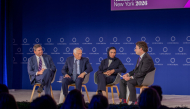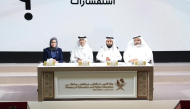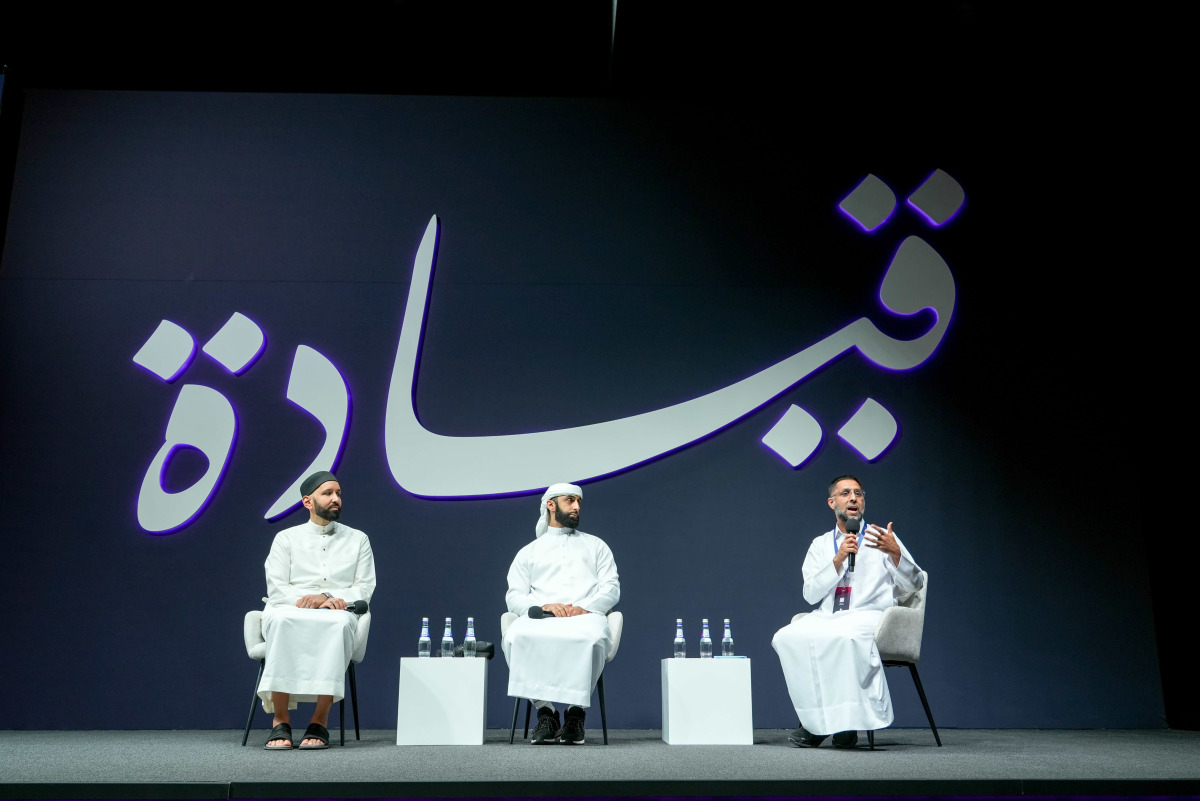
Experts at a discussion during the QIYADA conference.
Doha, Qatar: The importance of young Muslims finding and being guided by their “compass”, and using technology to drive positive change, has been emphasized by thought leaders as the second edition of Qatar Foundation’s QIYADA conference came to a close.
The two-day gathering at Multaqa (Education City Student Center) drew over 1,300 Muslim youth from Qatar to discuss, explore, and share experiences and perspectives on faith, identity, leadership, and addressing today’s challenges with scholars, educators, and other inspiring voices.
Held under the theme ‘Guided by Faith: Thriving in a Changing World’, QIYADA (Qatar Islamic Youth Aspiration and Development Assembly) has empowered young Muslims to reflect on their Islamic values, tackle global challenges, build their leadership skills, and embrace cross-cultural understanding. The conference was organized by the Office of Wellness and Spiritual Life within Qatar Foundation’s Higher Education division, with Qatar International Islamic Bank (QIIB) as official sponsor and the Ministry of Sports and Youth as participant sponsor
On the second day of the conference, educational consultant and lecturer Dr. Abdulrahman Al-Harami presented a talk titled ‘The Compass: Which Direction?’ in which he defined what he called “the compass of life,” and how people can best manage their time toward it.
“What is the thing I am willing to pour my time and effort into? That is your compass,” said Dr. Al-Harami, as he asked the young attendees at QIYADA to look within themselves and assess the value of their time and how they spend it.
“The gift of life is in the time we have, and those who do not know what their compass is will spend their lives lost as to their destination,” he said. “Many of us do not lead happy lives because we are always looking for tomorrow’s happiness. Very few think about how to create quality time for themselves in the now, so that they may look back on their days contentedly.”
Dr. Al Harami urged young people to remember one core principle: do not give up, saying: “Those who persist in something will be known by it. Take your dreams and aspirations seriously and let them be your compass in life.”
On the second day of the conference, Muslim chaplain, Imam, khatib, and teacher to young adults Sheikh Hisham Abu Yusuf spoke about technology in today’s world during a talk titled ‘Prophetic Leadership in the Age of AI’.
“There is no point talking about leadership if we don’t talk about the new reality of leadership that faces us today – the reality of a digital world,” he said.
“The reality is that people don’t exert themselves for answers because everything is known by ChatGPT; the reality of a world where everything is two clicks away.”
He outlined a series of practical steps for young people to consider, including quitting social media for a week and, at the end of it, calculating how much good they could have done in that time.
And he also encouraged the audience to learn a skill that could harness technology for good, saying: “Think of an issue you see in the world around you – healthcare, poverty, people not understanding the Qur’an, the Arabic language, the breakup of family, marriage. “There is a long list of problems, but where are the people that are willing to solve them?”
A panel discussion featuring scholar and human rights activist Dr. Omar Suleiman, Sheikh Ali Hammuda, editor of Islam21c website, and Dr. Osman Umarji, Director of Global Data Studies at Yaqeen Institute for Islamic Research and Senior Consultant to Qatar Foundation, reflected on events and topics discussed over the two days of the conference.
And speaking to participants about uncertainty, unpredictability, and the changing world, Dr. Umarji said: “You’ve all witnessed change at a rate that prior generations have never experienced.
“We’re seeing Artificial Intelligence and Large Language Models opening opportunities and possibly creating problems. And people are left wondering: how do we function in a world which we don’t know what it’s going to look like tomorrow?”
He explained that people often ask what they should study in school, wondering whether choosing a particular subject would guarantee them a stable career, and where they should study given the possibility of war breaking out anywhere in the world, saying: “This state of disequilibrium has caused a lot of anxiety – and rightfully so.”
Giving the conference’s concluding remarks, media professional, presenter, trainer, and khatib Sheikh Abdullah Al Buainain said: “How can you be a leader and show up without knowing who you are? Who you are is a Muslim.”
And he ended with a piece of advice: “Purpose is not derived from being on a stage or a platform; that is not a requirement of life. The most important question is ‘where do I belong?’ – and that is a question only you can answer.”