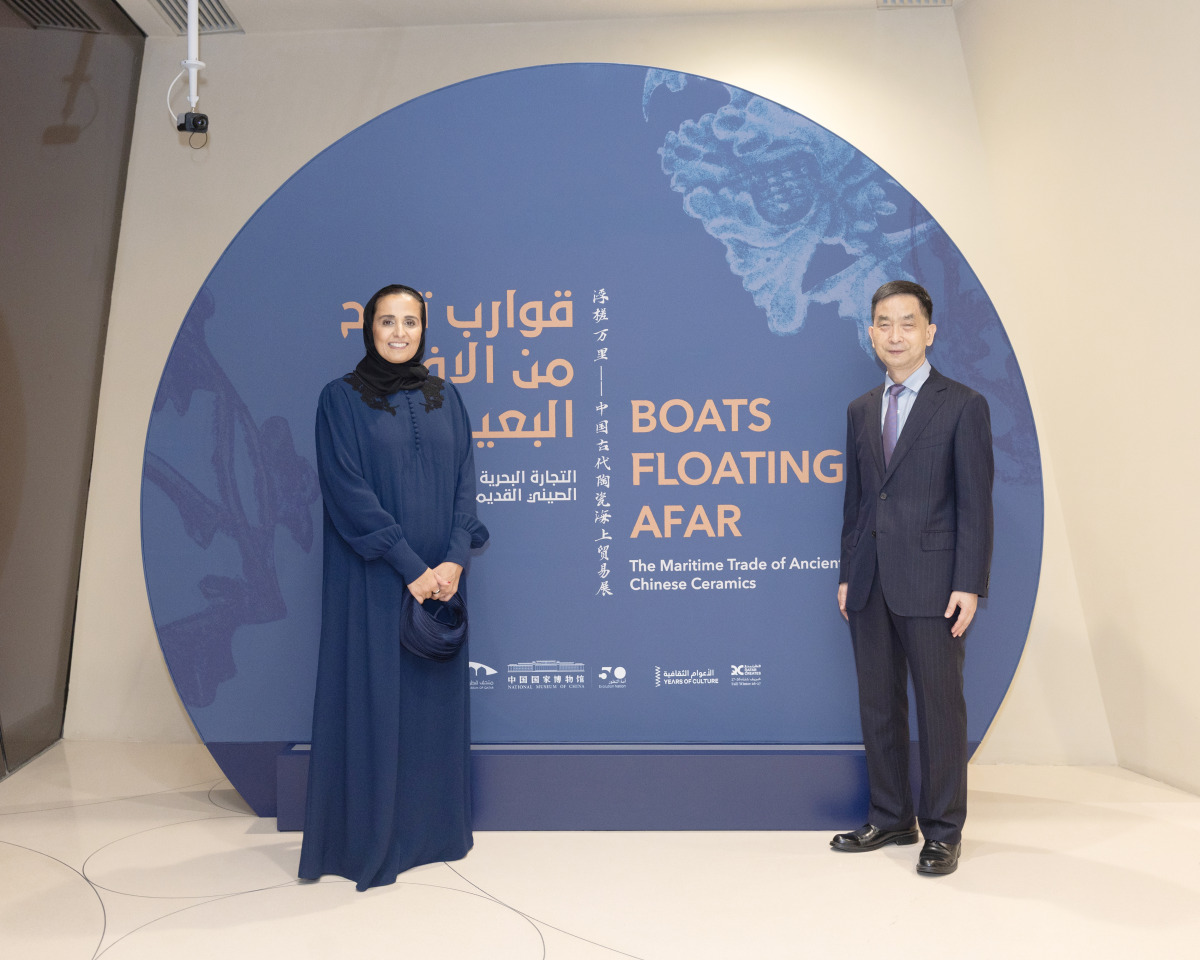
Chairperson of Qatar Museums H E Sheikha Al Mayassa bint Hamad Al Thani and the Ambassador of China H E Cao Xiaolin at the event.
Doha, Qatar: Qatar Museums opened yesterday ‘Boats Floating Afar: The Maritime Trade of Ancient Chinese Ceramics; at the National Museum of Qatar (NMoQ), exploring how Chinese ceramics travelled thousands of kilometres by sea, shaping artistic traditions, trade and daily life far beyond the places where they were made.
Organised in collaboration with the National Museum of China and presented in Temporary Gallery 13, the exhibition follows more than 1,000 years of ceramic production and maritime exchange from the Tang to the Qing dynasties (618-907 CE to around 1900 CE). More than 100 objects from the National Museum of China are shown alongside selected material from Qatar Museums’ collections.
‘Boats Floating Afar: The Maritime Trade of Ancient Chinese Ceramics’ places Qatar within broader histories of exchange that connected the Gulf with communities and trading centres across Asia centuries before modern global networks emerged. It will be on view until 15 February 2027.
Director of the National Museum of Qatar Sheikh Abdulaziz bin Hamad Al-Thani said, “The sea has shaped Qatar’s history for generations, sustaining communities through pearling, fishing and trade and connecting the country with ports and cultures across the region and beyond. Boats Floating Afar: The Maritime Trade of Ancient Chinese Ceramics places Qatar’s history within a far wider narrative of maritime exchange, revealing how objects, skills and ideas travelled across great distances. The objects on view offer tangible evidence of the networks that linked the Gulf with China and Asia centuries ago.”
Director of the National Museum of China Luo Wenli said: “Through Boats Floating Afar: The Maritime Trade of Ancient Chinese Ceramics exhibition, we hope to further advance exchanges and cooperation between the National Museum of China and the National Museum of Qatar. By reflecting together on the history of the Maritime Silk Road and appreciating the beauty of our respective cultures, we hope to deepen mutual understanding, enhance our friendship, and continuously consolidate and strengthen the friendly relations between our two peoples.”
Visitors can see ceramics produced at some of China’s best-known kiln centres, including Jingdezhen, Longquan, Dehua, Changsha and Yue. Celadon, bluish-white wares, Ming blue-and-white porcelain and richly decorated Qing pieces illustrate evolving techniques and tastes across successive dynasties. Several objects demonstrate how Chinese makers responded to overseas markets, adapting forms and decorative styles for customers far from China.
The exhibition unfolds across four thematic chapters, tracing the development of Chinese ceramic trade from the Tang Dynasty (618–907 CE) to the Qing Dynasty (1644–1911 CE). The first chapter, Endless Shores, introduces the beginnings of maritime trade and the influence of Chinese kilns beyond China. Sea of Sails follows the expansion of maritime networks during the Song and Yuan dynasties (960-1368 CE), when growing overseas demand led to new ceramic wares and trade systems.