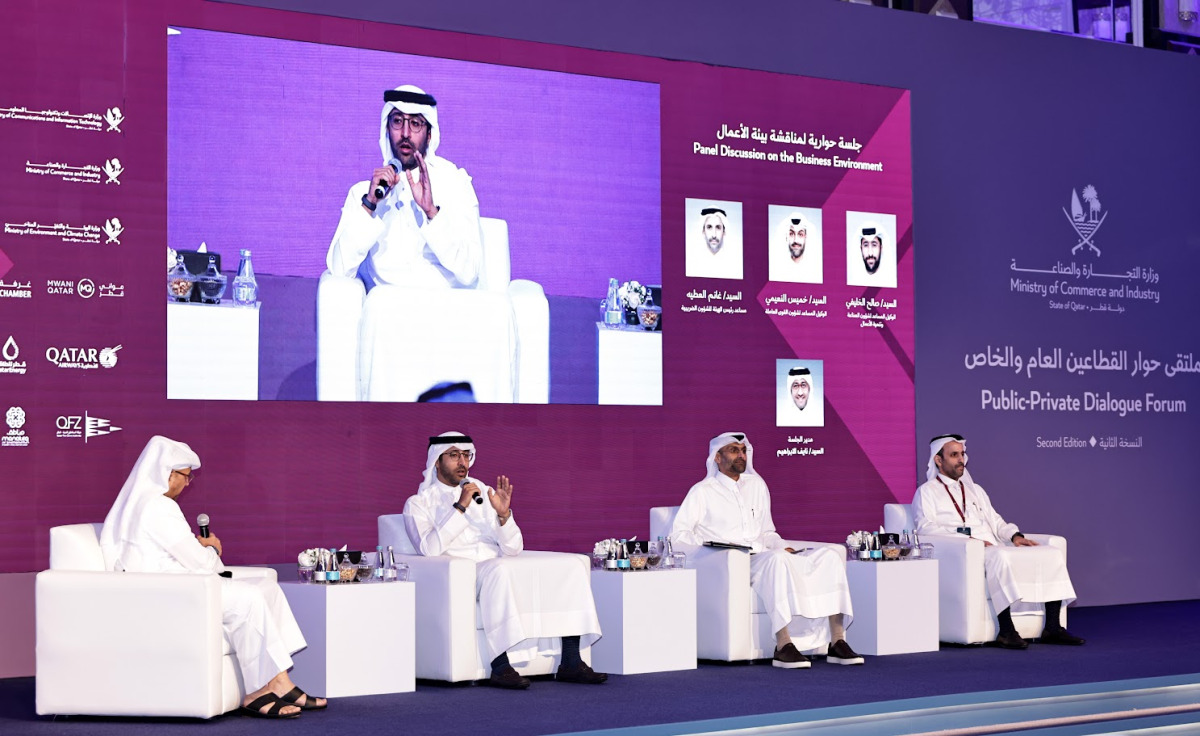
Assistant Undersecretary for Industry and Business Development at MoCI Saleh Majed Al-Khulaifi, Assistant Undersecretary for National Workforce Affairs in Private Sector at Ministry of Labour Khamis Mohammed Al Nuaimi, and Assistant President for Tax Affairs at the General Tax Authority Ghanim bin Khalifa Al-Attiyah during the panel discussion. PIC: Salim Matramkot
DOHA: Qatar is stepping up efforts to improve its business environment through legislative reforms, closer coordination between government entities and enhanced public-private partnerships, as officials highlighted initiatives aimed at attracting investment, supporting businesses and streamlining government services.
The discussions took place during a panel session titled ‘The Role of Legislation and Government Integration in Developing Government Services’, held on the sidelines of the second edition of the Public-Private Sector Dialogue Forum, organised by the Ministry of Commerce and Industry (MoCI) on Wednesday.
The session brought together Assistant Undersecretary for Industry and Business Development at the Ministry of Commerce and Industry Saleh Majed Al-Khulaifi, Assistant Undersecretary for National Workforce Affairs in the Private Sector at the Ministry of Labour Khamis Mohammed Al Nuaimi, and Assistant President for Tax Affairs at the General Tax Authority (GTA) Ghanim bin Khalifa Al-Attiyah.
Al-Khulaifi stressed that effective legislation and stronger cooperation between the public and private sectors are essential to achieving Qatar’s economic ambitions and increasing the private sector’s contribution to the national economy.
He said the Ministry was reviewing several legislative frameworks, including company laws, bankruptcy legislation and competition regulations, to address business challenges and create a more attractive investment environment in line with Qatar National Vision 2030.
He emphasised that the quality, flexibility and practical application of legislation were more important than the number of laws introduced, adding that policymakers must listen to private sector needs when developing new regulations.
Replying to a question, Al-Khulaifi further revealed that the Ministry was coordinating with 29 government and non-government entities to reduce administrative burdens on businesses. The objective is to eliminate the repeated submission of documents already issued by other government agencies, making procedures faster and less complicated.
Addressing the impact of the regional conflict on businesses, Assistant Undersecretary for Industry and Business Development at MoCI praised the resilience of Qatar’s private sector, saying companies had maintained production and worked to secure raw materials despite logistical challenges and supply chain disruptions. He expressed appreciation for businesses that helped maintain the continuity of essential supplies.
Meanwhile Al Nuaimi highlighted the Ministry of Labour’s efforts to attract skilled talent to Qatar and improve labour-related policies through initiatives that gather feedback from stakeholders. He said government entities must work together to develop integrated systems that simplify procedures and improve the experience of businesses and service users.
On the other hand, Al-Attiyah outlined the General Tax Authority’s efforts to improve tax-related procedures and legislation, noting that taxation policies could also encourage businesses to adopt healthier production practices. He cited the tax imposed on sugary drinks as an example, saying some companies had approached the authority with plans to produce healthier alternatives.
He also highlighted improvements in digital government services, including the introduction of a single window system and 11 services designed to simplify company and product registration and facilitate trade procedures. The issuance of tax certificates, which previously could take up to five days, has also been streamlined through an automated system that allows certificates to be issued instantly.
The panellists agreed that stronger institutional coordination, responsive legislation and digital transformation remain central to improving government services, supporting investors and strengthening the resilience of Qatar’s economy.