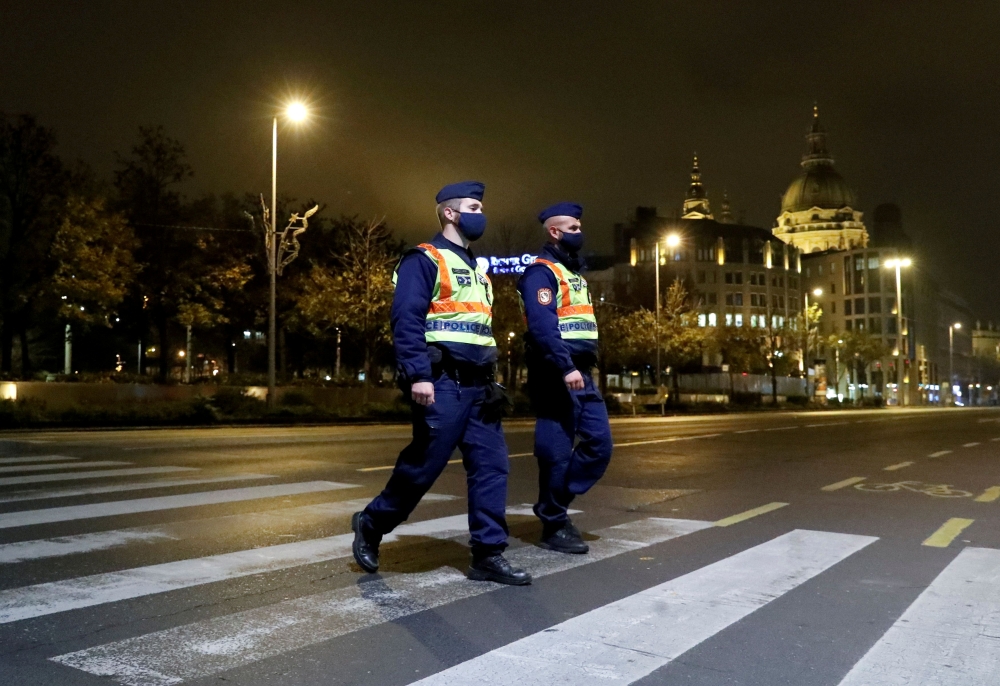
Police officers patrol during a night-time curfew imposed by the Hungarian government to curb the spread of the coronavirus, in Budapest, Hungary, November 11, 2020. REUTERS/Bernadett Szabo/File Photo/File Photo
BUDAPEST: Hungary is extending a partial coronavirus lockdown in force since early November until March 1, Prime Minister Viktor Orban's chief of staff said on Thursday.
Gergely Gulyas told a press briefing that any easing of restrictions now would lead to a tighter lockdown later, and Hungary could only start easing the measures if the number of cases falls sharply or if large numbers are inoculated.
"The measures taken in November have helped slow down and keep the pandemic under control," Gulyas said. "Experts say in the absence of a vaccine, any easing would lead to a new wave and even more drastic tightening later."
Current lockdown measures, including a night curfew and closing secondary schools and restaurants, were due to expire on Monday. Gulyas said the government would ask parliament to extend emergency government powers by 90 days.
Hungary had vaccinated 161,215 people as of Thursday using Pfizer and Moderna shots, the government said. Gulyas said vaccines arriving through the European Union's procurement process would not be enough to achieve mass inoculation.
Hungary, with a population of around 10 million, has reported 363,450 cases and 12,291 deaths.
Gulyas said Hungary, which last week became the first EU member to buy Russia's Sputnik V vaccine, would receive the first batch of the shot by the end of February, enough to inoculate 300,000 people.
Orban's government is under pressure to reopen the economy as soon as possible before a 2022 national election after last year's pandemic-driven crash led to its worst recession since the global financial crisis.
Gulyas said the government would accelerate the approval process for vaccines, granting emergency use approval to any shot already administered to at least a million people globally.
However, local health authorities would screen any new vaccine to be used in Hungary, he said.