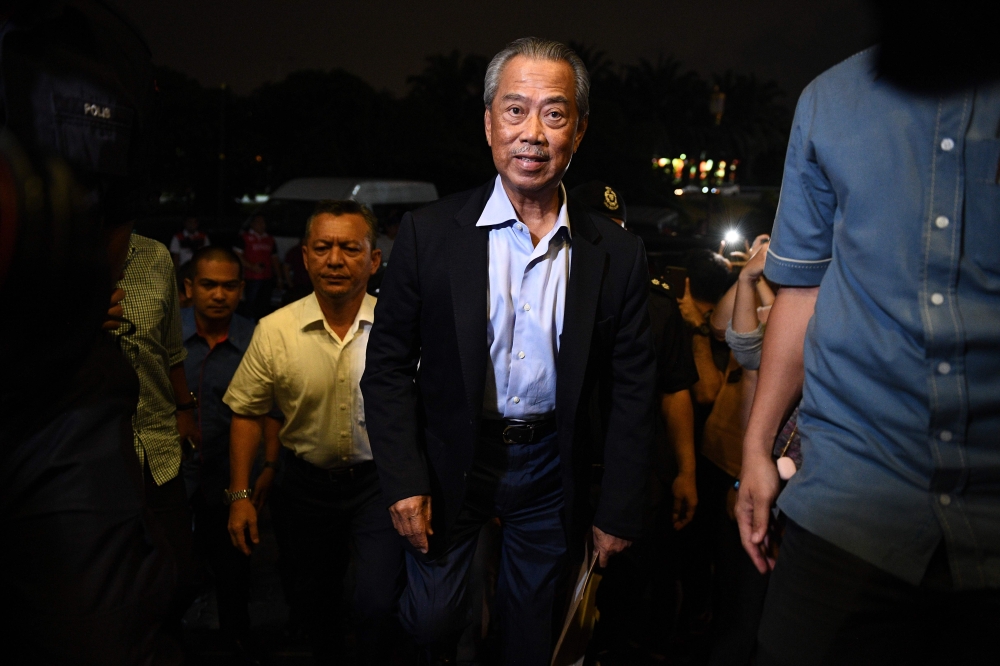
Muhyiddin Yassin (C), president of Parti Pribumi Bersatu Malaysia or Malaysian United Indigenous Party, arrives at the party headquarters in Kuala Lumpur on February 24, 2020. AFP / Mohd Rasfan
The race to form a government in Malaysia intensified rapidly late Friday, as interim Prime Minister Mahathir Mohamad’s party joined forces with the coalition it helped oust less than two years ago.
Mahathir’s party dropped him as their candidate for the premiership and picked president Muhyiddin Yassin. He will be backed by the Barisan Nasional coalition, which still counts former Prime Minister Najib Razak as a key figure -- the politician at the heart of a corruption scandal that brought down the previous administration.
Malaysia has undergone a week of extreme political turmoil, which saw the implosion of the government less than halfway through its term after a power struggle boiled over and Mahathir resigned. The king made him interim premier while trying to determine the candidate who has enough support to be the country’s next prime minister.
The politicking has paved the way for Najib’s coalition -- which ruled the country for over six decades until May 2018 -- to possibly regain a foothold and have a say again on how it should be run.
In their way is Anwar Ibrahim, the man who was positioned to be Mahathir’s successor until this week’s twists and turns. Anwar forged an alliance with arch rival Mahathir to topple Najib’s Barisan Nasional and was victorious. He was less successful at getting Mahathir to hand over power to him as the 94-year-old kept avoiding setting a date to do so.
A candidate needs the support of 112 out of 222 lawmakers to form the next government. Muhyiddin has about 96, while Anwar -- with the backing of what’s left of the Pakatan Harapan alliance -- has about 92. The remainder -- mainly regional parties from the Borneo states of Sabah and Sarawak -- haven’t declared their allegiances.
Key developments on Friday:
Malaysia’s king confirmed no one person commanded majority support. The sovereign had planned to contact leaders of political parties to give them a chance to present their nominations for prime minister.
Bersatu dropped Mahathir as candidate for prime minister, named Muhyiddin
Barisan Nasional opposition coalition, and Pan-Malaysian Islamic Party announced support for Muhyiddin as premier
Attorney-general Tommy Thomas reported to have resigned
Whoever emerges victorious will inherit an economy growing at the slowest pace in a decade, with Mahathir announcing on Thursday a 20 billion ringgit ($4.7 billion) stimulus package to counter the impact of the global coronavirus outbreak.
Anwar and Mahathir’s coalition won the 2018 election on a platform of fighting corruption, improving government accountability and promoting inclusiveness in multicultural Malaysia. After winning, Mahathir’s administration focused on rolling back an unpopular goods and services tax implemented by Najib, and prosecuting the former leader for his involvement in the 1MDB state fund scandal where billions of dollars disappeared.
Mahathir curbed fiscal spending to rein in government debt and limited cash handouts given during Najib’s tenure. As growth eased and costs of living continued to rise, voters got impatient with an administration that was perceived as slow in fulfilling campaign pledges and mired in internal bickering.
After leaving the ruling coalition this week, Mahathir said he wanted to build a "government that doesn’t side with any party.” But he refused to work with the United Malays National Organisation -- Najib’s party in the opposition alliance, and the group Mahathir once led and defected from.
Muhyiddin, once also from UMNO, was Malaysia’s deputy prime minister until he was dumped in July 2015 for undermining Najib during the 1MDB scandal. The attorney-general who’s prosecuting Najib was reported to have resigned on Friday, raising questions on how the trials of the former premier will proceed from here.
"Muhyiddin isn’t very dynamic like Mahathir,” said Ahmad Martadha Mohamed, a professor of government at Universiti Utara Malaysia, in Kuala Lumpur. "But he knows how to work around politics, he’s very seasoned.”