The College of Public Policy (CPP) at Hamad Bin Khalifa University (HBKU), in collaboration with the Doha Forum and Stimson Center, convened a panel discussion examining the findings of the Doha Forum 2020 Report on the theme of COVID-19 recovery.
The panel discussion titled ‘Coping with New and Old Crises: Global and Regional Cooperation in an Age of Epidemic Uncertainty’ analysed the current and long-term challenges that have emerged from the pandemic and highlight the need to build on enhanced global cooperation and solidarity engendered by the new crisis.
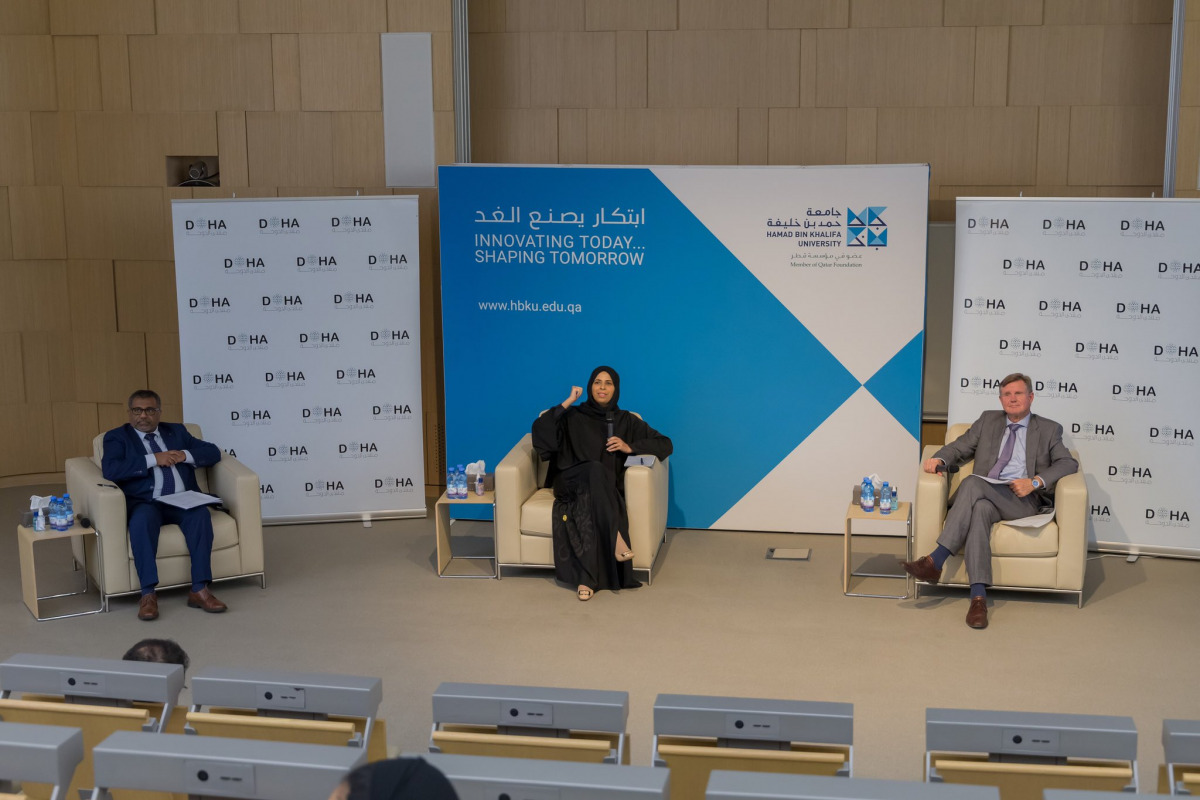
The Doha Forum developed the report in partnership with the Stimson Center, a US-based think tank. The panel discussion was held at Minaretein, Education City. Dr. Leslie A Pal, founding Dean of CPP, moderated the discussion between Assistant Foreign Minister and Spokesperson for the Ministry of Foreign Affairs H E Lolwah AlKhater, Director of the Just Security 2020 Program and a Senior Fellow at the Stimson Center Dr. Richard Ponzio, and Co-Chair of the Global Coalition on Youth, Peace and Security Saji Prelis.
In discussing the report’s recommendations, the speakers considered its findings that current international efforts toward global challenges are too often fragmented and underresourced. Charting the way forward, the report recommends a three-year global green recovery effort with four critical dimensions of globalnational-local interaction.
It also points to the promising role of new public-private partnerships to spur innovation through new technologies and promote job and wealth creation opportunities.
Al Khater said: “2020 has been a year that challenged the notion of multilateral cooperation. We saw both instances of solidarity and cooperation as well as cases of failure and isolationism.
The timely Doha Forum Report addresses the weaknesses that the pandemic has exposed in the global community. It also lays the road map ahead for how global and regional cooperation can lead to a durable, sustainable, and broad-based recovery from COVID-19.”
Speaking after the event, Dr. Pal said: “The pandemic has put into focus the fault lines in multilateral cooperation. At this critical juncture and facing a growing number of serious global challenges, we have new opportunities to address those challenges as an international community — if we pull together.
Therefore, the focus of this event has been the framework at the heart of the Doha Forum Report 2020 that offers a roadmap for a coordinated global green recovery effort.
No doubt this will be the first of many efforts to amplify further the role of civil society and academic institutions like HBKU in elaborating the global governance a n d p u b l i c p o l i c y implications.”