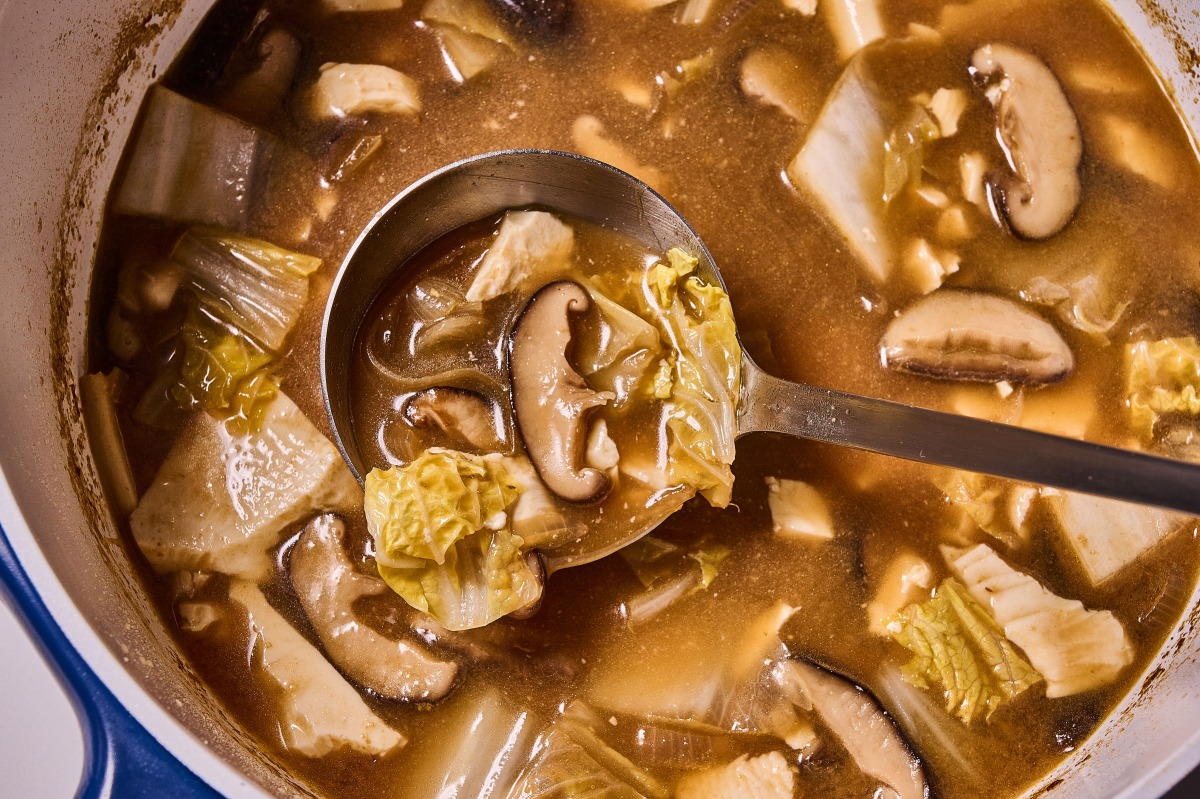
Baechu Doenjang Guk (Cabbage and Doenjang Soup). Photo by Lauren Bulbin/The Washington Post
After weeks of buttery sweets, crisp latkes, rich stews and cheese-laden casseroles, I’m in the mood for meals that are lighter but still warming and cozy. Baechu Doenjang Guk, or Cabbage and Doenjang Soup as it’s called in English, is Joanne Lee Molinaro’s way of soothing her mind and body.
Known to online audiences as the Korean Vegan, Molinaro has a new cookbook, "The Korean Vegan: Homemade,” that is full of easy but gratifying recipes. A born storyteller, Molinaro invites readers into her inner world in her latest book, sharing deeply personal remembrances from her childhood and early adulthood. After reading it, like her other fans, I felt a connection.
That connection helped me make the leap from reading her book to cooking from it. As I flipped through the recipes, the one for this soup stood out. "Baechu Doenjang Guk is for when you’re feeling a little blue or a little tired. It will lift your spirits with both its healing properties (the cabbage is so good for the tummy) and its mouthwatering flavor,” she wrote.
I called her to chat about how she created the dish. "Personally, I was having stomach problems at the time, and I had read that something that could help with stomach issues was cabbage, so I started cooking with a lot of cabbage,” she told me. "I remembered this Korean recipe with cabbage and doenjang. I had just been talking to a friend who’s a total foodie about where you draw the line between guk and chigae, soup and stew. I knew I wanted this to be a soup. One distinction is that there’s not too much protein … so it’s meant to be easy on the tummy and curative.”
Molinaro originally used standard green cabbage here, and although that worked well, she decided to try it with the cabbage Koreans have been using for centuries. "I thought it was okay with regular cabbage, but when I used napa cabbage, it felt like it came to life for me,” Molinaro said. "This soup is soothing both physically but also mentally for me. The flavor of doenjang is the most comforting flavor in my culinary vocabulary. It’s the flavor I go back to when something is really tough.”
Doenjang is a fermented soybean paste, similar to Japanese miso but more deeply savory and more pungent. Molinaro included a recipe for spicy doenjang chigae, a traditional Korean stew flavored with doenjang, in her first cookbook. It’s a dish that she ate countless times growing up but that her mother avoided making if a non-Korean was coming to the house, because she worried they’d be put off by the smell. In a surprising twist, that recipe was a hit among Molinaro’s readers. "I’d spent so much of my childhood being embarrassed at the smell and appearance of doenjang, and so the surprising popularity of this humble stew signaled to me what I’d always suspected deep down - despite all the boundaries we’ve erected to divide us, we have far more in common than we realize,” Molinaro wrote. "We all just love delicious food!”
Cooks know that most delicious food takes time. In Korean kitchens, one way to speed things up is to use a long-fermented paste, such as doenjang, to give depth and body to dishes that otherwise would need more ingredients or a longer cooking time. This Baechu Doenjang Guk is a case in point. It has just nine ingredients and takes only 35 minutes.
Sesame oil, shiitake mushrooms and yellow onion lend their flavors to the broth, but it’s the doenjang that acts as a backbone, grounding everything else, including the chopped cabbage and chunks of silken tofu. "Soups are great because they can be this easy,” Molinaro told me. It’s an instance of something simple being more than the sum of its parts. For Koreans like Molinaro, it might also be a taste of childhood: something comforting and gentle, soothing and warming - and just right for right now.
Baechu Doenjang Guk (Cabbage and Doenjang Soup)
This vegan soup, known as Baechu Doenjang Guk in Korean, is hearty with cabbage and tofu. Mushrooms, soy sauce and doenjang (a fermented soy paste) give the broth a deep, complex flavor. Adapted from "The Korean Vegan: Homemade” by Joanne Lee Molinaro, the dish is described as a mellow, soothing, stewlike soup, something to lean on when you’re feeling "a little blue or a little tired.” It’s simple, fortifying and warming.
Total time: 35 minutes
Servings: 4 (makes 8 cups)
Storage: Refrigerate for up to 4 days.
Where to buy: Doenjang can be found at Asian markets and online.
INGREDIENTS
1 1/2 teaspoons olive oil
1 1/2 teaspoons toasted sesame oil
8 fresh shiitake mushrooms (about 5 ounces), stems removed, sliced
1 small yellow onion (5 ounces), halved and thinly sliced
2 tablespoons doenjang, plus more as needed (see Where to buy)
4 cups vegetable broth, preferably low-sodium, divided
1 teaspoon reduced-sodium soy sauce, plus more as needed
4 large napa cabbage leaves, cut into 1-inch chunks
One (14-to-16-ounce) package silken tofu, drained
DIRECTIONS
In a large Dutch oven, Korean clay pot or other heavy-bottomed pot over medium heat, heat the olive and sesame oils until shimmering. Add the mushrooms and onion, and sauté until fragrant and softened, 4 to 5 minutes. Stir in the doenjang until the vegetables are evenly coated.
Add 1 cup of the broth and the soy sauce, and use a wooden spoon to scrape up any browned bits on the bottom of the pot. Add the remaining 3 cups of broth, increase the heat to medium-high and bring to a boil. Reduce the heat to medium-low and simmer for 10 minutes, so the flavors meld.
Stir in the cabbage, then use a dinner spoon to scoop the tofu into the soup. Cook until the cabbage is tender but not limp, 2 to 4 minutes. Taste, and stir in more doenjang and soy sauce, if desired. Ladle into bowls and serve hot.
SUBSTITUTIONS
Olive oil >> vegetable oil.
Sesame oil >> olive or vegetable oil.
Shiitake mushrooms >> a mix of different fresh mushrooms.
Soy sauce >> gluten-free tamari or liquid aminos.
Vegetable broth >> mushroom or poultry broth.
Napa cabbage >> any type of cabbage.
Doenjang >> any type of miso.
Nutritional facts per serving (2 cups) | Calories: 149, Fat: 7 g, Saturated Fat: 1 g, Carbohydrates: 15 g, Sodium: 485 mg, Cholesterol: 0 mg, Protein: 9 g, Fiber: 3 g, Sugar: 6 g
This analysis is an estimate based on available ingredients and this preparation. It should not substitute for a dietitian’s or nutritionist’s advice.
Adapted from "The Korean Vegan: Homemade” by Joanne Lee Molinaro (Avery, 2025).
From Washngton Post staff writer G. Daniela Galarza.