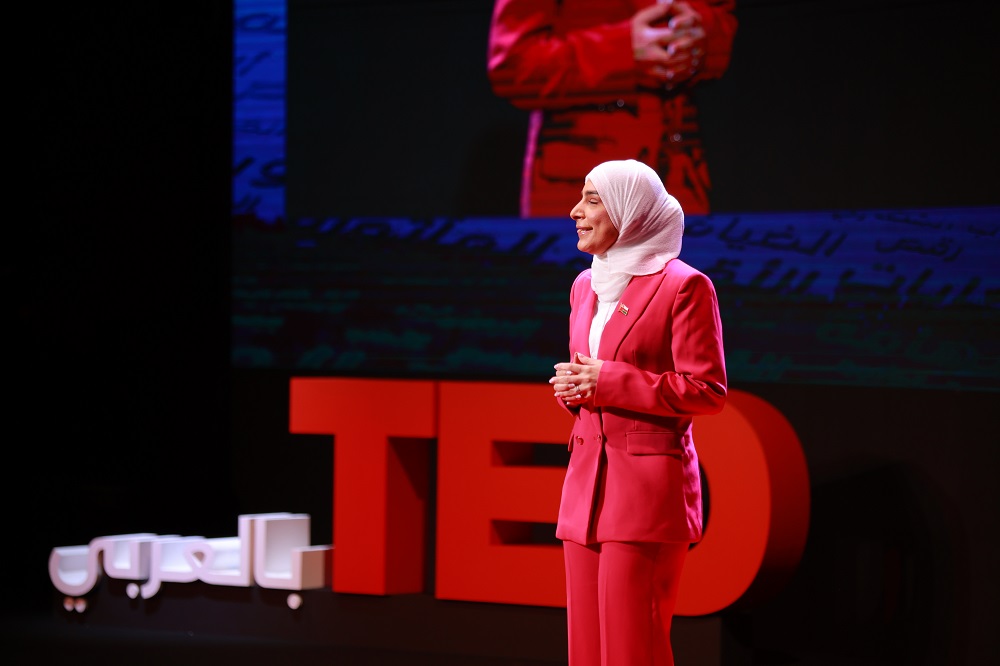
Shaikha Al Jassasi, from Oman, delivering her keynote speech at TEDinArabic, organised by TED and Qatar Foundation, in Jordan.
Doha: The blind do not need pity, they need opportunities — was the message Sheikha Al Jassasi from Oman sought to convey to the world through participating as a keynote speaker in the second regional event of TEDinArabic organised by TED and Qatar Foundation in Jordan.
She told her inspiring story of overcoming all the obstacles she faced, emphasising that the motive is not to showcase her success or what she has been able to achieve, but rather her belief that her experience will make people look at life differently, and have a positive impact on them.
Al Jassasi stood before the TEDinArabic audience at Al Hussein Technical University and told her story, which began the moment she was born blind. As she grew up, her dreams grew as well: eagerly waiting for the day she would go to school, imagining herself wearing the school uniform, taking the school bus with her classmates, and studying and reading like any other child. But all those dreams faded away due to the lack of an adequate place for learning, as schools at that time were not equipped to teach blind or visually impaired people.
After several attempts to advance her learning in her homeland, all of which were unsuccessful, eight-year-old Al Jassasi had to leave and travel to another country where there was a school for visually impaired children and that’s where the journey began.
In her speech at the TEDinArabic event, Al Jassasi touched upon the negative view that some in society may have of blind people or people with different abilities, saying they may be seen as “the helpless, miserable ones, who are unable to help themselves nor those around them.” But she does not see herself as “helpless” or “miserable”, but rather differently abled.
Asked for her views on the reasons behind this negative view towards the blind or those with different abilities, Al Jassasi attributed it to stereotypes portrayed by the media.
“In the Arab world, the models for people with different abilities are either portrayed as superhuman, or weak, but we rarely see the visually impaired portrayed as ordinary people – successful, but ordinary, just like anyone else in society who has his or her own differences,” she explained.
“Sometimes there may be a very exaggerated tone, as is evident from terms such as ‘people of determination’. Although this is motivating, it may not always be true, because not every individual with special needs is a ‘person of determination’, and some of them have succumbed to despair.”
As for the way society treats individuals with different abilities, Al Jassasi said, “Some people may be ashamed to deal with people with special needs, or to search and see how to deal with them.
“Many of the initiatives and efforts that we hear about are auspicious, but most of them are modest individual or institutional efforts; or they do not exist, and if they do, they might seem ideal in theory but can’t be practically implemented because there are no laws to support them.
“When we decide to seek education or jobs, we find that they are not fit for us. And the problem is not those with different abilities, but those organisations that have not been able to adapt their work environment to include the needs of individuals of all abilities, as a result of their assumption that the posts they have are appropriate for everyone.”
Al Jassasi believes that there is a responsibility that lies with people with special needs themselves, and that instead of withdrawing from society because of the challenges they may face, they should strive to integrate into it.
“It is difficult to be in a society that does not understand us, but withdrawing is not the answer,” she said. “We have to seek to engage in society and spread awareness, and this is what I am trying to do through my activity on social media platforms, especially Twitter.”
Al Jassasi’s sense of compassion prompted her to launch the monthly ‘Noor’ podcast, which she prepares and produces herself to provide awareness to parents of visually impaired children and help them find answers to many of the questions and fears that they may have at the beginning of their journey of raising their children. Her aim is to help enable them to overcome obstacles, based on her personal experience.
“I hope that we will see a change the children’s education programs across Arab countries to include individuals of all abilities, because if we prepare these children correctly from the beginning, we will have very successful models of leaders in the future,” Al-Jassasi said.
“In our society, early intervention programs for children with different abilities are very limited, which places a great responsibility on families. This means they have to educate themselves, read, learn about the experiences of others, and be their own children’s teachers and early intervention specialists. This can be difficult, but if you want to raise a child who is self-reliant, resolute, patient, and diligent, then this is what you have to do.”
The responsibility may be great, but Al-Jassasi has a motivational message to parents of children with different abilities.