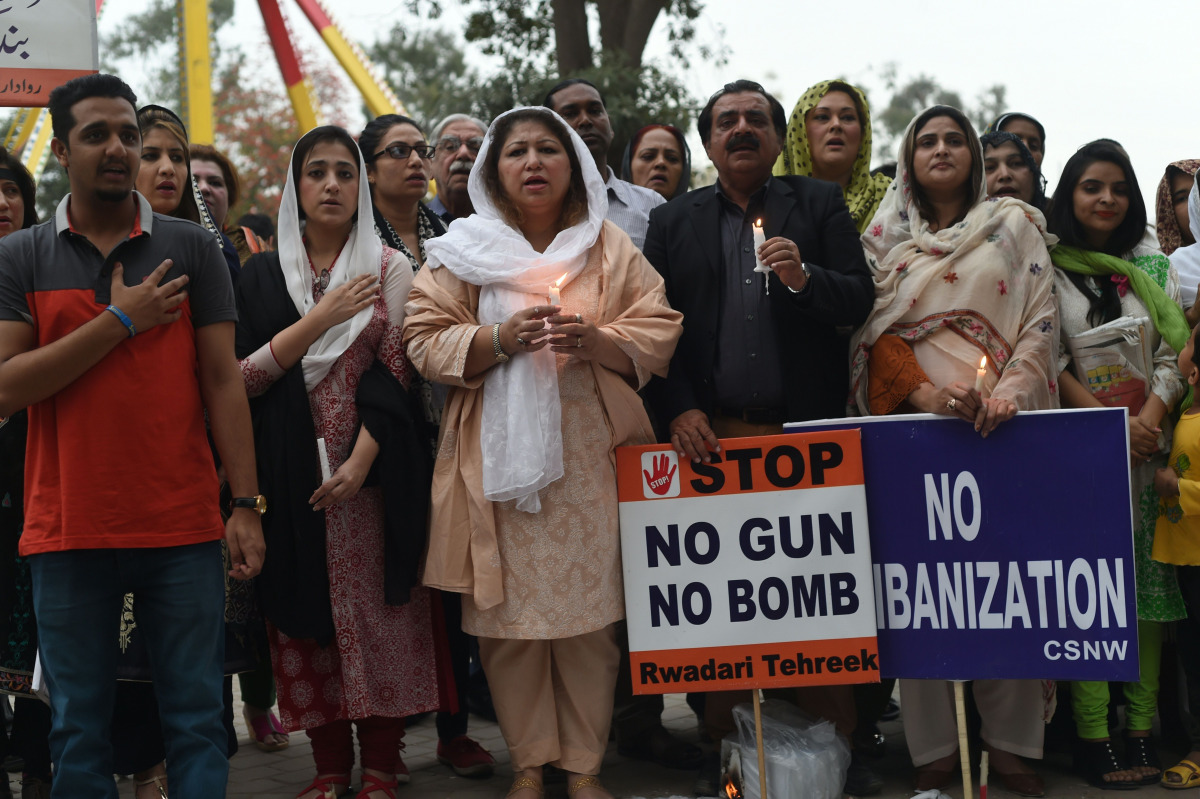
Pakistani civil society members sing the national anthem at the site of a suicide blast in Lahore on March 28, 2016 (AFP / FAROOQ NAEEM)
Islamabad: Pakistan witnessed another year of decline in militant attacks and resultant deaths. However, number of injured increased. Balochistan was most troublesome province from where majority of the militant attacks, maximum deaths, and injuries were recorded.
According to statistics issued by an Islamabad based independent think tank, Pakistan Institute for Conflict and Security Studies (PICSS), for the year 2016 the country saw 30 percent decline in militant attack and 28 percent decline in resultant deaths. However, an unprecedented 24 percent increase in number of injured was recorded compared with 2015. Average militant attacks per month has further dropped in 2016 from 60 to 42.
It is worth recalling that the average number of militant attacks per month before Zarb-e-Azb was 161, which dropped to 60 in 2015.
The overall picture of two years after National Action Plan the country saw 68 percent reduction in militant attacks, 62 percent decline in resultant deaths and 48 percent decrease in injuries. More than 950 people were killed and 1,815 were injured in 500 militant attacks during the year.
The percentage of decline in 2016 was far lower than 2015 when Pakistan had seen unprecedented decline in militant attacks and resultant deaths due to operation Zarb-e-Azb and National Action Plan after APS Peshawar attack.
PICSS militancy database shows that the anti-state violence has dropped below 2007, which was the year when Pakistan had seen sudden surge in militancy after Lal Masjid Operation. However, the number of militant attacks, subsequent deaths and injuries in 2016 remained higher than 2006.
Not a significant reduction in suicide attacks as compared to 2015 was recorded. PICSS recorded 16 suicide attacks, which includes attacks on Charsadda local courts, Lahore Gulshan Park, Quetta Civil Hospital, Saturday Prayer in a mosque in Mohmand Agency, Mardan Judicial Complex, and Dargah Shah Noorani in Khuzdar.
Lawyer community was one of the prime targets of suicide attacks and other militant activities as three major suicide attacks such as Quetta Civil Hospital Attacks, Chasadda and MardanKachehri attacks specifically targeted the lawyer community.
Apparent objective is to frighten legal fraternity from appearing courts against hard-core militant commanders. Security situation deteriorated in Balochistan in 2016 compared to rest of the administrative units of the country.
Although the number of militant attacks dropped from 35 percent yet death increased by 27 percent and injured increased by 121 percent. Increase in deaths and injuries was primarily due to three high profile attacks such as Civil Hospital attack on lawyers, Police Training Academy attack and Khuzdar Shah Noorani Shrine attack.
If compared with 2015, 71 percent decline in attacks and 33 percent decline in killings and 65 percent decline in injured was observed in the province. Except Balochistan, all administrative units saw reduction in deaths and injuries in militant attacks.