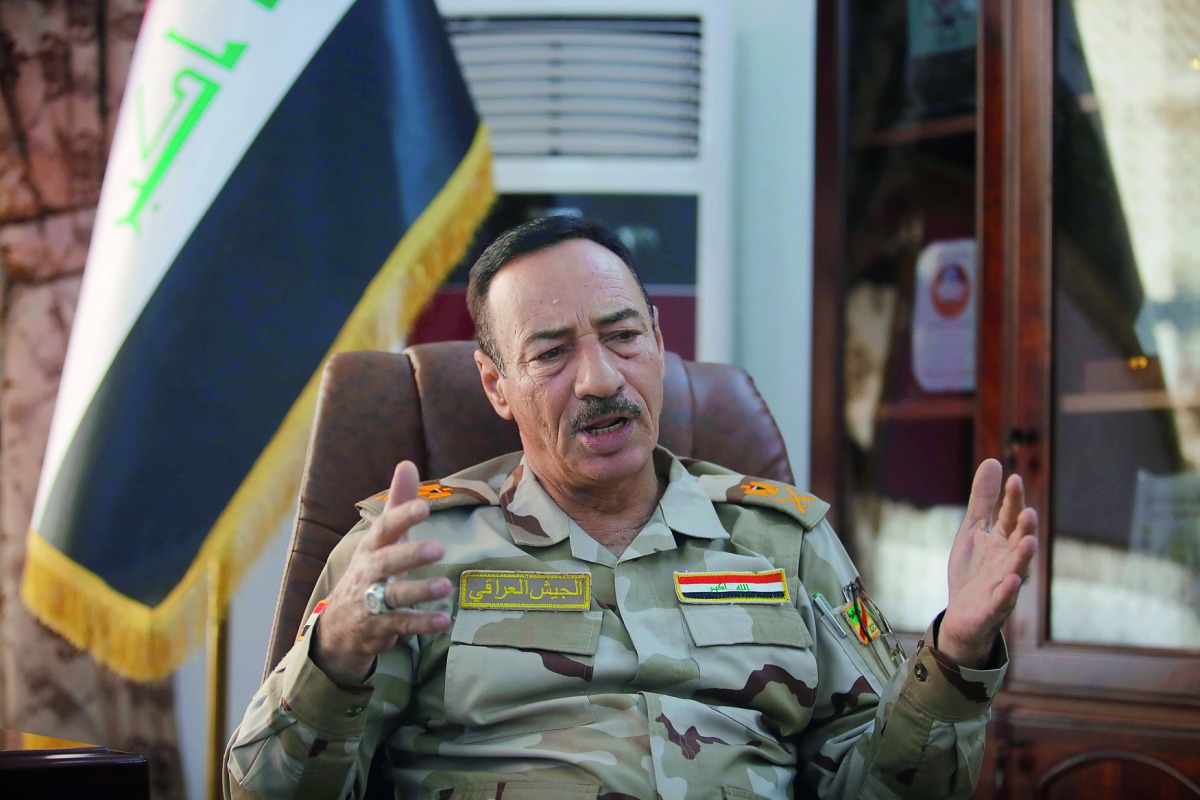
Major General Najm Abdullah Al Jubbouri speaking during an interview in Mosul, yesterday.
Mosul: A senior Iraqi general predicted a relatively easy victory for his forces in the upcoming battle for the Islamic State haven of Tal Afar as up 2,000 fighters and their families there are “worn out and demoralised”.
Less than one month after declaring victory in the city of Mosul, Iraqi forces are poised to attack Tal Afar, which is around 40km to the west of Mosul, in what will be the next major battle against the militants.
“I don’t expect it will be a fierce battle even though the enemy is surrounded,” Major-General Najm Al Jabouri said.
Jabouri, a key battlefield commander, said the fight would be simple compared to the nine months of gruelling urban combat in Mosul, which took a heavy toll on Iraqi forces.
“The enemy is very worn out,” said Jabouri, who was mayor of Tal Afar when it was overrun by insurgents more than a decade ago. “I know from the intelligence reports that their morale is low,” the general added. The city, with about 200,000 residents before falling to Islamic State, experienced cycles of sectarian violence between Sunnis and Shias after the US-led invasion of Iraq in 2003 and produced some of Islamic State’s most senior commanders.
It has also become the focus of a wider regional struggle for influence. A country which claims affinity with Tal Afar’s predominantly ethnic Turkmen population, opposes the involvement of Shia paramilitary groups fighting with Iraqi forces, some of which are backed by Iran.
Jabouri estimated there were between 1,500 and 2,000 militants left in Tal Afar. The figure may include some family members who support them.
“It’s a large number, but the terrain is favourable (to Iraqi forces),” Jabouri said. Only one part of the city, Sarai, is comparable to Mosul’s Old City, where Iraqi troops were forced to advance on foot through narrow streets. The rest of Tal Afar can be navigated in tanks and armoured vehicles.
Unlike Mosul, where Islamic State effectively held hundreds of thousands of people hostage to slow the advances of Iraqi forces, Jabouri said few civilians remained in Tal Afar, except those related to the militants.
Iraqi forces expect to face bombs, snipers and booby-traps. Despite being surrounded, there is no sign the militants are running low on ammunition, Jabouri said. Many local Turkmen members of Islamic State already managed to escape by mingling with displaced civilians and fled, where they can blend in anonymously, Jabouri said.
Of the remaining militants, Jabouri believed many were foreigners, former Soviet Republics and Southeast Asia—who became trapped after Iraqi forces severed all routes between Mosul and Tal Afar earlier this year.
The city had already been sealed off by Kurdish forces to the north, and mainly Shia para militaries to the south leading to shortages of food and water.
The US-led coalition has conducted air strikes in and around Tal Afar, paving the way for Iraqi forces to storm the city after reorganising and recuperating from Mosul. Jabouri said all that remained was to receive orders from Iraqi Prime Minister Haidar A Abadi to launch the assault: