DOHA: Indonesia’s economy is slowing but could be turned around by the new government’s infrastructure programme, QNB Group noted in its “Indonesia Economic Insight 2015” released yesterday.
The report examines the outlook for the Indonesian economy and the ongoing challenges facing the current administration, such as capital flight and an infrastructure gap, amidst the constraining environment of a slowing economy.
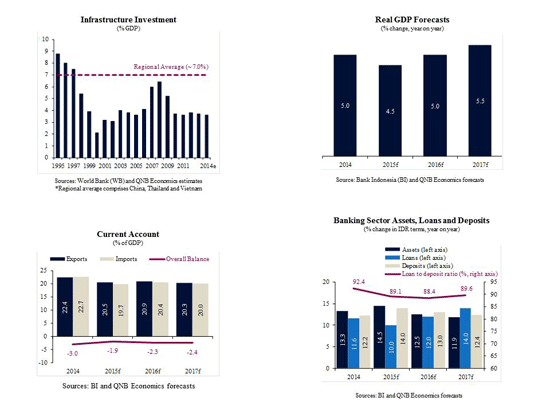
According to the report, underinvestment has led to supply bottlenecks and an infrastructure gap, which the new government hopes to close. Poor infrastructure creates crippling supply bottlenecks: heavy road traffic, congested transport networks and widespread power and water shortages.
As a result, growth is sub-par and inflation and interest rates are high.
However, Joko ‘Jokowi’ Widodo DK, the new president elected in October 2014, hopes to turn the situation around by revitalising investment in infrastructure.
QNB analysts expect Indonesia’s real GDP growth to slow in H2, 2015 on tighter financial conditions, as credit growth is slowing, interbank interest rates are rising and capital outflows may continue as US monetary policy begins to rise.
A recovery should begin in 2016, with infrastructure investment adding to growth.
By 2017, financial conditions should begin to ease as the US Federal Reserve nears the end of its tightening cycle, adding to growth through healthier capital flows along with a more stable Indonesian Rupiah (IDR).
In late 2015 and during 2016-17, QNB expects the current account deficit to widen as the infrastructure investment programme gets underway, which should lead to higher imports of capital goods.
Exports are likely to be held back by restrictions on the export of certain raw materials, which are designed to support the development of domestic manufacturing industries. However, slightly stronger exports are expected in 2016-17 than in 2015 due to a weaker IDR, which should boost competitiveness, as well as government policies to support manufacturing exporters.
Banking sector growth may be constrained by tight financial conditions until 2017 at the earliest
In 2016-17, deposit growth is expected to slow from high levels in line with falling inflation and lower nominal GDP growth.
Loan growth could be constrained in 2015-16 due to rising interest rates, depressed capital flows and higher NPLs.
From 2017, loan growth should pick up gradually as credit demand recovers (on higher economic growth and investment) and as financial conditions ease.
The Peninsula