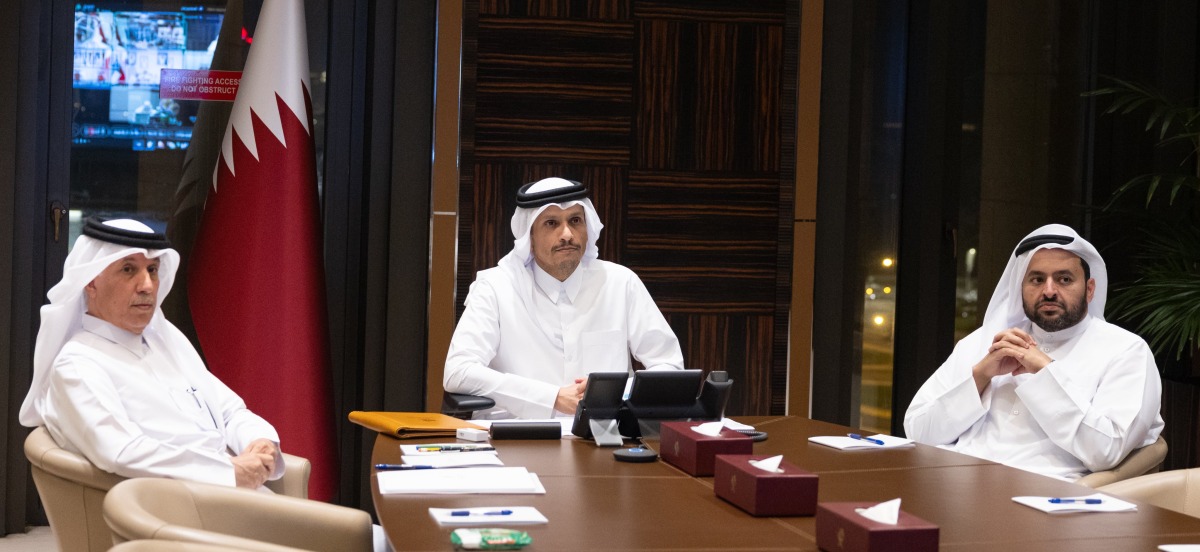
Prime Minister and Minister of Foreign Affairs H E Sheikh Mohammed bin Abdulrahman bin Jassim Al-Thani with Minister of State for Foreign Affairs H E Sultan bin Saad Al Muraikhi and Minister of State at the Ministry of Foreign Affairs H E Dr. Mohammed bin Abdulaziz bin Saleh Al Khulaifi during extraordinary meeting of GCC Ministerial Council.
Doha, Qatar: The Ministerial Council of the Gulf Cooperation Council (GCC) expressed its strongest condemnation of the heinous Iranian attacks on GCC states, as well as the Hashemite Kingdom of Jordan, describing them as a serious violation of the sovereignty of these states, the principles of good neighborliness, and a clear breach of international law and the United Nations Charter, regardless of any justifications.
The Council also emphasized that targeting civilians and civilian infrastructure constitutes a grave violation of international humanitarian law.
This came during the 50th extraordinary meeting via video conference yesterday, chaired by H E Dr. Abdulatif bin Rashid Al-Zayani, Minister of Foreign Affairs of the Kingdom of Bahrain and current Chairman of the GCC Ministerial Council.
Prime Minister and Minister of Foreign Affairs H E Sheikh Mohammed bin Abdulrahman bin Jassim Al-Thani, participated in the meeting along with Their Excellencies GCC Foreign Ministers.
The meeting was convened to discuss the Iranian missile and drone attacks targeting the United Arab Emirates, the Kingdom of Bahrain, the Kingdom of Saudi Arabia, the Sultanate of Oman, the State of Qatar, and the State of Kuwait, which began on Saturday, Feb 28.
The Council reviewed the extensive damage caused by these treacherous Iranian attacks, which targeted civilian facilities, service sites, and residential areas, resulting in significant material losses, threats to the security, safety, and lives of citizens and residents, and widespread terror among the affected populations. The Council discussed the necessary measures and steps to coordinate efforts to restore security and stability and achieve peace in the region.
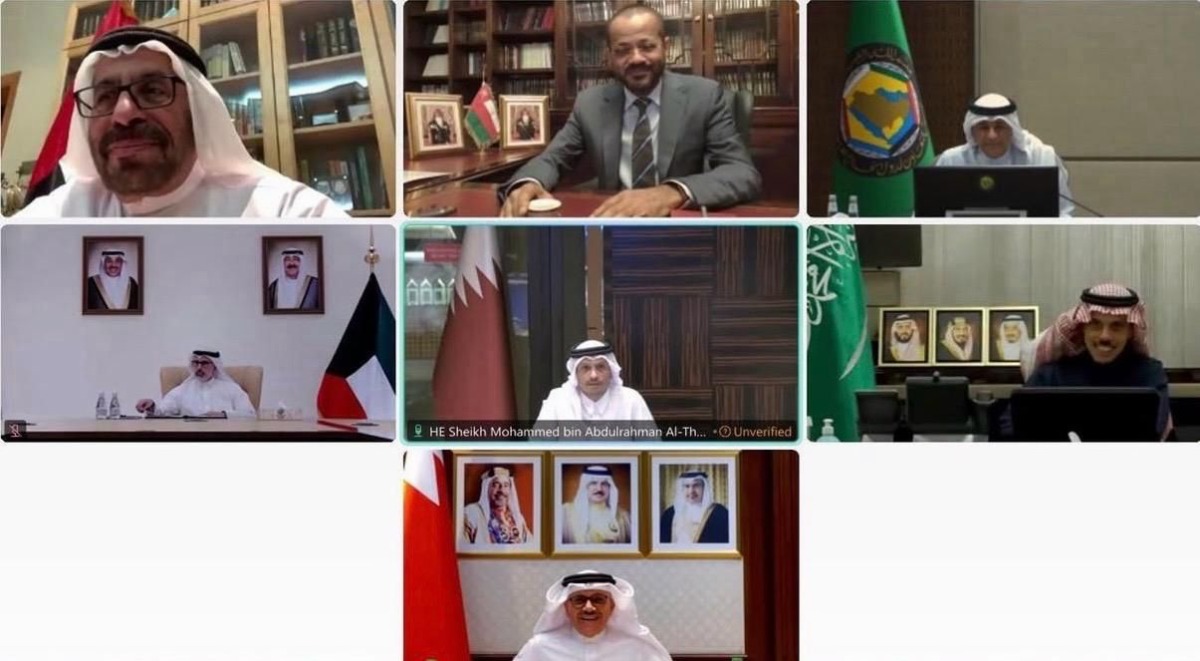
Prime Minister and Minister of Foreign Affairs H E Sheikh Mohammed bin Abdulrahman bin Jassim Al-Thani with Their Excellencies the Ministers of Foreign Affairs of GCC countries and GCC Secretary-General during an extraordinary meeting of the GCC Ministerial Council held virtually yesterday.
The Council reaffirmed full solidarity among GCC member states and their unified stance in confronting these aggressions, stressing that the security of one member state is indivisible and that any attack against any member constitutes a direct attack on all GCC states, in accordance with the GCC Charter and the Joint Defense Agreement.
The Council confirmed that member states reserve the legal right to respond under Article 51 of the United Nations Charter, which guarantees the right to self-defense, individually and collectively, in the event of aggression, and to take all necessary measures to preserve their sovereignty, security, and stability.
The Council praised the efficiency and readiness of the armed forces and air defense systems of member states, which confronted the missile and drone attacks with high professionalism, helping neutralize the threat, mitigate its effects, and protect lives, infrastructure, and vital assets. The Ministerial Council affirmed that in light of this unjustified Iranian aggression against GCC states, they will take all necessary measures to defend their security and stability, and to protect their territories, citizens, and residents, including the option to respond to the aggression.
Despite numerous diplomatic efforts by GCC states to avoid escalation, and their assurances that their territories would not be used to launch any attacks on the Islamic Republic of Iran, Iran continued to carry out military operations targeting GCC countries, affecting multiple civilian and residential facilities.
The Council stressed the urgent need to immediately stop these attacks to restore security, peace, and stability in the region. It also highlighted the importance of maintaining air and maritime security, protecting shipping routes, safeguarding supply chains, and ensuring stability in global energy markets, emphasizing that the security of the Gulf region is not only a regional issue but a cornerstone of global economic stability and maritime navigation.
The Ministerial Council called on the international community to strongly condemn these attacks and urged the UN Security Council to assume its responsibility by taking immediate and decisive action to prevent these violations, protect civilian lives, and prevent their recurrence, due to their severe implications for regional and international peace and security. The Council expressed its gratitude to GCC member states and appreciation to friendly and brotherly countries that condemned the Iranian attacks, expressed solidarity with GCC states, and supported measures taken to protect their sovereignty, security, and stability.
The Council noted that GCC states have consistently called for dialogue, negotiation, and resolution of all issues with the Islamic Republic of Iran, commending the role of the Sultanate of Oman in this regard. The Council emphasized the importance of dialogue and diplomacy as the only path to overcome the current crisis, maintain regional security, and ensure the safety of peoples in the region, warning that any escalation could undermine regional security and lead the region into dangerous paths with catastrophic consequences for international peace and security.
The Council concluded by extending its sincere condolences and profound sympathy to the families of the victims, and its best wishes for a speedy recovery to the injured.