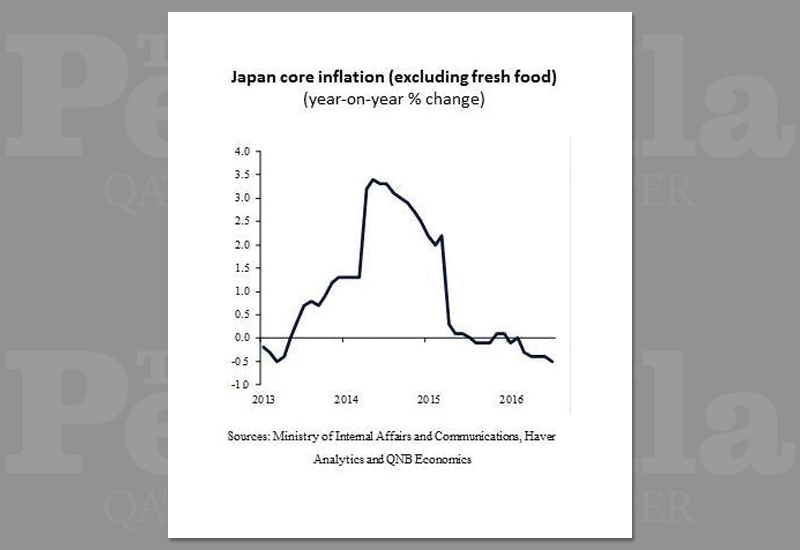
DOHA: On the fiscal side, Japan has ample policy space to stimulate its economy. For Abenomics to get back on track and achieve its ambitious target to get Japan out of deflation, fiscal policy needs to play a more active role, QNB noted in its weekly ‘economic commentary’ yesterday.
On 21 September, the Bank of Japan (BoJ) decided to augment its existing “Quantitative and Qualitative Monetary Easing” policy with a new one called “Yield Curve Control”. Central banks have traditionally conducted monetary policy by controlling short-term interest rates, reducing them when the economy is stuttering and increasing them when the economy is over-heating. The new BoJ policy represents an innovation as it aims to control long-term interest rates in addition to short-term rates. Despite the innovative move, the policy is unlikely to provide a significant boost to the Japanese economy or lift its nose-diving inflation rate. For that, fiscal policy could be a more potent tool, QNB analysts said.
The BoJ took four measures in its meeting on 21 September. First, it decided to keep the short-term policy rate unchanged at -0.1 percent. Second, it promised to keep 10-year bond yields at around the current level of ‘0’ percent.
Third, it will continue purchasing about 80 trillion yen of Japanese government bonds per year, which it judges to be sufficient to keep long-term rates at zero. Fourth, it promised to continue its purchases until core inflation overshoots the 2 percent target for a sustainable period of time.
Why did the BoJ act in such an unorthodox way? Recent data from Japan have shown activity slowing. Real GDP growth was only 0.7 percent in the second quarter. More importantly, deflation has set in again with core inflation touching -0.5 percent in July. Surveys of inflation expectations suggest that the downward trend in prices is likely to continue. The latest figures show that 27 percent of Japanese households expect prices not to rise compared with 18 percent a year earlier. Furthermore, attempts by the BoJ to stimulate the economy by introducing negative interest rates have backfired.
Negative rates have hurt commercial banks’ profitability and made them more reluctant to lend. This has been an important factor behind the recent weakening of data.
Will the new BoJ policies succeed in boosting growth and lifting inflation? We are doubtful. The BoJ’s promise to overshoot its inflation target is not credible given that it has not even succeeded in shooting inflation to its 2 percent target beyond the brief period in which the increase in consumption tax lifted prices.
Markets are also sceptical about the new policy package. The yen whipsawed following the BoJ announcement – initially weakening before strengthening against the US dollar.
And although Japanese equities have risen by around 3 percent, this was probably more due to the BoJ inaction of not lowering short-term rates deeper into the negative territory (which would have hurt banks) rather than its action on the other fronts.
More broadly, QNB believes that monetary policy has probably reached its limit in Japan.