DOHA: Tightening liquidity, slackening credit growth, and weakening profitability are expected for Qatar’s banks in 2016.
Although the drop in hydrocarbon prices and the Qatari government’s streamlining of its public investment program are putting the brakes on the domestic economy, banks’ asset quality held generally steady while credit growth remained resilient on the back of strong private sector activity in 2015. “Nevertheless, as liquidity in the banking sector tightens further with the rise of local and global interest rates, we expect credit growth will lose some steam, ratings services agency S&P noted yesterday.”
“We think that operating conditions for Qatari banks will toughen this year, denting their profitability,” said Standard & Poor’s credit analyst Timucin Engin.
In 2015, the Qatari public sector withdrew some of its deposits from the domestic banking system in the process. S&P expects more of the same in 2016 and foresee a further squeeze on banks’ liquidity. Further trimming of government spending will likely reduce private-sector lending opportunities. At the same time, we think banks will manage their funding profiles more conservatively, which should translate into lower growth. We also expect credit losses will increase given the economic slowdown and the pressure we expect in some sectors, such as contracting, the ratings services agency noted in an article tilted “Qatari banks’ profitability to wane in 2016”.
“Qatari interest rates already started to increase in 2015 in response to contracting liquidity, and we expect this trend will continue in 2016. On December 16, 2015, the US Federal Reserve raised interest rates for the first time since 2006, and market participants expect further increases this year.
“Given that the Qatari riyal is pegged to the US dollar, we expect US rate hikes will trigger further increases in domestic interest rates over time.”
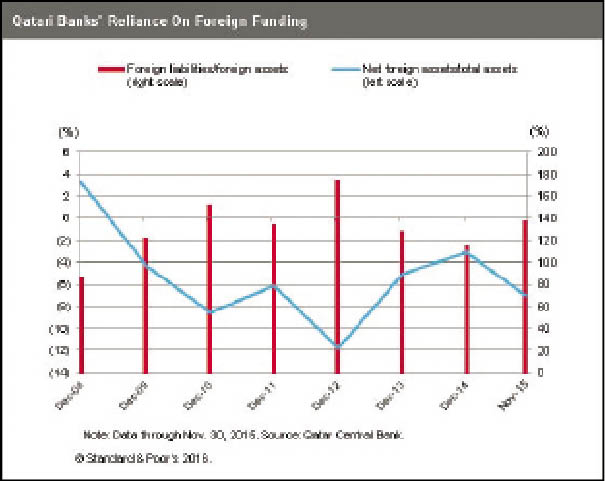
Domestic credit in Qatar had grown by 17 percent year on year as of November 30, 2015, visibly outpacing deposit growth. At the same time, the loan-to-deposit ratio in the domestic market had increased to 114.8 percent by end-November 2015, up from 100.4 percent one year earlier. We note that Qatar has the highest loan-to-deposit ratio among the six GCC banking markets”, S&P analysts noted.
“Importantly, we foresee some tension on banks’ asset quality,” added Standard & Poor’s credit analyst Nadim Amatouri.
“Over the past few years, public-sector lending took a back seat, while a visible portion of new lending was in the private sector. We now anticipate increased credit losses in the private sector, particularly given our expectations for slowing real GDP growth.”
In particular, the banks’ exposures to contractors are susceptible to losses amid slacker capital spending. Moreover, as in other Gulf Cooperation Council countries, we think a drop in the performance of capital markets could translate into some losses on certain high-net-worth portfolios.
The Peninsula