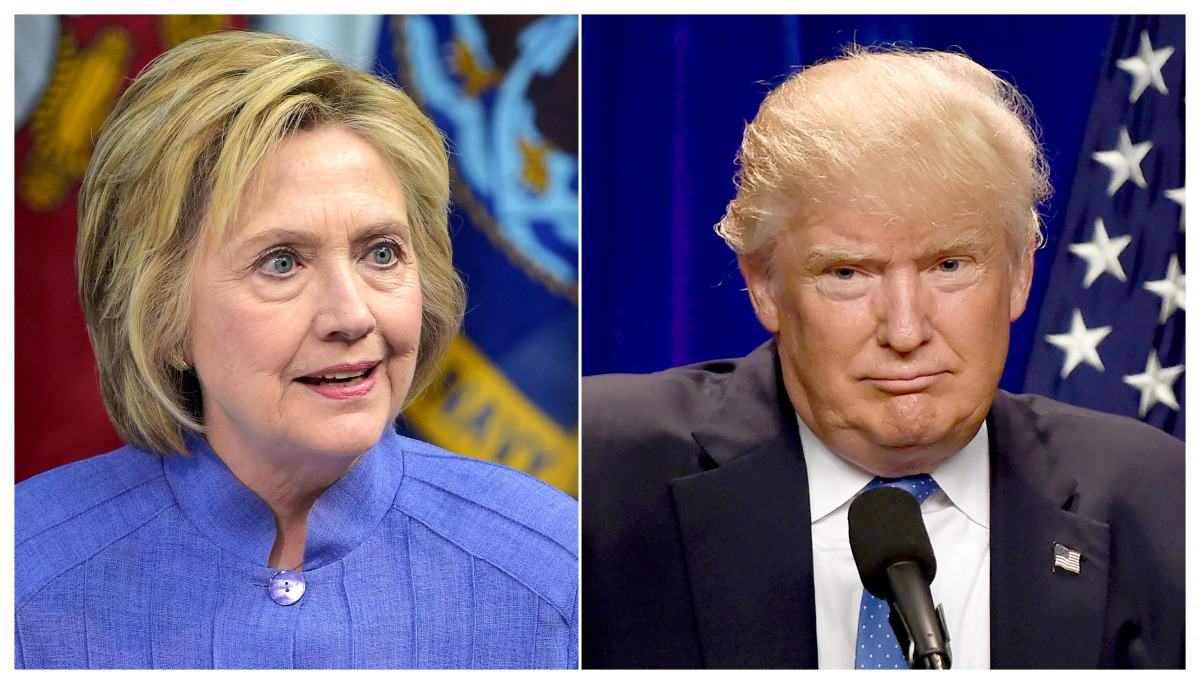
This combination of file photos shows Hillary Clinton on June 15 2016 and Donald Trump on June 13 2016 (AFP)
Washington: US-Russian relations were one of the key distinctions between the programmes of presidential candidates Hillary Clinton and Donald Trump, due to the international crises led by Syria and the diplomatic failure of US Secretary of State John Kerry and Russian Foreign Minister Sergei Lavrov. The developments of the Ukrainian crisis in 2014 which led to the EU and the US moving a missile shield on the borders of Russia. The return of a bipolarity inside the United Nations and the competition between Russia and the US.
Speaking exclusively to Qatar News Agency, political science professor at George Mason University Mohammed Al Sharkawy said that the two presidential candidates are similar in terms of being realistic in dealing with Russia, but differ in their positions towards.
For Trump, he doesn't mind that Russian President Vladimir Putin takes part in managing the many crises in the Middle-East to bear the responsibility and share the gains. The first topic on the agenda would be to eliminate or at least contain ISIS.
Al Sharkawy said that Trump is a mixture of isolationist foreign policies and protectionist economic ones. As for Clinton, the professor remarked that she will look to combine soft power, hard power and smart power. In other words, the professor said, she will use the stick while also offering a few carrots.
He expected Clinton to escalate its attack on ISIS and Russian targets in Syria, adding that it will look to enhance the power of NATO. Clinton, Al Sharkawy says, doesn't mind being called one of the hawks of the Democratic Party. She looks up to Henry Kissinger in terms of diplomatic work and is proud of her methods in international politics.
On their policies towards the Middle-East, Sharkawy said that Trump gives priority to the national security of Israel and preventing Iran from entering the Nuclear Suppliers Group.
The professor said that other than those differences, the US methods of managing crises (and not potentially their settlement) in all of Iraq, Syria, Yemen and Libya.
He added that it was clear that Trump will look to reconsider the US agreement with Iran, Al Sharqawi maintained that Trump also look to make financial deals with Iran that would appeal to his supporters. The professor highlighted that the Iranian market was in need of different types of spare parts, renewing the infrastructure of the aviation sector, technology among others. (MORE)
On the other hand, Al Sharkawy said that Clinton is looking to maintain good relations with the US in the region and will be more pragmatic than Barack Obama to serve the strategic benefits of the Middle-East, primarily counterterrorism and extremism.
On Iran's nuclear programme, Al Sharkawy highlighted Trump's criticism of Obama and Kerry for the deal, describing it as "the worst deal ever negotiated." He said that such remarks were part of Trump's tactics of cursing all of Obama's achievements and in turn, describing the Democratic Party's policies as a failure. He highlighted that Trump didn't propose an alternative policy, simply because he cannot do that according to Al Sharkawy. The professor described Trump as the slogan candidate.
Al Sharkawy stressed that no one should take what the candidates say seriously during the campaigns because there will be some propaganda aspects to them. He added that Trump's criticism of NATO was part of Trump's tactic of appealing to voters based on his performance and not a presidential programme. Al Sharkawy stressed that the success of the candidate nowadays relies on his or her performance rather than their respective programmes.
On the US' future policies with some countries after the current administration normalized relations with Cuba, Sharkawy said that the situation can be summed up by saying that Trump is against opening up to Cuba and all of Obama's policies over the past eight years. Al Sharkawy stressed that Trump did not offer any alternatives, which means that it was just biased criticism. If Clinton Wins, Al Sharkawi thinks she will maintain Obama's achievements in the US and abroad. He said that a Clinton win would basically be a third term for Obama, as the policies would largely the same while adding some of Bill Clinton's economic policies when he was president.
On the Palestinian issue, Al Sharkawy said that Clinton could get talks going again after hope has fainted in implementing the Oslo accord in its 23rd anniversary. He added that Clinton considers US-Israeli coalition as central she pledges to provide Israel with everything it needs to keep its military strength. Unlike Obama whose relationship with Netanyahu went cold, Clinton wants to ties to be closer between the two countries even though she disapproves of the settlement policies around Al Quds and in the West Bank.
For Trump, he said that he could use his skill in brokering deals to mediate as an impartial party and help Israel and Palestine broker a deal. Al Sharkawy maintained though that there is a big difference between commercial and political deals, especially a historic dispute that's political, religious, cultural and ideological in nature since 1948 and led to 1967, 1973 and 2006 wars, as well as Gaza's separation from the West Bank in 2007.