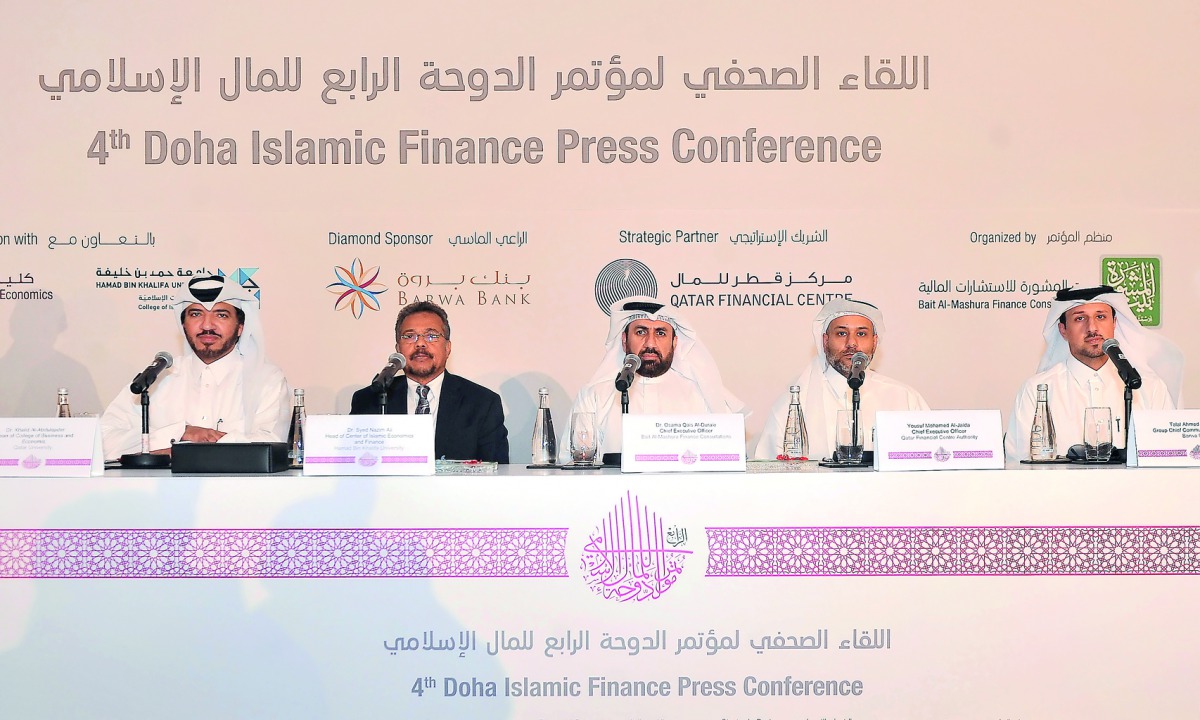
FROM LEFT: Dr Khalid Al Abdulqader, Dean of Business and Economic College at Qatar University; Dr Syed Nazim Ali, Head of Center of Islamic Economics and Finance at Hamad bin Khalifa University; Talal Ahmed Al Khaja, Group Chief Communications Officer at
DOHA: The 4th Doha Islamic Finance Conference, scheduled to be held on January 9 at Sheraton Hotel, will bring together experts from more than 16 countries.
The high-profile event, to be opened by the Minister of Finance H E Ali Shareef Al Emadi, will be held under the patronage of Prime Minister and Minister of Interior H E Sheikh Abdullah bin Nasser bin Khalifa Al Thani.
The latest edition of the conference, entitled “Contemporary Financial Trends and Knowledge Capacity Building”, will discuss the challenges and opportunities in global and regional Islamic finance industry, organisers said yesterday.
Organised by Bait Al-Mashura Finance Consultations, in strategic partnership and diamond sponsorship of Qatar Financial Center and in cooperation with the College of Islamic Studies at Hamad Bin Khalifa University and College of Business and Economics at Qatar University, as well as in diamond sponsorship of Barwa Bank, the event is expected to attract over 600 delegates, Dr Osama Qais Al Duraie, Chief Executive Officer, Bait Al Mashura Finance Consultations told media, yesterday.
The conference will be attended by a number of local and international financial officials and bankers and scholars, academicians, and experts from the financial sector in the Arab countries and worldwide, he said.
The growing development of the Islamic finance industry reflects the efficiency and effectiveness of the Islamic finance instruments to contain financial shocks and adapt to developments, despite the economic changes and challenges in the arena. This is due to the nature of these instruments, as they are based on Islamic Shari’a principles that protect them from risk, and on fair distribution of potential risks between contracting parties, in addition to the flexibility of these instruments to accommodate all developments according to Islamic Shari’a principles, Dr Osama said.
Yousuf Mohamed Al Jaida, Chief Executive Officer, Board Member of Qatar Financial Centre (QFC) Authority said the Islamic Finance Conference plays a key role in supporting the growth and development of the Islamic Finance sector both locally and globally. He added that Qatar has a strong economic foundation that helps support and enhance the investment trends in the Islamic finance industry, and was one of the first countries in the region to adopt Islamic banking and create the regulatory environment for Islamic focused inward FDI through various regulatory bodies, including the QFC Regulatory Authority.
The 4th Doha Islamic Finance Conference will also see the QFC launching its first economic report on Islamic Banking in Qatar in partnership with Thomson Reuters.
Talal Khaja, Group Chief Communications Officer at Barwa Bank expressed the bank’s pleasure to sponsor the conference. He said: “Qatar today is a distinguished country in various economic, developmental and cultural fields in line with its leading vision. Our support to the conference is a part of our commitment to the community and our responsibility, severally or jointly with our partners such as Bait Al Mashura Finance Consultations, for spreading the culture of finance industry and developing its tools. We are confident of the success and progress of the Islamic banking as well as its ability to achieve objectives.”
Dr Khalid AlAbdul Qader Dean of the College of Business and Economics at Qatar University said: the College of Business and Economics at Qatar University is keen on activating the role of academic institutions in the development of society through community partnerships and initiatives
Dr Syed Nazim Ali, Head of Center of Islamic Economics and Finance at the College of Islamic Studies at Hamad Bin Khalifa University, noted: “Since its establishment and through its distinguished academic programs and research centers, the college seeks to be a leading place for contemporary Islamic studies and Islamic finance. The College’s participation in this important event reflects our vision of the importance of the Islamic finance sector in the contemporary global financial system as well as its relevance to the policy formulation and management of economic systems.”