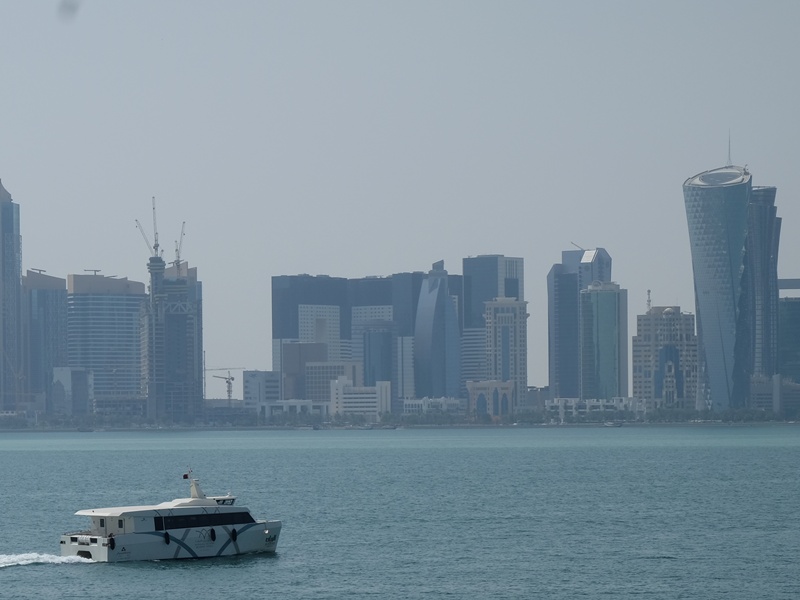
Doha skyline (Photo: The Peninsula)
International Monetary Fund (IMF has hailed Qatar for responding effectively through its policy reforms to the new reality of sustained lower energy prices. “The drop in international oil and gas prices has put considerable pressure on the fiscal and external positions. However, the authorities’ policy response has been adequate, underpinned by cuts to current expenditures and renewed efforts towards increasing non-oil revenues," IMF noted in a statement issued after the preliminary findings of its staff at the end of an official visit to the country.
The Fund noted that Qatar, unlike many other hydrocarbon exporting countries, financed the fiscal deficit mainly through domestic and foreign borrowing without drawing down their sovereign wealth fund. “Qatar has already raised a total of $14.5bn of external debt and issued $2.6bn of domestic bonds and Sukuk (Islamic bonds). The decline in energy prices has reduced Qatar’s current account surplus, from 24 percent in 2014 to 8.4 percent of GDP in 2015. While bank credit to the public sector has increased private sector credit growth, though moderating in recent months, remains robust. Despite tightening liquidity in the banking system, banks remain sound and well capitalized, with a non- performing loan ratio of about 1.2 percent, the lowest in the GCC region”, the IMF document noted.
The fiscal adjustment planned in 2017 by the authorities is moving in the right direction. During 2017–18, further subsidy cuts, increase in public fees, a moderate recovery in global commodity prices and the implementation of a VAT will drive inflation, which is expected to moderate back to low levels over the medium term. Fiscal and external balances are projected to persist in the near term, though improvements are projected for the medium term, as hydrocarbon prices recover slightly and fiscal adjustment advances.
The main external risk remains the possibility of persistently lower energy prices. In addition, the prospects of further rises in the US interest rates may complicate efforts to bolster economic growth. Spillovers to the non-oil sector would be transmitted through slower government spending and declining liquidity in the banking system. Qatar’s domestic risks are related to the ongoing public investment program.
“While crucial for further economic development and diversification, it could bring about over-heating in the near term, potential resource misallocation and reduced expenditure efficiency in the medium term. Overall, financial risks in the banking sector are moderate as banks’ balance sheets remain strong. However, the loan-to-deposit ratio has risen, possibly implying increased credit risk. Moreover, the expansion strategy of some banks into riskier foreign jurisdictions could potentially increase downside risks for their asset quality”, the Fund cautioned.
On the economic policies, the Fund noted that the GCC agreement on the introduction of VAT by 2018 is a welcome development, and Qatar is already taking actions to ensure its smooth and timely implementation. The authorities’ plan to implement excises on tobacco and sugary drinks starting in 2017 in line with a GCC-wide agreement will yield additional revenue. Complementary revenue measures should be explored, including broadening the corporate income tax base to include GCC companies.
Deficit financing should remain supportive of private sector credit growth without jeopardizing external debt sustainability. Financing the deficit mainly through external borrowing as well as asset drawdown seems appropriate, taking into consideration the risk-return tradeoff between the cost of external borrowing versus the return on accumulated assets. Qatar has made good progress in public investment management. A new tender law and public finance law were recently approved. Building on these developments, further efforts to enhance monitoring of public expenditures will help improve efficiency and better management of investment spending.
Qatar needs to carefully manage liquidity pressures. Increasing transparency of T-bill auctions and improving communication with respect to the QCB’s liquidity operations would allow banks to better anticipate liquidity conditions in the interbank market and strengthen their liquidity management. The fixed exchange rate regime remains appropriate. The peg to the US dollar continues to serve Qatar well. Nevertheless, given that the Qatari economy is evolving towards more diversification.