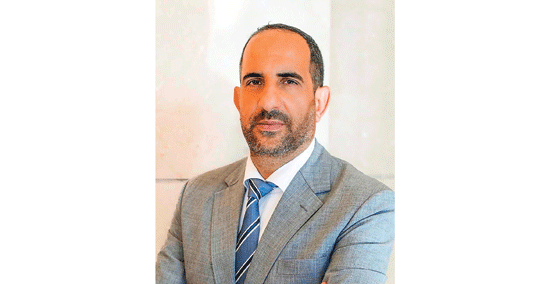
DOHA: Integrated rail transport systems have to be customer driven solutions; and in the current resource-conscious world, engineering solutions need to consider various aspects of sustainability that can help reduce their long-term operational impact, said Salah Nezar (pictured), Sustainability Director at Qatar Project Management (QPM).
Nezar said water and energy conservation, improved indoor environmental quality, as well as fire and life safety, are some of the key sustainability issues QPM considers in infrastructure projects.
He said that stakeholders in the region overall that are involved in aspects of procurement, design, construction, and operation of rail systems must commit to the vision of greater sustainability.
This is applicable to many countries in the region where resource availability is limited and at a significant premium.
Set against a backdrop of highly energy intensive desalination processes that supply almost all of the region’s usable water and hydrocarbon-intensive power generation, utilising modern sustainability concepts can dramatically contribute to the de-carbonisation of the region and shift resource utilisation over the long term.
Energy efficiency can be achieved in many ways including the use of day light for public terminals, and pathways, while new advances in solar power technology can supplement mainline power sources. Much of this can also be applied to ancillary infrastructure such as maintenance facilities and underground car parks. Tunnel lighting, ventilation and safety systems can also be designed to utilise minimal resources and deliver world-class results.
During the construction process, a great deal of energy and water can be saved by just using sophisticated monitoring systems and optimising use, such as by recovering water during tunneling and dewatering processes, with zero tolerance for groundwater and soil contamination during and post construction.
By recrafting human thermal comfort contours by increasing air movement within occupied zones and merging them with sustainable cutting edge technologies, significant reductions in energy consumption can be expected across a rail network’s various operational elements, according to QPM.
Today, it is possible to design complex systems using fluid dynamics models to ensure adequate thermal comfort with minimal resource utilisation.
Another factor to consider is the assessment of climate change vulnerability, which includes factors related to desertification, heat waves and extreme weather phenomena such as sand storms or flash rain storms. This is critical in ensuring the resilience of equipment and apparatus serving critical rail systems that operate under extreme climatic conditions.
Another important point highlighted by Nezar was the importance of using a fully integrated approach between various construction packages to avoid costly mistakes, omissions and uncoordinated design. The use of Building Information Modeling (BIM) before embarking in the real world of construction will help in providing optimal coordination.
The Peninsula