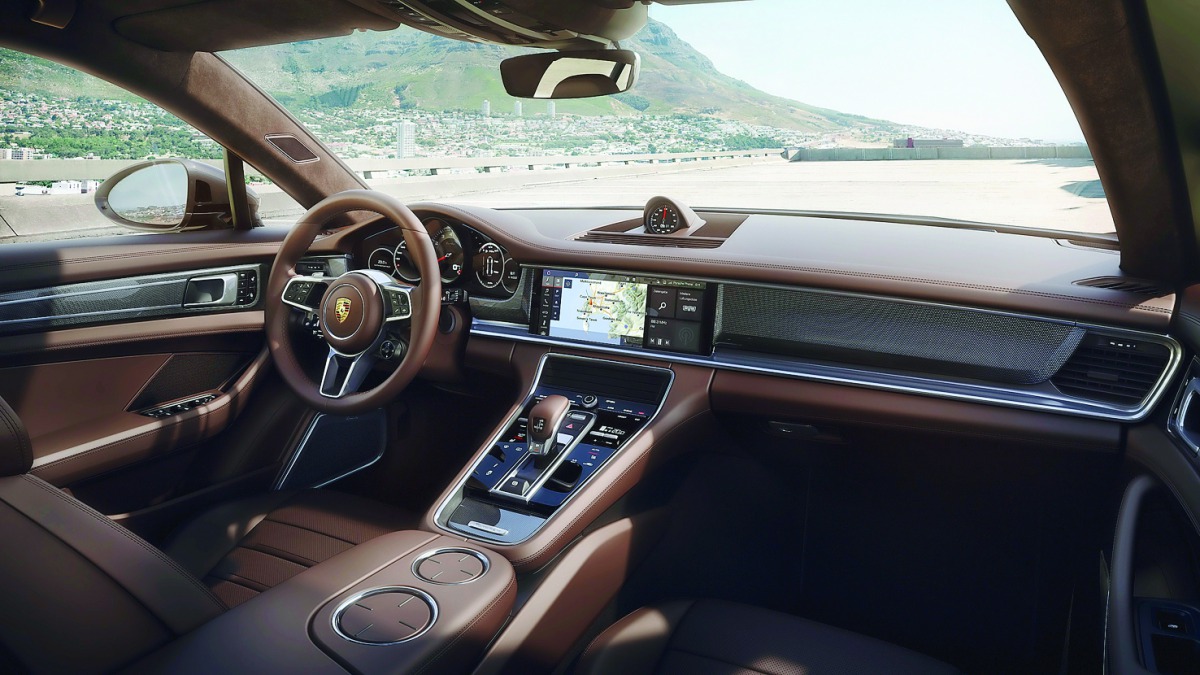
Interior of Panamera Turbo Sport Turismo.
Porsche is expanding the Panamera family with the addition of the all-new Panamera Sport Turismo which is celebrating its world premiere at the 2017 Geneva Motor Show beginning today.
Making a profound statement in the luxury segment with its unmistakeable design, the Sport Turismo, with up to 550 hp (404 kW), is more versatile than any other model in its class. The new model offers the perfect combination of everyday usability and maximum flexibility, with its large tailgate, low loading edge, substantial luggage compartment volume and a 4+1 seating concept.
“The Panamera Sport Turismo is a step forward into a new segment, but retains all of those values and attributes that are characteristic of Porsche”, says Michael Mauer, Director of Style Porsche. From a technological and design perspective, the Sport Turismo utilises all the innovations introduced with the latest Panamera model line. These include the digital Porsche Advanced Cockpit, chassis systems, such as rear axle steering, and the Porsche Dynamic Chassis Control (PDCC Sport).
In addition, all Panamera Sport Turismo vehicles feature the standard Porsche Traction Management (PTM), an active all-wheel drive system with electronically controlled multi-plate clutch. For all S- and Turbo-models, adaptive air suspension with three-chamber technology is also part of the standard equipment.
The design and concept of an all-round sports car. Just like the Panamera luxury sedan, the Sport Turismo is characterised by its very dynamic proportions. The vehicle is 5,049 millimetres long, 1,428 millimetres high and 1,937 millimetres wide, while the wheelbase spans 2,950 millimetres. The silhouette is further characterised by short body overhangs and large wheels measuring up to 21 inches.
Beginning from the B-pillars (start of the rear doors), the Sport Turismo features a completely unique rear design. Above the pronounced shoulder, an elongated window line and equally long roof contour lend the vehicle its striking appearance. At the rear, the roof drops less dramatically than the window line, resulting in a distinctive D-pillar which transitions into the shoulder section in a coupé-like fashion.
The roof extends into an adaptive spoiler with three angles of deployment, depending on the driving situation and chosen vehicle setting. The system generates additional downforce of maximum 50 kg on the rear axle.
Up to a speed of 170 km/h, the spoiler stays in its retracted position with an angle of minus seven degrees, reducing drag and optimising fuel consumption. Above 170 km/h, the roof spoiler automatically moves to the performance position with an angle of plus one degree, thereby increasing driving stability and lateral dynamics.
When Sport and Sport Plus driving modes have been selected, the spoiler automatically moves to the performance position at speeds from 90 km/h. The angle of inclination is automatically adjusted to plus 26 degrees, when the panoramic sunroof is open at a speed of 90 km/h or above. In this case, the spoiler helps to minimise wind noise.
The new Sport Turismo is the first Panamera to feature three rear seats. The two outside seats take the form of individual seats, producing a 2+1 configuration. As an option, the Panamera Sport Turismo is also available in a four-seat configuration with two electrically adjustable individual seats in the rear.
The usability of the luggage compartment benefits from the electrically operated, wide tailgate, and a loading edge height of just 628 millimetres. Measured to the upper edge of the rear seats, the up to 520-litre storage capacity of the Sport Turismo (Panamera 4 E-Hybrid Sport Turismo: 425 litres) increases that of the luxury sedan by 20 litres.
The backrests of the three rear seats can be folded down together or individually and are unlocked electrically from the luggage compartment.