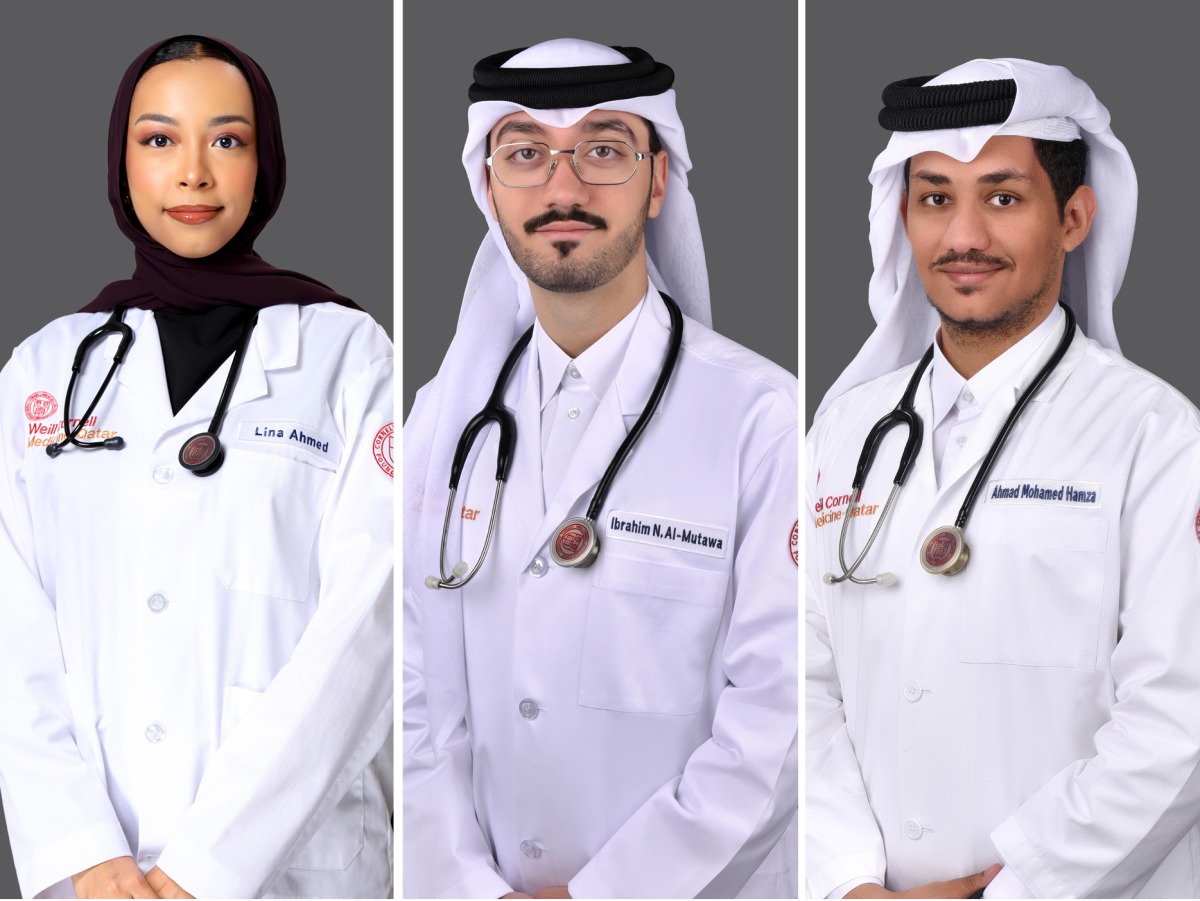
From left: Lina Ahmed, Ibrahim Nasser Al-Mutawa and Ahmad Mohamed Hamza
Doha, Qatar: At a moment that marks both culmination and commencement, graduates of Weill Cornell Medicine-Qatar (WCM-Q), a member of Qatar Foundation, stepped into the next chapter of their lives yesterday, receiving US-accredited MD degrees as part of the Class of 2026. Beyond the ceremony, what stood out most was not just academic excellence, but a shared sense of purpose, aspirations shaped by years of rigorous training and a commitment to making a difference in patients’ lives locally and globally.
The Peninsula spoke to some graduates and their stories reflect more than personal achievement, they embody a collective vision of service, innovation, and lifelong learning. From internal medicine to reconstructive surgery and pediatrics, these new doctors are united by a shared commitment to advancing healthcare and making a meaningful impact on the communities they serve.
For Class Valedictorian Lina Ahmed, the journey into medicine began at a crossroads. “I knew clearly that I wanted to pursue medicine, but I was not entirely sure what path I would take to get there,” she said, recalling her final days of high school in Saudi Arabia. Discovering WCM-Q just weeks before the application deadline proved pivotal. “The more I read about it, the more it felt like everything was aligning… it felt like I had found exactly the right place to begin my journey into medicine.”
Her time at WCM-Q, she explained, was defined by continuous growth through distinct phases of learning. “At every stage, you grow in a different way and develop a new set of skills,” she said, describing the transition from foundational sciences to hands-on clinical training. Early patient interactions during clerkships and later responsibilities during sub-internships gave her a clear sense of what it means to be a physician. “By the end of the programme, I felt like I came out with an exceptionally well-rounded set of skills,” she added.
Looking ahead, Ahmed is set on pursuing internal medicine residency in the United States.
“I’m really looking forward to the opportunities for growth and learning that residency will bring,” she said. “More than anything, I’m excited to take care of patients and continue developing as a physician.” Her academic journey was marked by numerous honours, including Academic Distinction and the Humanism in Medicine Award.
For Ibrahim Nasser Al-Mutawa, the path to medicine was shaped over years within the Qatar Foundation ecosystem. “I did not just study within its system; I grew up in it,” he said, having started at Qatar Academy Doha at the age of four. “The decision was not a single moment, but the result of years of exposure to an environment that continuously encouraged ambition and purpose.”
Al-Mutawa described WCM-Q’s curriculum as a carefully structured progression that bridges theory and practice. His clinical years, including time spent in New York, were particularly transformative. “Working alongside multidisciplinary medical teams… allowed me to translate knowledge into meaningful patient care,” he said, noting that his exposure to operating rooms abroad broadened his perspective.
Driven by a desire to serve underserved communities, Al-Mutawa plans to specialise in plastic and reconstructive surgery at Hamad Medical Corporation. “My main goals are to help less fortunate patients in the Middle East and Africa access reconstructive procedures,” he said. “As physicians, we are a pillar of our nation, helping and supporting people.”
Similarly, Ahmad Mohamed Hamza highlighted the role of WCM-Q’s academic rigor in shaping his ambitions. “The opportunity to train in a high-standard medical programme while being part of a system that invests in healthcare development in Qatar was a major factor,” he said.
Reflecting on his journey, Hamza emphasised the importance of discipline and adaptability. “Maintaining a top standing in my class required consistency,” he said, adding that clinical training helped him develop essential skills in patient care and communication.
Now, he is setting his sights on pediatrics. “My goal is to become a compassionate pediatrician who provides high-quality care, supports families, and contributes to improving child health,” he said.