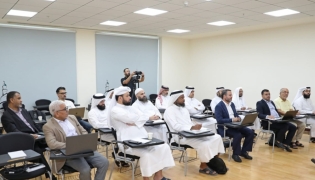
The Palestinian students with HMC physicians and officials.
DOHA: Eight Palestinian audiology and speech technicians, including two women, have completed their one-year training at Hamad Medical Corporation (HMC).
The graduates received the training as part of Qatar Red Crescent’s (QRC) efforts to build medical capacity in hospitals and health centres in the Gaza Strip.
The QRC celebrated graduation of the Palestinian students at a ceremony held at its headquarters in Doha.
The technicians received a year-round training at HMC within its clinical audiologist diploma program implemented in collaboration with the International Centre for Cooperative Health Education, University of Toronto, Canada.
“Since its inception, QRC has been working to provide various kinds of support to the Palestinian people, making them on top of its priorities and interests.
“This comes in line with Qatar constant policy of supporting the Palestinian people to alleviate their suffering,” Palestinian ambassador to Qatar Munir Ghannam said in his speech.
Saleh bin Ali Al Mohannadi, QRC’s secretary general congratulated the graduates on their achievement which he said will be of direct benefit to the people of Gaza.
“Today we are more than pleased to celebrate the fruit of this cooperation between QRC and HMC,” Al Mohannadi said.
“We heard about the need for this specialization in Palestine some time ago, after we had received many complaints that there are no technical specialists in this type of important subspeciality.
These graduates will be an essential complement to the cochlear implant surgeries being carried out, and I believe that their presence will lead to high success rates,” he added.
Dr Khalid A Hadi, Head of Audiology and Balance Unit, HMC, said the graduates will now be able to ensure correct diagnosis, treatment and rehabilitation for children and elderly people in Gaza in conjunction with the cochlear implants program that is being run by Qatar Red Crescent.
Due to the blockade imposed on the Gaza Strip, the presence of qualified staff working with those with hearing disabilities was previously almost non-existent. Nearly 4473 people in the Gaza Strip suffer difficulties with speech and hearing.
The number of cochlear implant surgeries in this area is expected to rise over the coming years, leaving a dire need for qualified specialists and technicians particularly technicians trained in the field of clinical audiology, the QRC said yesterday.
The Peninsula