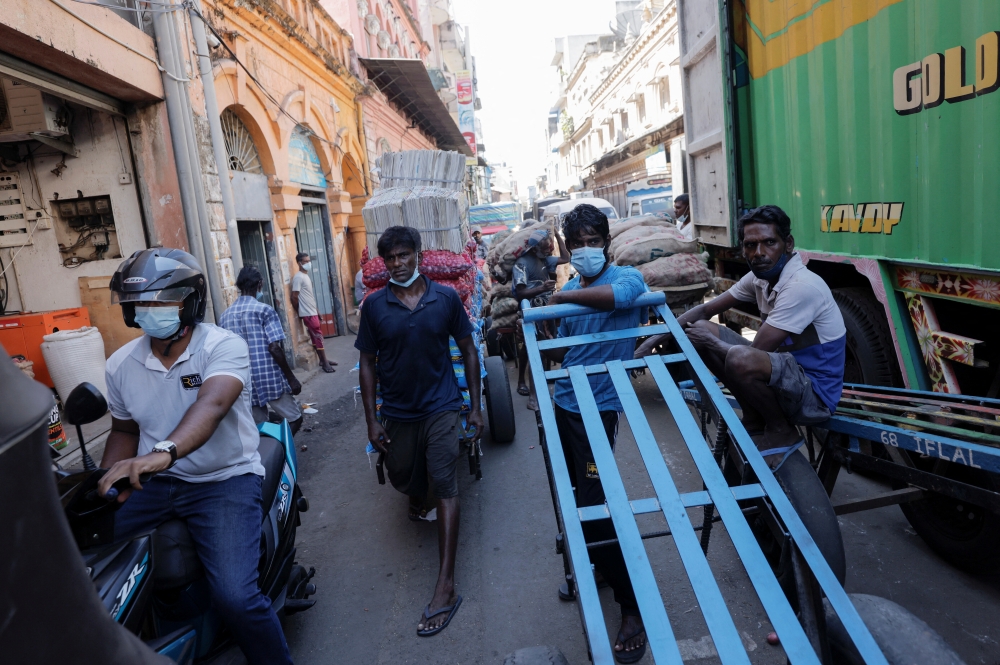
Men wait with their carts at a market, amid the country's economic crisis in Colombo, Sri Lanka, April 7, 2022. REUTERS/Dinuka Liyanawatte
Sri Lanka’s president named an advisory panel to help resolve a growing debt crisis and engage with lenders, including the International Monetary Fund, signaling he remained in control despite his government losing its parliamentary majority and calls for his resignation.
Gotabaya Rajapaksa used his sweeping executive powers to name the group made up of economists and fiscal experts to advise him, after his new finance minister resigned within 24 hours and the opposition rejected his invitation to join an interim government.
The new presidential advisory group will "provide guidance that will address the present debt crisis and lead towards sustainable and inclusive recovery for Sri Lanka,” Rajapaksa’s media office said in a statement late on Wednesday.
The move signals that Rajapaksa, a former military officer, has turned his focus to steering the country through $8.6 billion of debt repayments due this year and Asia’s highest inflation, confident that he will remain in power given the lengthy parliament and legal process to oust him. It also comes ahead of talks with the IMF that are slated for later this month.
Data showed the nation’s foreign-exchange reserves dropped 16% to $1.94 billion in March.
Rajapaksa, who often rules by issuing gazettes late at night, has yet to address the country and parliament on economic and political situation. Over 40 lawmakers from the ruling coalition said they will vote as independents, leaving the government with less than the 113 needed to maintain a simple parliamentary majority.
Rajapaksa’s remaining lawmakers said he will not resign under any circumstance and the speaker, one of his allies, earlier rejected the opposition’s proposal for parliament to ask the president to step down, saying it had no democratic right to do so.
The opposition also wants to push for a change to the country’s constitution that will limit Rajapaksa’s wide-ranging executive powers, which include calling for elections mid-way through a five-year parliament term and appointing and firing government officials and judges.
Rajapaksa repealed a five-day-old emergency order as crowds of protesters defied the proclamation that had given him sweeping powers to detain people in favor of a less heavy-handed approach. Protests have largely been peaceful although there have been reports of police firing tear gas and water cannons against crowds in Colombo over the past week.
"If the call for the president to resign is not met, the worry is how far is this going to go. There’s increasing anger and frustration but the larger question is what next,” Bhavani Fonseka, a senior researcher at the Center for Policy Alternatives in Colombo, told Bloomberg Television.
"It is not just the president or the prime minister resigning, but there doesn’t seem to be a plan among the political leadership on what can be done and that also raises concerns,” she added.
The interim government, hastily formed after the entire cabinet resigned earlier in the week, now consists of the president’s brother Mahinda Rajapaksa as prime minister and three other ministers. There’s speculation that new cabinet ministers will be appointed, local media reported, after the prime minister held meetings with ruling party lawmakers at his home on Wednesday.
In the mean time, Presidential Advisory Group on Multilateral Engagement and Debt Sustainability held discussions with the president on "key matters in going forward with the IMF program” and will continue to be in regular communication, Rajapaksa’s media office said.
The group members include Indrajit Coomaraswamy, a former governor of the Central Bank of Sri Lanka and Shanta Devarajan, a professor at Georgetown University’s Edmund A. Walsh School of Foreign Service and a former senior director of development economics at the World Bank. Sharmini Coorey, a former director of the IMF’s Institute of Capacity Development, is also part of the panel of experts.