Doha, Qatar: This fall, Qatar Museums, the nation’s preeminent institution for art and culture, and Years of Culture, Qatar’s cross-cultural exchange initiative, will present “Expanded Tradition. Contemporary Craft Practices in Mexico”.
The exhibition focuses on a group of artisans rooted in established traditions who are innovating from within and traces the continuity of Mexico’s vibrant craft heritage while examining how a new generation of makers is reinterpreting inherited techniques, materials, and forms in response to current contexts. Presented as a headline programme of the Qatar Canada and Mexico 2026 Year of Culture, the exhibition is curated by Ana Elena Mallet, Distinguished Professor at the School of Architecture, Art and Design, Tecnológico de Monterrey. The exhibition’s design and museography are developed by LANZA Atelier, a Mexico City–based architecture studio.
On view from October 27 through December 26, 2026 at M7, Qatar’s epicentre for innovation and entrepreneurship in fashion and design, Expanded Tradition focuses on artisanal process, rather than completed objects. It demonstrates how knowledge is transformed through new visual narratives and in response to contemporary concerns, such as sustainability, authorship, global circulation, local economies, and innovation that does not break with the past. The exhibition proposes tradition as a living field of transmission, situated learning, and constant transformation.
Ana Elena Mallet, curator of the exhibition, said: “Tradition is not preserved, it expands. The artisans in this exhibition are not simply making objects, they are producing meaning, building continuity from difference, and demonstrating that craft, far from being exhausted, is renewed every time new hands inhabit it.” The exhibition unfolds across five thematic sections. Inheriting the Gesture explores craft as embodied knowledge, focusing on how gestures, techniques, and movements are passed down through families, communities, and workshops rather than on the finished object itself. Material Fictions highlights how artisans move beyond utilitarian objects to create visual narratives through imagined landscapes and symbolic forms.
Imagined Territories examines how artisans transform territory into symbolic language, using landscapes, nature, agriculture, and collective memory to create emotional and conceptual visual narratives. Wearing Identity considers how textile and fashion practices reinterpret traditional garments, using the body as a space to reconsider identity, gender, contemporaneity, and representation. Inhabiting Ancestral Futures highlights how artisans use inherited knowledge to imagine new functions and forms, presenting tradition as a living practice that can shape future possibilities.
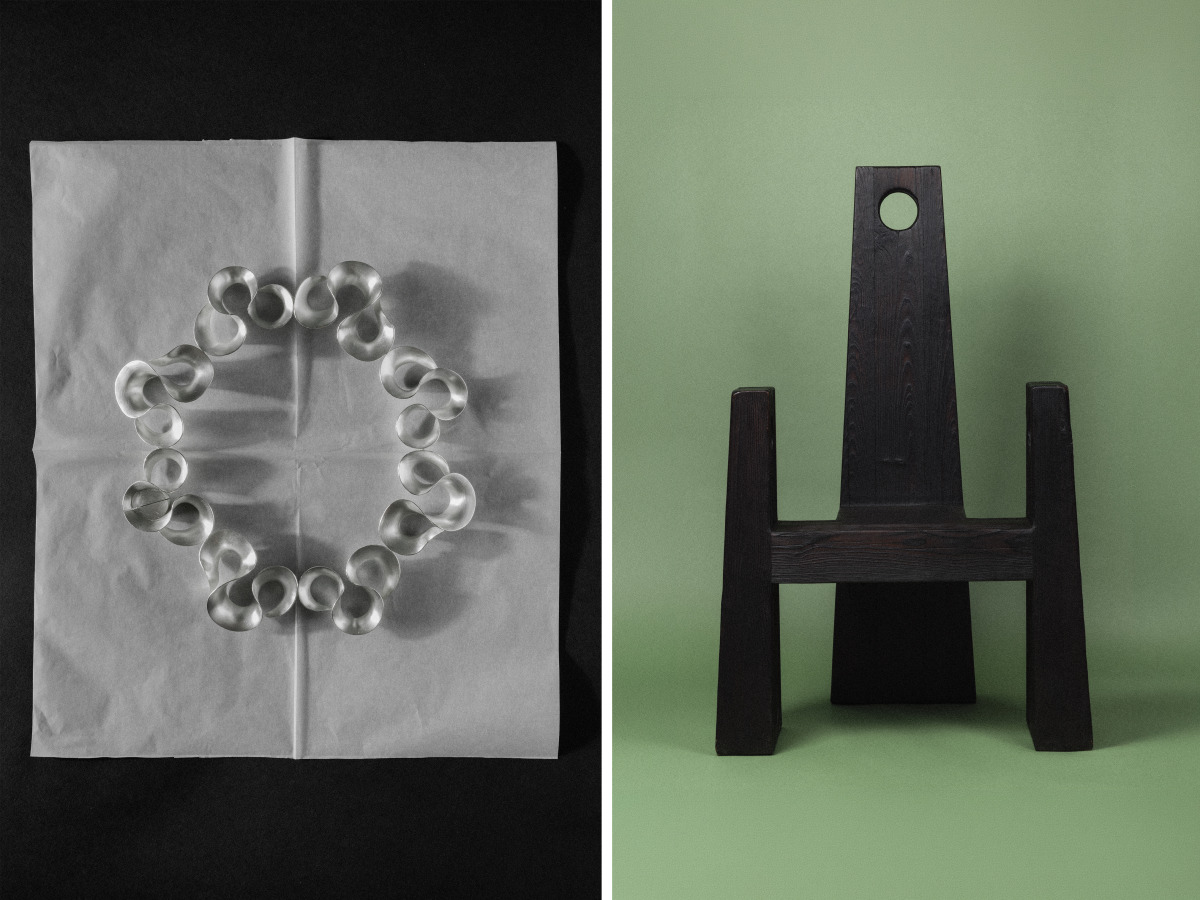
Artisans featured in the exhibition are based throughout Mexico, working in disciplines from dress-making and textiles, to jewellery and furniture design, and pottery.
More than 100 objects will be featured, including: Gourds shaped by Erandine de Saint Phalle Navarro into vase-like ornaments with goldleaf and inlaid macque; filigree earrings made with lapis lazuli and piedra del Cielo, a stone native to Jalisco, by Elizabeth Rangel Roque; white clay and adobe sand works by Naaz Zepeda and Chus Chilol from the artisan’s Wise Woman series, which depicts potters, cooks, farmers, and other workers (done in collaboration with Simona and Alberta); hand-modeled and decorated clay figurines by Rodrigo de la Cruz Cabrera depicting queens and weavers; fish-shaped footwear by Ever Jesús Arellanes Luna made with red snapper fish skin with calfskin insole lining; necklaces made of silkworm cocoons and threads and coloured with natural dyes by Esperanza Martínez Velasco; and utensils, including a ladle, a butter dish, and a large knife, carved from cocuite wood by Román Antonio Rosendo and the Collective
Aguay Monte.