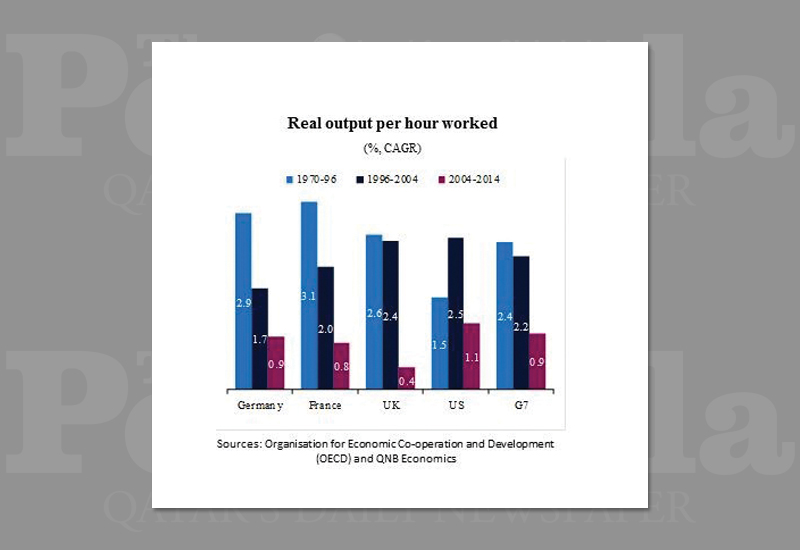
The persistence of productivity slowdown could result in steeper rises in interest rates than previously thought, an issue that the US may have to face soon, suggests a latest QNB Economic Commentary examining the factors responsible for global productivity slowdown.
One of the most important problems facing the global economy today is the decline in productivity growth. Productivity is the main determinant of long-term living standards and its slowdown has been an issue for some time, pre-dating the global financial crisis and impacting a wide range of countries. Part of the problem is due to statistical mis-measurement issues, especially in relation to the difficulty of measuring quality improvements in services and the impact of new technologies. But part of the slowdown is real and may persist into the future. The decline in productivity growth implies slower global economic growth in the future. From a policy perspective, the persistence of productivity slowdown could mean a faster tightening of monetary policy, especially in the US, which is embarking on its own tightening cycle. Productivity growth has been on a downward trend since 1970s. In the US, it fell from an average annual growth of 2.5 percent over 1996-2004 to merely 1.1 percent in 2004-14. More recently, productivity has disappointed even more, with its growth averaging merely 0.5 percent over the last three years. The problem is not confined to the US, but has also impacted most of the large economies (see chart). Among the G7 countries, productivity growth has slowed from 2.4 percent in 1970-96 to only 0.9 percent in 2004-14.
There are three theories explaining this slowdown in productivity. The optimistic theory argues that the productivity slowdown is a result of increased statistical mis-measurement. According to this theory, it is harder to measure productivity improvement in services than in manufacturing. The second theory acknowledges the mis-measurement problem, but argues that it cannot explain the full extent of the slowdown in productivity witnessed in recent decades. Part of the slowdown in productivity is real and the factors driving it could persist into the future. These factors include the slowdown in global trade and increased protectionism, which has shielded less-productive firms from international competition. Another factor is slower investment growth, which has reduced the capital and machines available to each worker, leading to slower productivity gains.
The third, and most pessimistic, theory on productivity growth argues that technological progress is over and that we have picked all the low-hanging fruit of major productivity gains.
QNB suggests the second theory is the most plausible. It believes that part of the slowdown is due to statistical mis-measurement but part of the slowdown is real and could persist into the medium term, without being overly pessimistic about the long term. The productivity slowdown implies a lower rate of economic growth, especially when combined with declines in population growth. In addition, a slower rate of productivity growth means that firms must hire more workers to meet rising demand, because it cannot make existing workers more productive. The resulting lower unemployment and tighter labour market typically leads to higher wages and inflation.