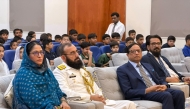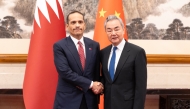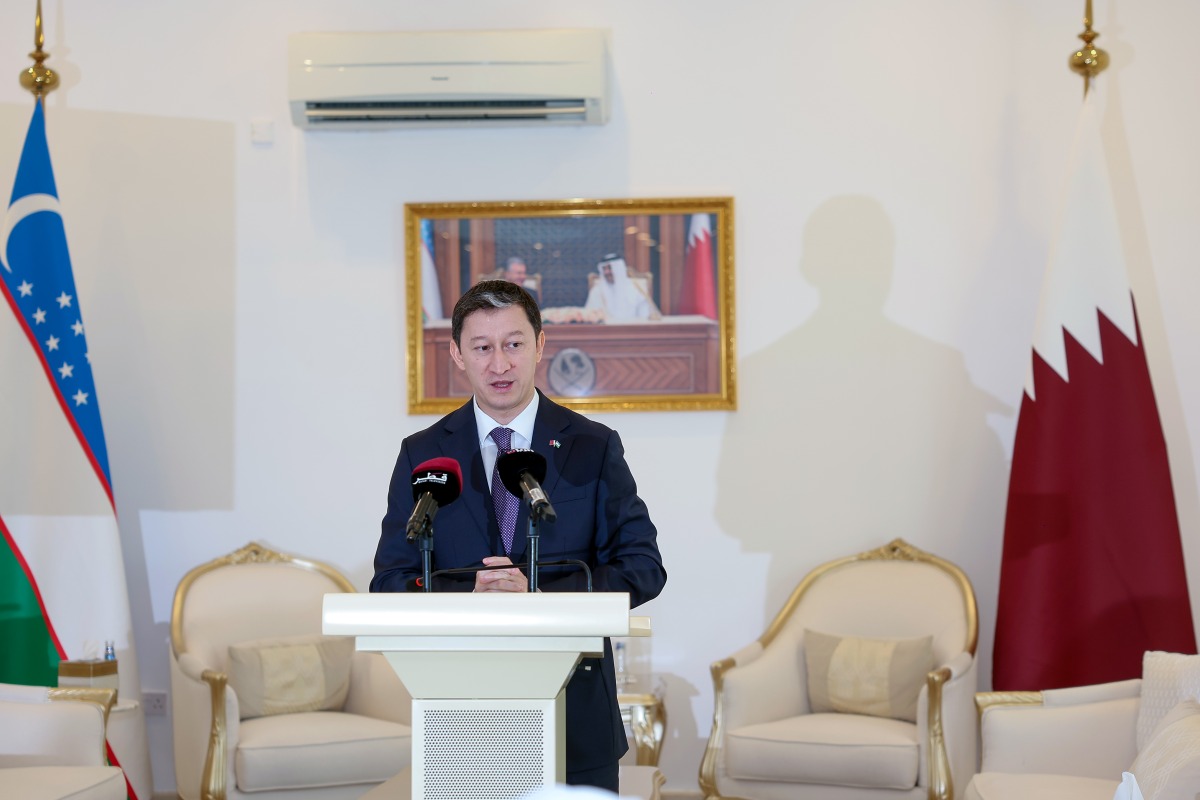
Ambassador of Uzbekistan to Qatar H E Dr. Ashraf Khodjaev addressing an event marking the 35th anniversary of Uzbekistan's independence.
Doha, Qatar: Ambassador of Uzbekistan to Qatar H E Dr. Ashraf Khodjaev has said that Uzbekistan-Qatar relations have evolved into a strategic partnership in recent years.
“Uzbekistan’s expanding international engagement is reflected in the rapid development of its relations with the State of Qatar. Diplomatic relations, established in 1997, have in recent years evolved into a strategic partnership, supported by a series of high-level visits and growing cooperation in trade, investment, energy, infrastructure, tourism, education and culture,” Ambassador Khodjaev said while addressing an event to mark the 35th anniversary of Uzbekistan independence at embassy yesterday.
He said that a major milestone was the state visit of Amir H H Sheikh Tamim bin Hamad Al-Thani to Uzbekistan in June 2023.
“The visit opened a new chapter in bilateral relations and resulted in the signing of 15 agreements and memoranda covering investment, trade, taxation, education, culture, agriculture, tourism and other areas.”
He added, “This was followed by the state visit of President Shavkat Mirziyoyev to Qatar in October 2023, where the two leaders agreed to further elevate bilateral relations and witnessed the signing of a new package of agreements and memoranda. In December 2023, His Highness the Amir again visited Tashkent for a working visit to attend the International Anti-Corruption Excellence Award ceremony.”
He said that Qatra-Uzbekistan partnership has continued to gain momentum. “In 2025, trade between Uzbekistan and Qatar increased by more than 30 percent, while Uzbekistan’s exports to Qatar grew by more than 36 percent. In 2026, the two sides have continued to develop projects in energy, transport and logistics, infrastructure, industry, agriculture, tourism, education and finance.”
Qatari companies and institutions, the Ambassador said, are increasingly exploring investment opportunities in Uzbekistan, while both countries are working to expand trade and establish new mechanisms for business cooperation. “The growing Uzbekistan–Qatar partnership is an important bridge between Central Asia and the Gulf and reflects the shared vision of both countries for stronger economic and people-to-people ties.”
Ambassador Khodjaev said that since gaining independence in 1991, Uzbekistan has built the foundations of a sovereign state and developed its own path of national development. “Over the past decade, and particularly since 2016 under the leadership of President Shavkat Mirziyoyev, the country has embarked on a far-reaching programme of reforms aimed at modernizing the economy, strengthening social protection, expanding international cooperation and improving the quality of life of its people.”
One of the most consequential changes, he said, has been the transformation of Uzbekistan’s economic model. “The reform programme launched in 2017 introduced major changes in currency and price liberalization, trade, taxation, the investment climate and the role of the state in the economy. The World Bank has described the reforms as a major economic and social transformation and notes that Uzbekistan has emerged as one of the world’s leading reformers among developing economies. Real GDP growth averaged approximately 6 percent annually between 2017 and 2025.”
He said that the scale of the transformation is increasingly reflected in the country’s economic indicators. “In 2025, Uzbekistan’s economy grew by 7.7 percent, while exports increased by 24 percent in US-dollar terms. Foreign investment has become an increasingly important driver of growth, with more than $60bn in foreign direct investment attracted since 2017, according to the World Bank.”
He further said that one of the most internationally recognized examples of Uzbekistan’s reform process has been the transformation of its cotton sector. “Following commitments made by President Mirziyoyev in 2017, Uzbekistan worked with the International Labour Organization and other international partners to eliminate child and forced labour from the cotton harvest. In 2021, the ILO reported that systemic child labour and systemic forced labour had come to an end in Uzbekistan’s cotton sector.”
On country’s foreign policy, he said, “The country has pursued an increasingly open and pragmatic foreign policy, with particular emphasis on good-neighbourly relations and Central Asian cooperation. The Consultative Meetings of the Heads of State of Central Asia, initiated by President Mirziyoyev in 2017, have become an important mechanism for regional dialogue. Trade, transport, border connectivity and humanitarian exchanges have expanded across the region. Uzbekistan’s trade with other Central Asian states increased from $2.4bn in 2016 to $8.3bn in 2025, while the number of joint enterprises with regional partners exceeded 1,800.”