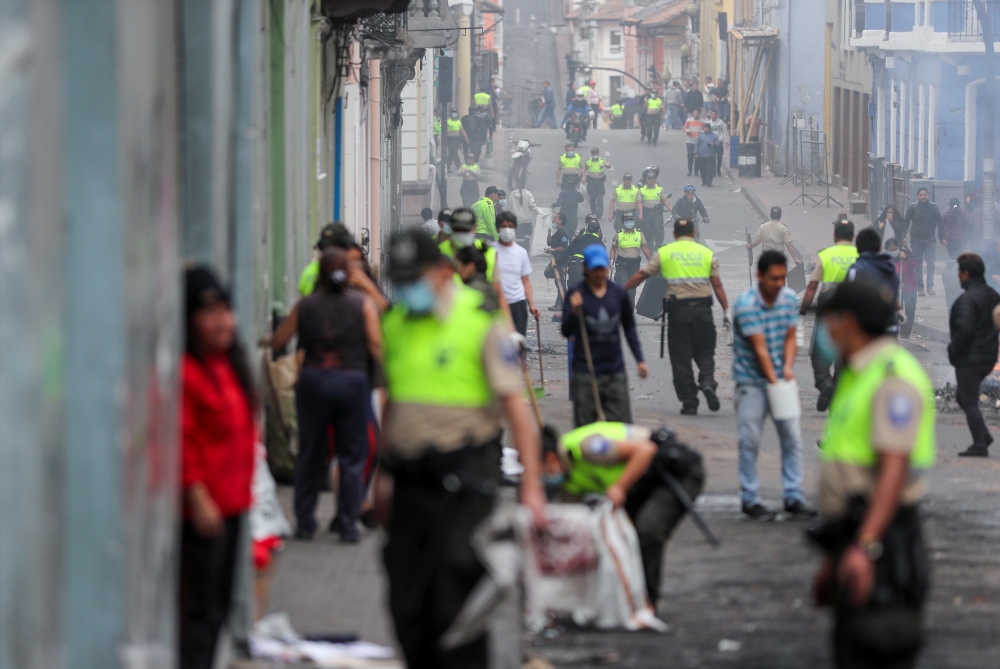
Police officers clean up the remains of a barricade after a protest against Ecuador's President Lenin Moreno's austerity measures in Quito, Ecuador, October 8, 2019. REUTERS/Ivan Alvarado
As Ecuadorian protesters infuriated by rising fuel prices invaded government offices and oil fields, the president and his administration fled the capital, warning of a coup.
In a national address late Monday, President Lenin Moreno said he had moved the executive branch from Quito to the port city of Guayaquil due to security threats. The president said that allies of his predecessor Rafael Correa had infiltrated protests against increases in fuel prices in a bid to topple his government.
"They are the ones behind this coup attempt,” Moreno said, without providing evidence. "The looting, vandalism and the violence show that here there is an organized political intention to destabilize the government and break the democratic order.”
The government of the South American nation of about 16.5 million decamped after another night in a week of unrest. Protesters in Quito damaged Ecuador’s congressional building and violently entered the comptroller general’s office across the street. On Monday, rioters also attacked an oil production facility, a major dairy and dozens of rose plantations. They burned police and military vehicles as security forces struggled to contain the violence.
"When I read that Moreno had left, I felt that we’ve been left alone, who is going to defend us?” said Susana Vega, a Spanish teacher in Quito. "This isn’t a strike, this is something much more sinister.”
The tumult began when the government eliminated subsidies on gasoline and diesel, a move welcomed by the International Monetary Fund and rating companies including Moody’s Investors Service. Moreno reiterated Monday night that he wouldn’t reinstate the fuel subsidies, which had been in place since the 1970s and which were costing the government close to $1.4 billion a year. Observers didn’t take that as the final word.
"There is a non-zero risk that Moreno knuckles under pressure and rolls back the subsidy cuts,” Edwin Gutierrez, London-based head of emerging-market sovereign debt at Aberdeen Asset Management, wrote in a written reply to questions. "Given the violence and protests, that risk has clearly risen.”
The nation’s dollar bonds due in 2028 fell 3.6 cents to 93 cents on the dollar, the biggest drop since they were sold in January 2018, sending yields up 0.65 percentage point.
The nation has been engulfed by the protests. In the Amazon region, demonstrators entered facilities of the Sacha oilfield, prompting authorities to shut down production and causing the loss of 70,000 barrels of Ecuador’s 550,000 barrel-a-day output.
Central regions were cut off from television and radio service as demonstrators seized repeater antennas. Indigenous communities blocked numerous main roads in the Andean region, home to half the nation’s residents. Cuenca, the third-largest city, is receiving supplies by air.
As president, Moreno has been a maverick. When he took office in 2017, many assumed he’d continue to lead the country along the repressive and spendthrift path forged by Correa, his former mentor. Correa is responsible for a string of ill-considered public works projects, including power plants, refineries, pipelines, airport terminals and a railway. They have been dogged by cost overruns, construction and design flaws and accusations of corruption. Correa defaulted on $3.2 billion in bonds for political reasons.
Today, Correa is living in Belgium, evading charges that he had a political opponent kidnapped. Moreno, who some expected would be Correa’s stooge, has purged the government of those close to the former president.
The president cut the fuel subsidies as he tried to meet commitments to improve government finances under the terms of a $4.2 billion financial agreement with the IMF.
"The stakes are high,” said Siobhan Morden, the head of Latin America fixed income strategy at Amherst Pierpont Securities in New York. "If President Moreno reinstates the subsidies, then the IMF program is at risk.”
For his part, Correa, who governed the country for a decade, said in a post on Twitter that Moreno "is finished” and called for elections.
Comptroller General Pablo Celi said the attack on his office was an attempt to destroy evidence used in ongoing investigations.
"Actions like these prove that a conspiracy is under way in the country that seeks to impact and destroy the democratic order,” he said in a video sent to reporters.