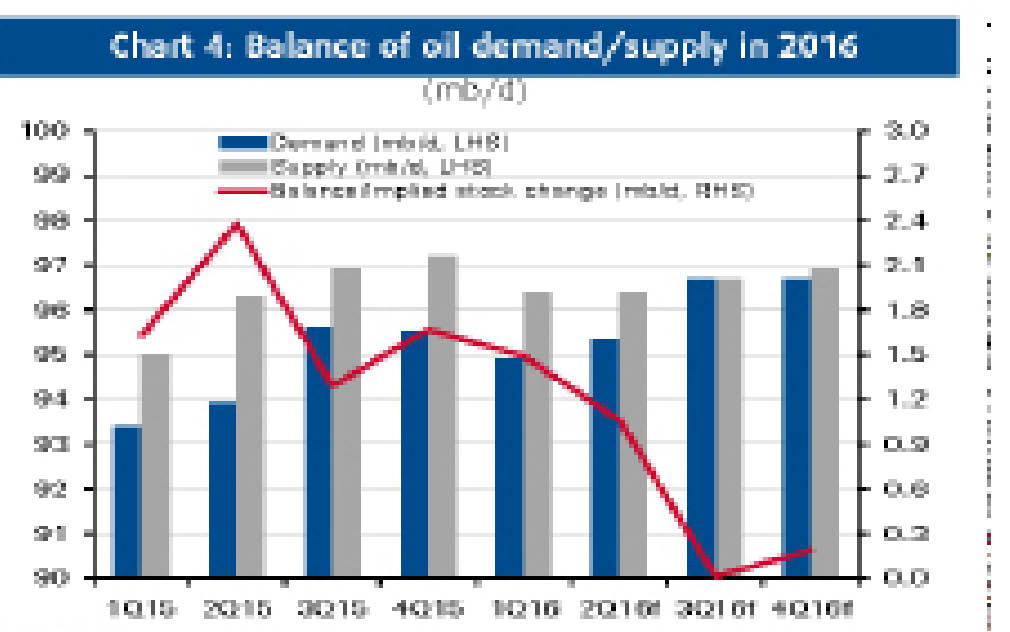
DOHA: Oil markets are looking to the second half of 2016 for demand and supply to balance. A more meaningful adjustment to the demand/supply dynamic is likely to come about after oil consumption peaks during the third and fourth quarters of the year and when non-Opec production, especially US light tight oil production (shale), records further declines in output, NBK’s update on oil market noted yesterday.
According to the International Energy Agency (IEA), the market should reach equilibrium in 3Q16. The agency also estimates that by 4Q16, non-Opec supply will have contracted by around 800,000 barrels per day (b/d). US shale production is expected to account for much of the fall, NBK analysts said.
US crude production, which fell by one percent in 2015, was already down three percent, or 280,000 b/d, at 8.9 mb/d by 22 April of this year, the US Energy Information Administration (EIA) noted. The increase in production efficiency that has come about despite sizable falls in drilling activity and capital spending by oil firms looks to be finally tapering off.
Rising Iranian output offsets losses in Nigeria to keep Opec production steady in March and Opec and Russia fail to sign off on a production freeze in Doha.
Overall, Opec production held steady at 32.2 mb/d for the second consecutive month in March, according to Opec secondary source data. Output declines in Nigeria and Libya due to supply disruptions and in the UAE as a result of maintenance were broadly offset by output gains in Iran and Iraq. Production in Saudi Arabia and Kuwait was unchanged.
Unshackled by sanctions, Iranian production has been increasing at the rate of about 135,000 b/d a month in 2016. Output reached 3.3 mb/d in March, an impressive rise of 405,000 b/d year-to-date. This is still short of the 500,000 b/d that Iranian officials boasted could be brought online immediately post-sanctions. Nevertheless, Iran is only a few months away from reaching its pre-sanctions production capacity level of 3.6 mb/d. Its target of 4 mb/d, however, is unlikely to be attained without significant investment in view of the weakened state of the country’s oil infrastructure.
Iran’s refusal to countenance capping production before reaching its target of 4 mb/d proved decisive in the Doha negotiations. Attention now shifts to Opec’s biannual meeting in June, when members will likely resume their discussion of production ceilings.
April saw oil markets shrug off the failed Opec/Russia output freeze accord and propel prices to their biggest monthly gain since 2009.
According to NBK analysts, April may come to be known as the month in which oil market sentiment turned perceptibly bullish. Shrugging off the failure of Opec and Russia to agree on a production freeze, oil prices posted their largest monthly gain in seven years in April. By the end of the month, Brent crude, the international benchmark, had surged by almost 22 percent to close at $48.1 per barrel (bbl)—its highest level since November 2015. Similarly, West Texas Intermediate (WTI), the US crude marker, ended the month 20 percent higher at $45.9/bbl.
Since hitting 13-year lows in mid-January, oil prices have rallied by a remarkable 72 percent on the back of several bullish signals including the production freeze talks, supply outages among Opec members, falling US shale production and a depreciating US dollar.
Rather than dwell on the inability of Opec and Russia to agree on oil output cuts at the 17 April meeting in Doha, markets took their cues from the supply disruptions that have come thick and fast since February. Among the largest oil producers to witness falls in output were Iraq, Nigeria, Ghana and Kuwait.The Peninsula