By Sachin Kumar
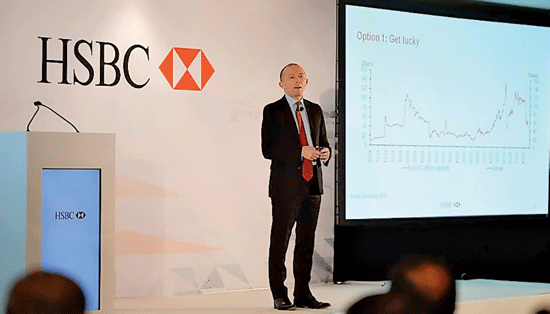
DOHA: The balance sheets of the Middle East oil producers are strong enough to absorb the terms of trade shock, said Simon Williams, Chief Economist, CEEMEA, HSBC at the 18th Middle East Economist Roadshow.
The event aw discussion on the important global and regional trends shaping the Middle East’s economies.
“The balance sheets of the Middle East oil producers are strong enough to absorb the terms of trade shock. However large the deficits may get, they are going to be funded. The dollar pegs are going to hold,” said Williams. “While there is no crisis on the horizon, the terms of trade shock is too large to ignore. Deficits approaching half a trillion dollars over 2015-17 mean that spending will be cut, interest rates will rise and growth will slow markedly,” he said.
He said that Qatar is better placed than other economies to face the current volatility. “The wealth that Qatar commands leaves it better placed than many of its peers, but even here the downturn in activity will be marked. Capital and current spending growth will slow, investment in the energy sector will reverse, and the dollar-driven appreciation of the currency will undermine competitiveness,” said Williams.
More than 150 people gathered yesterday for HSBC’s the roadshow. Each year, the roadshow visits Abu Dhabi, Dubai and Riyadh, before making stops in Qatar, Kuwait and Oman.
“The start of a Fed (Federal Reserve) tightening cycle will not be US dollar positive in our view. Like other countries that have had to quickly reverse their post-crisis rate hikes, the Fed’s cycle will likely be shorter than before. If this is due to low inflation, the USD should fall against both Emerging Market and Developed Market FX,” said David Bloom, Global Head of Foreign Exchange Strategy, HSBC.
“So far, the ECB has successfully managed to weaken the euro (EUR), but fighting any EUR-USD upside may be more difficult, given that it faces several crucial self-imposed constraints that make a large-scale expansion of the quantitative easing (QE) programme difficult. We see EUR-USD at 1.20 by year-end 2016,” he said.
“The consensus in markets is for further Bank of Japan (BoJ) easing, given stubbornly low inflation in Japan. However, we do not share this view, and think that large-scale QE is reaching its limits of effectiveness. This, combined with technical and political difficulties, means we see the BoJ holding off on further easing,” said Bloom. “We therefore change our USD-JPY forecasts, to 115 in Q4 2016, from 125,” he added.
The Peninsula