By Sachin Kumar
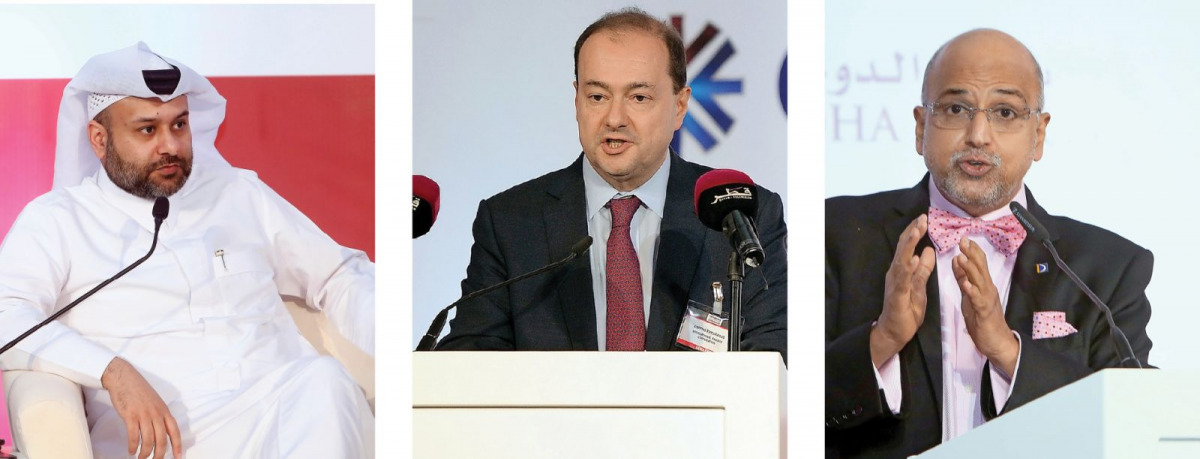
DOHA: Despite decline in oil prices, Qatar has a stable economy and the country would continue to attract foreign companies, Yousuf Mohamed Al Jaida, Chief Executive Officer, Qatar Financial Centre, said yesterday.
“Amid the ongoing instability in the region, Qatar is a stable country and the businesses want stability and market,” he said in a keynote interview at The Euromoney Qatar Conference.
He said that regulatory framework in Qatar is being done. “The regulators in Qatar had announced a single regulator in 2013. The banking sector, insurance sector and asset management sectors are being looked at by all the regulators. There is a lot of work there to achieve in regulators ambition in terms of a single regulator. We are assisting a lot in those regulations,” he added.
He said a lot of infrastructure and legal enhancement will continue to attract firms to Qatari market which will contribute in the development of private sector. It will contribute to the diversification efforts in the country.
Speaking about the evolution of QFC in the past years, he said the centre and its team has achieved a lot in the past ten years and has learned many things.
He said QFC, set up in 2005, was set as a onshore centre, unlike other financial centres in the region. Other financial centres in the region were created offshore. “We have allowed firms to integrate with local economy and contribute to local economy,” he added.
Speaking on some of the global challenges constraining growth, Dimitris Tsitsiragos, Vice-President of International Finance Corporation, looked at the requirements for infrastructure development. “With some 1.2 billion people in the world lacking access to stable power, and 2 billion people expected to move to urban areas in the next 25 years, shortfalls in infrastructure is likely to directly impact economic growth,” said Tsitsiragos.
In the Mena region, there is an estimated 20 percent shortfall in power generation capacity and parallel shortfalls in water, hospitals, schools and housing — issues that are likely to be exacerbated by the increased flow of migrants and internally-displaced people. Tsitsiragos highlighted the key role of the private sector, and in public-private partnership in ensuring these needs are met now and in the future.
Dr R Seetharaman, Group Chief Executive Officer, Doha Bank presented overview of global economic scenario. He said the signs of economic recovery in the United States are still not clearly visible and the world’s biggest economy has yet not achieved sustainable growth momentum. The world will come to know by next week if the Federal Reserve will raise rates or not. He said major economies around the globe are showing signs of slowdown. Europe in deviating from US as it is continuing its bond buying programme. China, the engine of economic growth in the world, is slowing down after witnessing growth of around 9-10 percent for a decade. Economies of Russia and Brazil are also in stress.
He added that compared to other economies fundamentals of Qatar’s economy is very strong. Ongoing efforts of diversification by the government will further help Qatari economy to grow.
He said that advance economies are reshaping fiscal consolidations central banks around the globe are trying to reset fiscal focus.
World leaders are talking in UN Paris Climate Conference to achieve the goal of carbon neutral world. Other speakers said Qatar will be less dependent on oil and gas sector going forward because of the ongoing diversification efforts.
The Peninsula