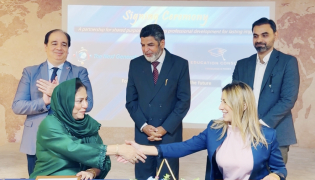
Sarajevo--Bosnian lawmakers on Wednesday backed Denis Zvizdic of the main Muslim party here as PM-designate, four months after general elections in the ethnically-divided country which were won by nationalists.
Zvizdic, a senior official of the Party of Democratic Action (SDA), now has 30 days to form a cabinet that must be approved by the parliament.
In last October's vote, Bosnian Muslim, Croat and Serb main nationalist parties won the country's three-man presidency and dominance in both central and regional parliaments.
Since the 1992-1995 war between its Croats, Muslims and Serbs, Bosnia consists of two semi-autonomous entities.
Each of the two -- the Serbs' Republika Srpska and the Muslim-Croat Federation -- has its own government. They are linked by weak central institutions that include the presidency and the central parliament.
In the 42-seat central assembly, Zvizdic enjoys backing of the SDA, Croat HDZ and Serb SDS party as well as of several minor political groupings.
Zvizdic, a 50-year-old architect, told the lawmakers on Wednesday that continuation of the process of Bosnia's approach to the European Union and "implementation of serious social and economic reforms" would be his top priorities.
Bosnia desperately needs economic and social reforms that have been blocked for years. It is the only country in the Balkans region that has yet to officially apply for the status of a EU candidate country.
Brussels last year adopted a new initiative aimed at accelerating reforms in Bosnia, necessary for its progress towards EU membership.
It consists of delaying difficult constitutional reforms that have led to political stalemate amid inter-ethnic disputes among the three main communities and to focus on reforms.
Bosnia remains one of the poorest countries in Europe with the jobless rate standing at over 40 percent.
A year ago mass protests broke out against the government's failure to fight graft and enact EU-sought reforms.
Bosnia's 1992-1995 war claimed some 100,000 lives.
AFP