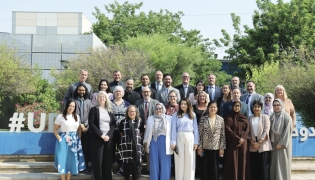
Doha: Professor Hilal A Lashuel, Executive Director, Qatar Biomedical Research Institute (QBRI), a research and development entity under Qatar Foundation for Education, Science and Community Development (QF), co-chaired the Brain Forum 2015 in Lausanne, Switzerland.
The annual global event highlighted challenges and opportunities in translating scientific advances in neuroscience, computing, drug discovery, and brain research to new technologies, tools and treatments that will improve the quality of life and healthcare.
The forum was a partnership between W Science Initiative and Swiss Federal Institute of Technology in Lausanne.
It was co-chaired by Prof Lashuel; Professor Patrick Aebischer, President, Swiss Federal Institute of Technology in Lausanne; Dr Walid Juffali, Chairman, W Science Initiative; and Dr Jamil Al Imad, CEO, the W Science Initiative.
The high-profile event was first launched in Jeddah in 2013.
As a key research and development entity, QBRI contributes to QF’s mission to build Qatar’s innovation and technology capacity by improving and transforming healthcare through scientific research in prevention, diagnosis and treatment of diseases.
With the primary aim of addressing national priorities for growth and development, QBRI’s work also highlights Qatar’s role as an emerging global centre for healthcare innovation.
The forum was founded on the principle that progress is achieved through dialogue, engagement and collaboration between stakeholders involved in shaping the landscape and future of brain research.
Prof Lashuel said: “Towards achieving this goal, we sought to bring together leading scientific and academic experts from around the world, including philanthropists and leaders from the industry, funding agencies, and policymakers to share knowledge and expertise with the aim of improving our understanding of the human brain in addition to finding new ways to enhance brain function and find treatments for neurological diseases that are threatening our society today.”
Prof Lashuel, one of the key individuals behind the development of the forum, is a founding member of the Scientific Advisory Committee and co-chaired the development of scientific programmes for the forum in 2013 and 2015.
On the first day of the forum, he chaired a panel discussion with some of the pioneers and scientific leaders behind major national and regional brain initiatives, including the US Brain Initiative launched by President Barack Obama in 2013, the European Human Brain Project, Allen Institute for Brain Science and the recently announced China Brain Science Project.
“It is amazing to think about what we have been able to achieve with our limited understanding of the brain today and what will be possible once these ambitious global initiatives achieve their goals.
“There is no doubt that advances in the interface of neuroscience, engineering and computer science during the next five to 10 years will transform many aspects of our lives and bring new hope to those suffering from brain diseases,” Prof Lashuel said.
The Peninsula