DOHA: An increasing number of companies might be using the renminbi (RMB) to do business with China, but few are capitalising on the government’s new trading initiatives and are missing out on potential business opportunities, according to a new survey by HSBC.
The survey said almost a quarter of companies are now using the renminbi to do business with China, but few are capitalising on the Chinese government’s flagship ‘Belt and Road’ trade initiatives.
In the poll of 1,600 decision-makers across 14 countries, 24% said their firm is using RMB. Yet when asked about Belt and Road - the name given to a series of policy developments and infrastructure projects designed to spur $2.5 trillion of cross-border commerce annually - just 41% said they understand the opportunities it presents. What’s more, only 7% of ‘aware’ businesses are working on a strategy.
“Belt and Road projects are already presenting huge opportunities for companies that can help develop physical infrastructure such as highways, ports and telecommunications networks,” said Noel Quinn, Chief Executive of HSBC Commercial Banking. “But these are only the first steps. By boosting connectivity, Belt and Road will catalyse trade between more than 65 countries that are home to nearly two thirds of the world’s population. For any company seeking growth and new customers, that’s an exciting proposition to explore.”
First laid out by Chinese President Xi Jinping in 2013, the Belt and Road blueprint aims to develop two corridors linking China to the world.
The ‘Belt’ refers to the historic overland Silk Road trading routes connecting China via central Asia to Europe and the Middle East. The ‘Road’ refers to the maritime equivalents to the south, linking China, Southeast Asia, India and Africa.
Chinese enterprises invested $14.8bn in 49 countries along the ‘New Silk Road’ last year, working on projects including an Indonesian railway, a Greek logistics hub and Bangladeshi power facilities.
From the small number of businesses that are aware of Belt and Road, the survey shows that European and North American firms are seeking an early advantage. In Europe, 12 percent of ‘aware’ businesses are developing strategies to benefit from these initiatives, with North America close behind at 9 percent.
In the Asia-Pacific region outside China just 6 percent of ‘aware’ firms are making specific Belt and Road plans.
As the initiatives progress they are likely to boost international use of the RMB. Seeking to track global perceptions of China’s trade and currency, HSBC commissioned a similar survey from Nielsen in 2015. Allowing for one country change, replacing Brazil with Mexico, comparison of the two surveys shows the number of companies using RMB for cross-border commerce rising to 24 percent from 17 percent a year earlier.
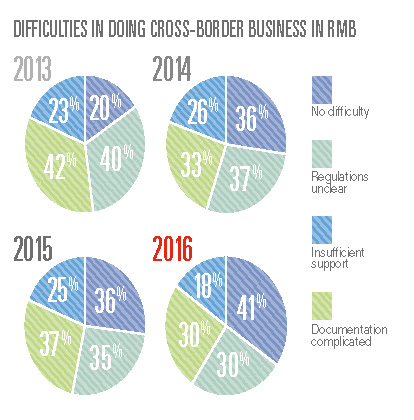
One reason for this is that businesses are finding the RMB much easier to use, according to the 2016 survey. As Chinese financial regulations evolve, and as businesses become more accustomed to using China’s currency, respondents said they’re having less difficulty understanding regulations, navigating documentary requirements and moving funds than they did in the past.
For its 2016 survey HSBC polled decision-makers in Australia, Canada, China, France, Germany, HK, Malaysia, Mexico, Singapore, SKorea, Taiwan, the UAE, the UK and the US who represent companies that conduct international business with or from China.