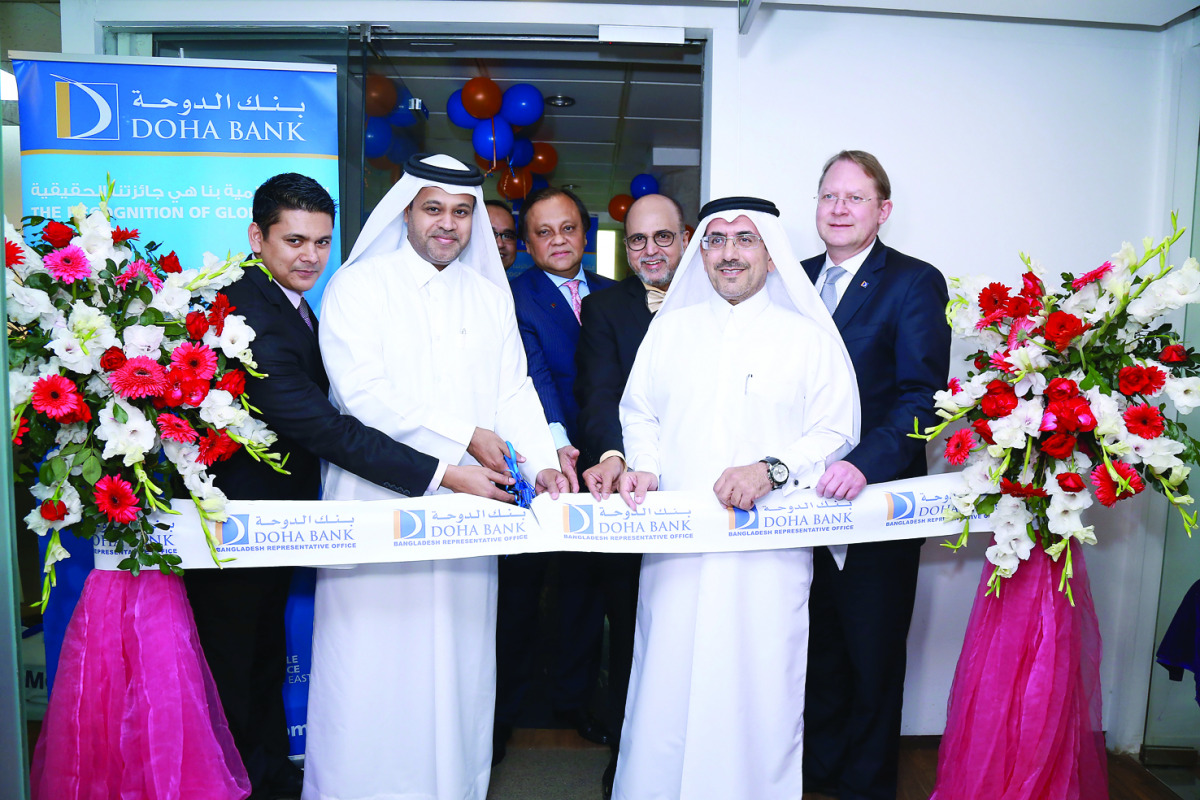
Qatar's Ambassador to Bangladesh, Ahmed Mohamed Al Dehaimi (second left) cutting the ribbon to mark the official inauguration of the Doha Bank's representative office in Dhaka.
Doha Bank yesterday announced it inaugurated the Bank's Bangladesh representative office in Dhaka. The inauguration ceremony was held in the presence of Qatar's Ambassador to Bangladesh, Ahmed Mohamed Al Dehaimi; Anis A Khan, Managing Director and CEO of Mutual Trust Bank; Abdul Matlub Ahmed, President Federation of Bangladesh Chamber of Commerce & Industry (FBCCI) and CEOs and Senior Officials of Bangladesh Banks.
On the occasion Doha Bank hosted a grand reception at The Westin Dhaka Hotel in Dhaka on the same day. The reception was attended by banking fraternity and other dignitaries in Bangladesh.
Dr R Seetharaman, CEO of Doha Bank gave an insight to the current global economy scenario. He said: “ The recent IMF outlook had given global growth of 3.1 percent in 2016. A more subdued outlook for advanced economies following the June UK vote in favour of leaving the EU and weaker-than-expected growth in the US. As a result, the 2016 growth forecast for advanced economies has been scaled down to 1.6 percent. Emerging and developing economies expected to grow by 4.2 percent this year.”
Dr Seetharaman also gave an insight on the Bangladesh Economy, and said: “The economy would grow at 7.2 percent in the current 2016-17 financial year. Bangladesh's annual inflation picked up in September, driven by higher food prices, to 5.53 percent. Bangladesh has done an impressive job in reducing poverty over the last decades and has the potential to end extreme poverty by 2030."
He added: "To move to the next level and realise its goal of becoming a middle-income country by 2021 and overcoming extreme poverty by 2030, the country needs to sustain its economic and remittances growth, create more and better infrastructure and improving the quality of health and education.”