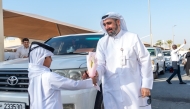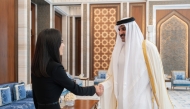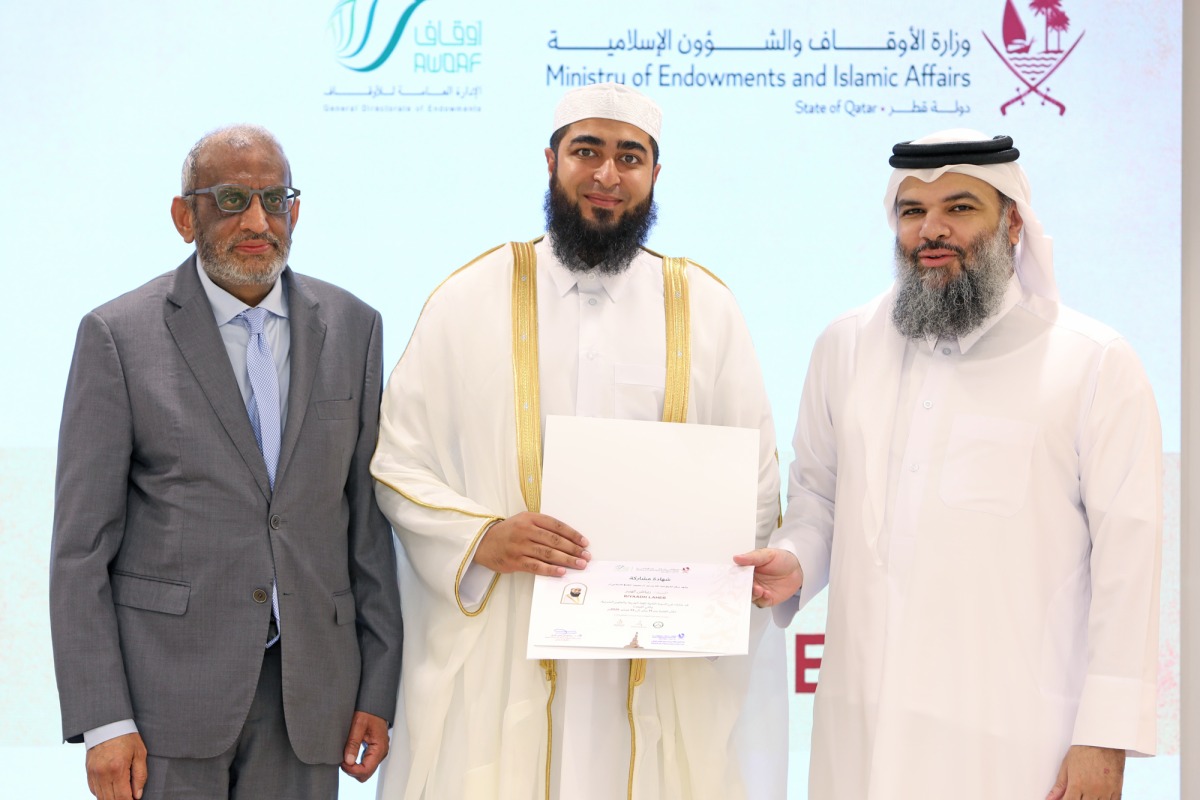
Undersecretary of the Ministry of Awqaf and Islamic Affairs H E Dr. Sheikh Khalid bin Mohammed bin Ghanem Al Thani and Ambassador of South Africa to Qatar H E Ghulam Hussein Asmal honouring a participant.
Doha, Qatar: Undersecretary of the Ministry of Awqaf and Islamic Affairs H E Dr. Sheikh Khalid bin Mohammed bin Ghanem Al Thani, honoured a distinguished group of professors and instructors from the Islamic University affiliated with the Muslim Judicial Council of South Africa, marking the conclusion of the second Arabic language and Islamic sciences course organised by the Sheikh Abdullah bin Zaid Al Mahmoud Islamic Cultural Centre.
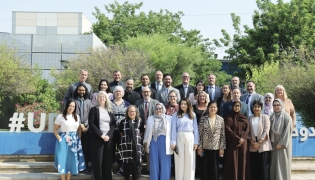
The month-long programme brought together 15 instructors and aimed at enhancing Arabic language proficiency and deepening knowledge in Islamic sciences. The honouring ceremony was held in the presence of the Ambassador of the Republic of South Africa to Qatar H E Ghulam Hoosein Ismail, along with department directors, heads of sections, officials, and invited guests.
In his closing remarks, the Undersecretary reaffirmed the Ministry’s commitment to supporting specialised academic and educational programmes that promote the Arabic language and strengthen its presence among non-native speakers. He emphasised the importance of deepening knowledge in Islamic sciences in a way that reflects Islam’s message of moderation, openness, and dialogue, while fostering intercultural understanding and communication among nations.
He further noted that the Ministry places great importance on its international scholarly and outreach role through organising specialised courses and hosting academic delegations from around the world. Such initiatives, he said, contribute to conveying the bright image of Arab and Islamic culture.
For his part, Sultan Saad Al Badr, Assistant Director of the Sheikh Abdullah bin Zaid Al Mahmoud Islamic Cultural Centre, explained that the course builds on the Centre’s ongoing efforts in teaching Arabic to non-native speakers and reinforcing its position as a leading institution in this field. Since its establishment, the Centre has consistently organised academic programmes, welcomed educational and cultural delegations, and developed effective partnerships with academic institutions worldwide.
He added that the programme included 130 intensive training hours in teaching Arabic to non-native speakers, based on the “Pathway to Arabic” curriculum and delivered according to accredited academic methodologies. Participants also attended specialised lectures in Islamic sciences supervised by prominent scholars and professors, contributing to the enhancement of their linguistic proficiency, academic knowledge, and teaching skills.
Mufti Ismail Yousuf Bhamjee, representative of the Islamic University under South Africa’s Darul Ifta, expressed his deep appreciation to the Ministry of Awqaf and the Islamic Cultural Centre for their care and support.