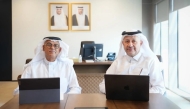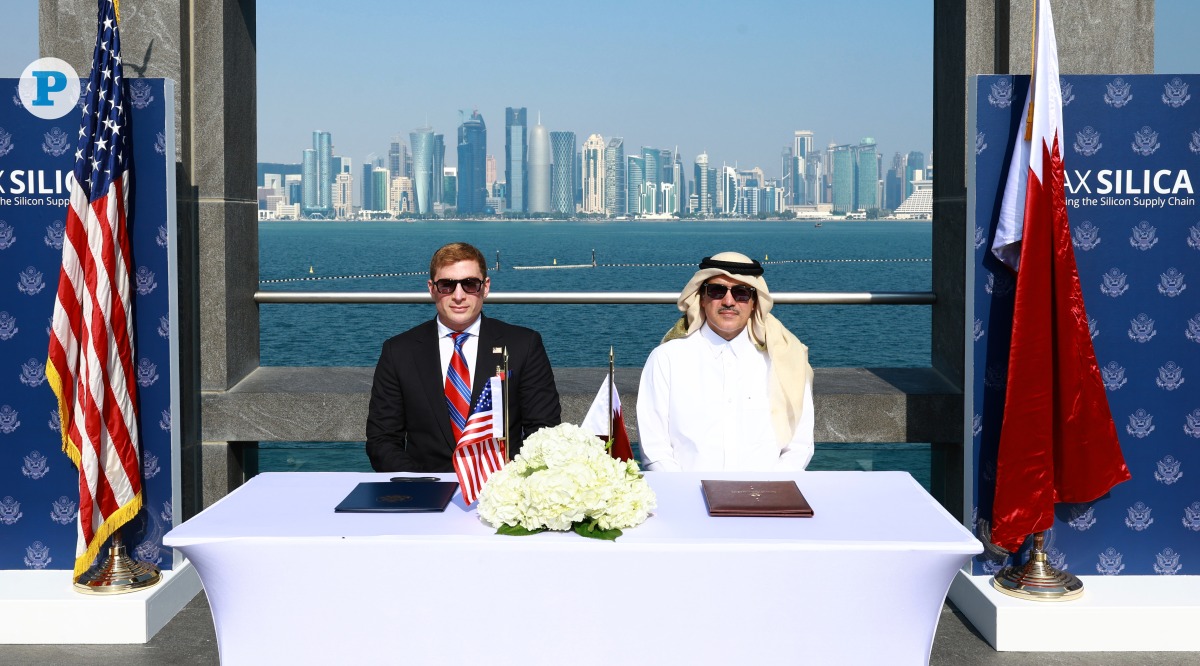
Minister of State for Foreign Trade Affairs H E Dr. Ahmed bin Mohammed Al-Sayed, and the US Under Secretary of State for Economic Affairs H E Jacob Helberg during the signing ceremony yesterday. Pic: Rajan Vadakkemuriyil/The Peninsula
Doha, Qatar: Qatar has joined the Pax Silica Declaration, reinforcing its expanding role in global economic cooperation and strategic partnerships focused on growth and security across technology sectors and supply chain resilience.
The framework signed yesterday by the Minister of State for Foreign Trade Affairs, H E Dr. Ahmed bin Mohammed Al-Sayed, and the US Under Secretary of State for Economic Affairs, H E Jacob Helberg, reflects a shared recognition by countries that economic resilience and national security are increasingly intertwined in a rapidly evolving technological landscape.
Speaking at the signing ceremony, Dr. Al-Sayed said the declaration marks an important advance in Qatar-US relations, grounded in mutual trust, aligned interests, and a shared vision for long-term stability and prosperity.
He said Qatar remains committed to participating in leading international initiatives aimed at strengthening secure and reliable supply chains in semiconductors, artificial intelligence (AI), and other advanced technologies. Dr. Al-Sayed noted that the global economy is undergoing a profound transformation driven by advances in AI, rising demand for energy and critical minerals, and rapid technological change.
He emphasised that sustained cooperation and trusted partnerships are essential to bolstering tech ecosystems during this transition.
The Minister also highlighted Qatar’s investments in digital infrastructure, advanced industries, and innovation, citing cloud computing facilities established by US companies as a key factor in positioning the country as a leading digital hub in the region.
In a post on X, the Ministry of Commerce and Industry stated, “This step reinforces the partnership between the two countries and contributes to building a more resilient and sustainable economic ecosystem.”
Meanwhile, Helberg said the initiative reflects a shift from an oil-based economic model toward one centred on technological innovation and described as “silicon diplomacy.” He noted that while oil and steel defined the 20th century, the modern era is increasingly shaped by computing power and access to critical minerals.
He said the partnership will involve collaboration on strategic investments, including critical minerals security initiatives, modernisation of global logistics infrastructure, expanded data-centre capacity, and deeper cooperation in artificial intelligence. Helberg also invited Qatar to participate in an upcoming ministerial meeting on critical minerals in Washington, DC adding, “Welcome to the alliance. Let us work together to build the operating system for the 21st century.” With Qatar’s accession, Pax Silica now comprises eight members, as officials said additional countries are expected to join as the coalition expands its role as a platform for secure, inclusive, and sustainable global economic growth.
The United States described Qatar as a “key partner” due to its sustained investments in advanced technology, secure energy supply chains, and critical materials.
Pax Silica is an economic security alliance designed for the AI era, bringing together partner nations with shared strategic assets such as computing infrastructure, silicon, critical minerals, and energy resources.
On the sidelines, Dr. Al-Sayed also held talks with the Chief Executive Officer of the US International Development Finance Corporation, Binh Black, exploring opportunities to deepen cooperation in commercial and investment areas, with a focus on expanding joint investment prospects.