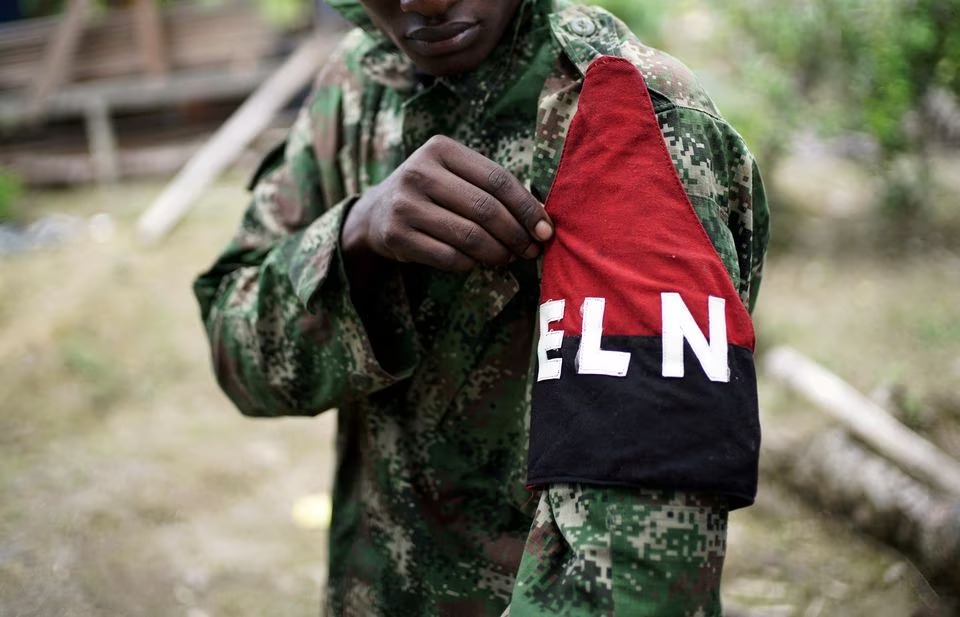
A rebel of Colombia's Marxist National Liberation Army (ELN) shows his armband while posing for a photograph, in the northwestern jungles, Colombia August 31, 2017. REUTERS/Federico Rios/File Photo
Mexico City: Colombia's government on Monday resumed peace talks with National Liberation Army (ELN) rebels, as a bilateral ceasefire is set to be discussed despite recent tensions.
The ELN reacted angrily last month after the government claimed it had agreed a ceasefire with the Marxist guerrillas.
The government was forced to backtrack but the spat has not derailed peace talks, which began in Venezuela in November.
"We are ready!" said the government delegation in a statement on Sunday.
It said the second round of talks would begin "within the framework of building a complete and definitive peace".
Colombia resumed peace talks with the country's last recognized armed rebels in November after Gustavo Petro became the South American country's first ever left-wing president in August.
The talks had been suspended by his conservative predecessor Ivan Duque following a car bomb attack on a police academy in Bogota that left 22 people dead.
Colombia has suffered more than half a century of armed conflict between the state and various groups of left-wing guerrillas, right-wing paramilitaries and drug traffickers.
But last year the government and the ELN agreed to return to the negotiating table with mediation by Norway, Mexico, Venezuela, Brazil and Chile.
"We hope that the work in this second cycle will deliver an effective advance and support for the Colombian peace process," Pablo Beltran, head of the ELN delegation, said upon his arrival in Mexico City on Saturday.
The previous round of talks in November resulted in prisoner releases as well as the provision of "urgent humanitarian care" for ELN political prisoners and for aid to be sent to areas most affected by the conflict.
Founded in 1964 by trade unionists and students inspired by Marxist revolutionary icon Ernesto "Che" Guevara and the Cuban revolution, the ELN has taken part in failed negotiations with Colombia's last five presidents.
It can count on around 3,500 fighters within a loose structure in which different guerrilla units operate largely independently of each other.