DOHA: After a tough start to the year, global financial markets have recovered strongly in recent weeks. Early in the year, a number of concerns plagued financial markets and pushed back expectations for increases in the US Federal Reserve’s (Fed) policy rate. However, more recently, the alleviation of these concerns and a recovery in financial conditions means that the Fed is now more likely to press ahead with rate hikes.
“If the current relative calm in financial markets persists, then we can expect two or three rate hikes this year,” QNB noted in its weekly ‘economic commentary’ yesterday.
Global financial markets struggled at the beginning of 2016: the MSCI world equity index fell 11.5 percent in the first six weeks of the year with the worst losses in China, down more than 20 percent; the US S&P index fell 10.5 percent over the same period; and oil prices fell 19.4 percent due to concerns about global demand and continued excess supply.
Markets were struck by a range of global economic concerns. First, in China, the devaluation of the renminbi and slowing growth raised the risk of further devaluations and runaway capital flight. Markets may also be concerned about the tail-risk of a full-blown balance of payments crisis. Second, a raft of negative data pointed to a slowdown in economic activity concentrated in the global manufacturing sector.
Industrial production contracted in December in the world’s largest manufacturing hubs, the US, Japan and Eurozone. Q4 GDP growth collapsed to 0.7 percent in the US (later revised up to 1 percent) and -1.4 percent in Japan (later revised up to -1.1 percent). Third, lower oil prices raised the risk of credit events amongst oil producers that could destabilise financial markets.
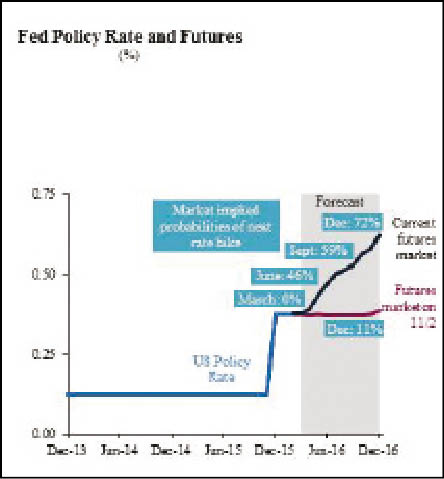
According to QNB analysts, one significant result of the turmoil in financial markets was that the Fed backed off on its rhetoric around the next rate hike. In her testimony to Congress on February 10, Fed Chair Janet Yellen said that tightening financial conditions would need to be taken into account. Market expectations for rate hikes were substantially revised down, with only an 11 percent chance of a rate hike priced into financial markets for the whole of 2016.
It does now appear that concerns about China and the global economy have eased. Global equity markets have recovered some ground from their lows. The MSCI world equity index is now only 3.6 percent down for the year, the S&P is 2.7 percent down and oil prices are up 9.8 percent. Meanwhile, Chinese equity markets are down 18.0 percent for the year.
The Chinese authorities have reversed their exchange rate policy, letting the renminbi appreciate and calming capital flight concerns. And, finally, GDP growth is now expected to rebound in Q1 2016 in the US (2.0 percent consensus forecast) and Japan (1.2 percent consensus forecast). Recent data also suggests that consumption in the US is beginning to pick up with stronger retail sales, consumption and consumer confidence data.
Two key data points for the Fed have also come in stronger than expected in the last two weeks, strengthening the case for the Fed to raise interest rates.
First, core inflation rose to 1.7 percent in January, nearing the Fed’s 2 percent target and compared with expectations of 1.5 percent. Second, nonfarm payrolls came in much stronger than expected at 242k in February, keeping unemployment down at 4.9 percent and providing a further indication of the strength of the US labour market.
Futures markets have re-priced to incorporate the increased likelihood of a Fed rate hike. A hike on March 16th remains highly improbable given the recent financial turmoil and without more data to confirm the economy is back on track. However, current futures markets imply a 46 percent probability of a 25 bps rate hike by June and 72 percent by December.
In a commentary in mid-February, QNB postulated that the Fed would press ahead with rate hikes if markets stabilised. Now that global financial markets have stabilised, a rate hike this coming June does seem to be firmly back on the cards. In December, the Fed reckoned it would hike rates four times in 2016. Markets now expect one hike by the end of the year, up from zero at the peak of the market turmoil. The truth is likely to be somewhere in the middle, so, if the current relative calm in financial markets persists, then we can expect two or three rate hikes this year. The Peninsula