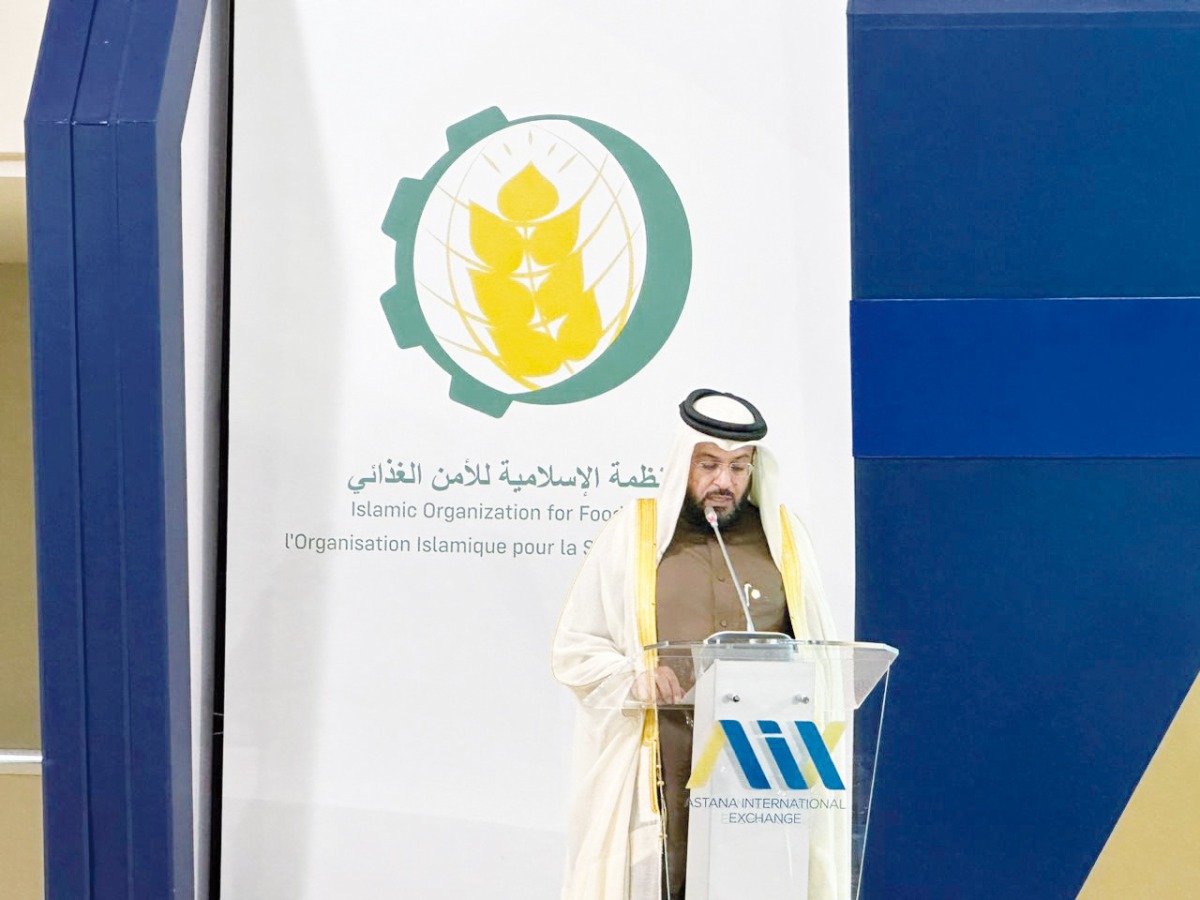
Director of the Food Security Department at the Ministry of Municipality, Dr. Masoud Jarallah Al Marri addressing the event.
Astana: The State of Qatar participated in the annual celebration of the Islamic Organization for Food Security (IOFS) Day, which falls on December 12 of each year, at the organisation’s headquarters in Astana, Kazakhstan.
In a speech on this occasion, Director of the Food Security Department at the Ministry of Municipality, Chairman of the Executive Council of IOFS, Dr. Masoud Jarallah Al Marri, affirmed that the annual celebration of the organisation reminds of its important role towards achieving partnerships for sustainable food security in Islamic countries and documents its keenness on the need to enhance responsibility.
He stated that this comes in light of the current situation and the recurring crises that threaten food security in countries of the world in general and Islamic countries in particular, which requires more concerted efforts and capacity building to strengthen the food security system to withstand these challenges.
Dr. Masoud noted that the escalating crises and growing challenges facing the world, such as disruptions in international food supply chains, water scarcity and climate change, and their negative impact on agriculture and food production make it necessary for the organization’s member states to pay more attention to food security issues, discuss difficulties and challenges, and search for appropriate solutions.
He added that the Islamic Organization for Food Security, on this occasion, affirms its continuation of work to implement its commitments towards food security issues of Islamic countries, by providing expertise and technical knowledge, assessing and monitoring the food security situation, providing social safety nets and humanitarian assistance among other measures.
Al Marri pointed out that the organisation calls on all member states to strengthen their cooperation with the organisation, mobilise the political will to support and strengthen efforts to achieve the desired goal, and build a food security system that is able to withstand and adapt to the challenges and crises that threaten it.