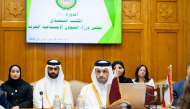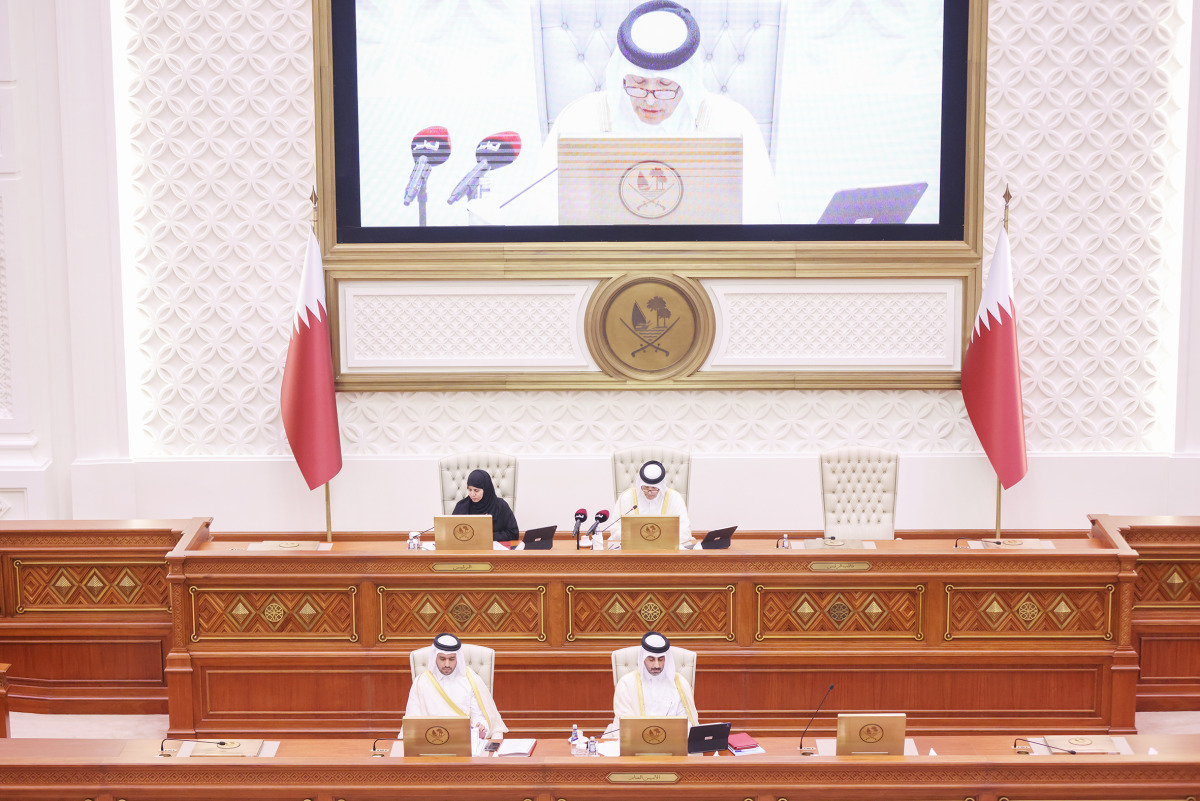
Shura Council Speaker H E Hassan bin Abdullah Al Ghanim chairing the Council's session yesterday.
Doha, Qatar: The Shura Council held its first session of the second ordinary session of the second legislative term, corresponding to the 55th annual session, yesterday, electing the heads of its six permanent committees by acclamation.
The session was chaired by Speaker of the Shura Council H E Hassan bin Abdullah Al Ghanim at the Tamim bin Hamad Hall at the council’s headquarters. The committee heads were elected in accordance with the council’s internal regulations, which provide for nominations to the chairmanships of its permanent committees.
H E Khalid bin Ghanem Al Ali was elected chairman of the Legal and Legislative Affairs Committee, while H E Yousef bin Ali Al Khater was elected chairman of the Internal and External Affairs Committee.
H E Mohammed bin Youssef Al Mana was elected chairman of the Financial and Economic Affairs Committee, and H E Abdullah bin Nasser bin Turki Al Subaie was elected chairman of the Health, Public Services and Environment Affairs Committee.
H E Khalid bin Ahmed Al Obaidan was elected chairman of the Education, Culture, Sports and Media Affairs Committee, while H E Dr Sultan bin Hassan Al Dhabet Al Dosari was elected chairman of the Social Affairs, Labour and Housing Committee.
At the beginning of the session, Secretary-General of the Shura Council H E Nayef bin Mohammed Al Mahmoud read out the agenda, including Decree No. 58 of 2026 calling the council to convene its second ordinary session of the second legislative term, corresponding to the 55th annual session.
The session followed the opening of the new legislative session by Amir H H Sheikh Tamim bin Hamad Al Thani, who addressed the council on national priorities, regional developments and the requirements of the coming phase.
In his address at the opening session, Al Ghanim welcomed H H the Amir and expressed his gratitude for the Amir’s patronage of the opening. He also paid tribute to the Father Amir, H H Sheikh Hamad bin Khalifa Al Thani, recalling his role in building modern Qatar, developing the country’s resources, investing in human development and strengthening the principle of Shura.
He said H H the Amir was continuing that legacy, guiding Qatar towards further development and prosperity while strengthening its regional and international standing. Commenting on the Amir’s address, Al Ghanim said it presented a clear vision of the country’s circumstances and the priorities of the coming period amid exceptional regional conditions and rapidly evolving challenges.
He commended the government’s handling of the circumstances the country had faced, under the Amir’s directives, and its efforts to ensure the continuity of state institutions, meet the needs of citizens and residents, and safeguard their security and stability. He also praised the public’s awareness, sense of responsibility and solidarity during that period.
Al Ghanim reaffirmed the council’s commitment to fulfilling its national responsibilities, supporting the state’s efforts to protect its security and interests, and contributing to regional stability through dialogue and peaceful solutions. He highlighted the importance of ensuring the safety and freedom of navigation through international waterways and said the council would continue to use parliamentary diplomacy and regional and international platforms to advance these objectives.
He also pointed to Qatar’s success in securing support for an emergency item submitted by the Shura Council on preserving ceasefire agreements and supporting the establishment of peace. The item was placed on the agenda of the Inter-Parliamentary Union’s General Assembly, reflecting Qatar’s continued emphasis on dialogue and diplomacy and its rejection of wars and conflicts, he said.
Reviewing the council’s work during the previous legislative session, Al Ghanim said it had held 37 regular sessions and completed the study of 23 draft laws. It had also considered four requests for general debate and submitted three proposals to the government addressing priority community issues.