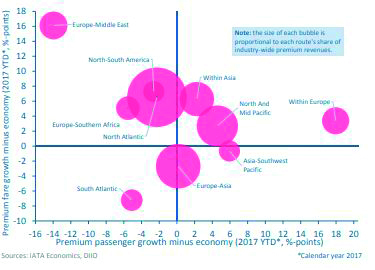
DOHA: The share of international O-D (origin/destination) passengers flying in the premium-class cabin increased to 5.3 percent in 2017 as a whole, up slightly from 5.2 percent in 2016. However, with premium-class fares generally holding up better than those in economy, the premium cabin’s share of total international revenues increased to 27.2 percent, up from 25.9 percent, according to IATA’s Airline Monitor for January-February.
Premium-class demand in 2017 was supported by the broad-based pick-up in economic and trade conditions, particularly on key markets to, from and within Asia. That said, premium demand has lagged behind in a number of cases, notably between Europe and the Middle East, where impacts from travel bans and tighter government budgets in the Gulf region have taken a toll.
Year-on-year growth in industry-wide revenue passenger kilometres (RPKs) slowed to a 46-month low of 4.6 percent in January, although this was distorted by temporary factors including the later timing of Lunar New Year this year. The bigger picture is that global passenger traffic is carrying solid momentum into 2018, helped by buoyant global economic conditions.
Meanwhile, although the upward trend in seasonally adjusted freight tonne kilometres (FTKs) has slowed over the past six months or so, carryover effects helped year-on-year FTK growth to make a robust start to 2018 (8.0 percent).
Industry-wide available seat kilometres (ASKs) increased by 5.3 percent year-on-year in January 2018. This was the first time in 15 months in which ASKs grew faster than RPKs in year-on-year terms, mainly reflecting that aircraft schedules are generally fixed in advance for the season and are therefore usually less prone to the type of fluctuation seen in RPKs in January.
Meanwhile, available freight tonne kilometres (AFTKs) grew by 4.2 percent year-on-year in January 2018 – just over half the pace of demand. AFTKs and FTKs are trending upwards at a broadly similar pace in SA terms.
The number of available seats in the global airline fleet increased by 0.3 percent month-on-month in January, and by 5.4 percent compared to the same month in 2017. As expected, we saw a pronounced drop-off in aircraft deliveries in January following the usual end-year spike seen in December.
73 aircraft were delivered in the month, six fewer than were made in January 2017. Net storage activity made another modest negative contribution to the size of the fleet, with 127 aircraft being put into storage, and 103 returning into service.