By Satish Kanady
DOHA: The international ratings agency Standard & Poor’s, which affirmed Qatar’s sovereign ratings at ‘AA/stable/A-1+’ in March, said on Thursday that Qatar’s economy will remain resilient, supported by solid macroeconomic fundamentals. The forecast is despite S&P’s expectation of continued institutional weaknesses and a moderate increase in hydrocarbon prices over the next two years.
“We could lower the ratings on Qatar if developments in hydrocarbon production and prices, or in the banking sector, were to significantly weaken the country’s external or fiscal positions; for example, if the government’s gross liquid assets fall significantly below 100 percent of GDP, by our estimates”, the ratings agency noted in its’ latest “Middle East And North Africa Sovereign Rating Trends Mid-Year 2016” report.
The S&P said it could also raise the ratings on Qatar if it saw domestic institutions mature faster than expected, alongside significant improvements in transparency regarding government assets and external data quality.
S&P rates eight of the 13 MENA sovereigns in the ‘BBB’ rating category or above . The average MENA sovereign rating is now close to ‘BBB’, one notch lower than in mid-2015. “When weighted by GDP, the average moves closer to ‘BBB+’. This average, weighted by nominal GDP, has fallen more sharply than the unweighted average over the past 12 months mainly because we have lowered the rating on the region’s largest economy, Saudi Arabia. While the ratings on the regional net hydrocarbon importers--Jordan, Egypt, Morocco, Lebanon, Ras Al Khaimah (RAK), and Sharjah--have remained unchanged, we have revised the outlook on Jordan and Egypt to negative. Our ratings on Lebanon also have a negative outlook.”
According to the report, the first half of 2016 saw an intensification of downward rating pressure on some net-hydrocarbon exporters, with the downgrades of Saudi Arabia, Oman, and Bahrain. The net exporters’ average rating was close to ‘A+’ in July 2015, some three notches higher than currently.
There is also a notable division in ratings within the net exporter grouping, with Abu Dhabi, Kuwait, and Qatar continuing to be rated at ‘AA’. Ratings for the net importers have remained static over the same period, as negative factors emanating from fiscal and external pressures, as well as ongoing regional conflict, have muted the benefit of lower import bills.
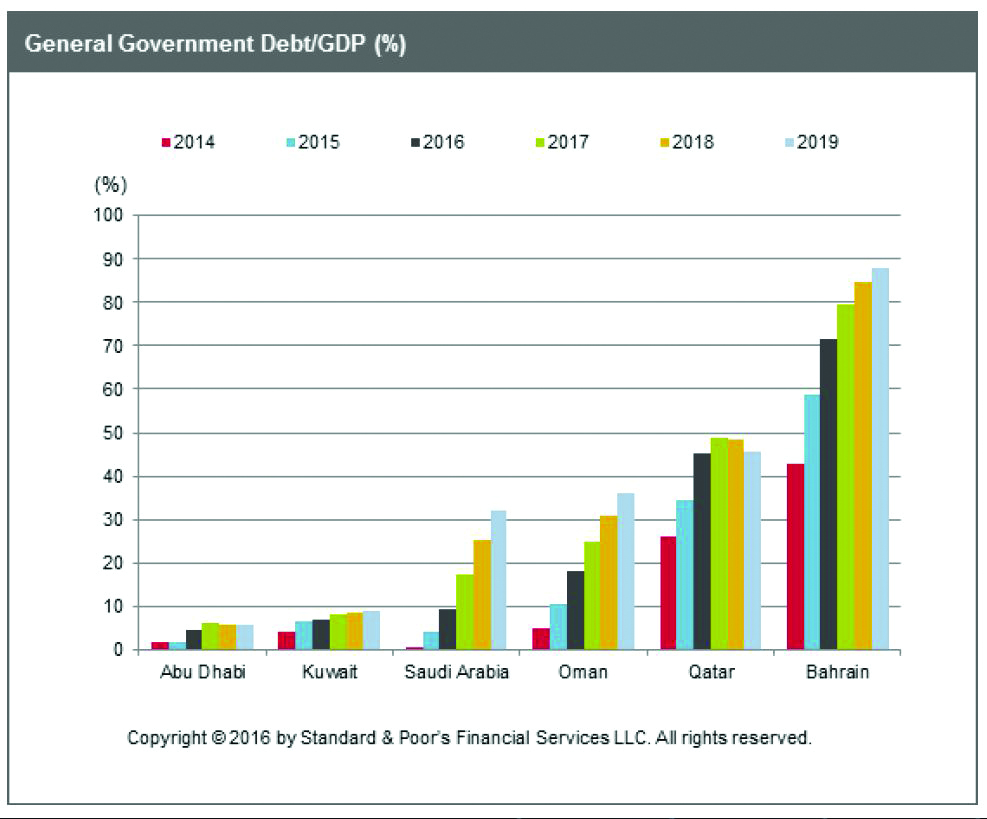
Given the uniformly high dependence among GCC sovereigns on receipts from hydrocarbon exports, the consequences of a sharp fall in prices are clearly visible in both fiscal and external data. While the resulting imbalances differ in scale and duration, one commonality among GCC sovereigns is the emergence of almost unprecedented fiscal financing needs. In Bahrain, Oman, and Saudi Arabia fiscal deficits are expected to average 12 percent of GDP per year in 2016 and 2017. Although much lower, fiscal deficits for Abu Dhabi and Qatar are above 5 percent of their GDPs. S&P estimates the combined fiscal deficits for GCC sovereigns to total over $100bn (9.2 percent of GDP) in 2016, similar to 2015.
“We see two main options for meeting these funding needs. A government can issue debt to finance its fiscal deficit, or, if available, draw on its assets--which could include diverting investment income generated by assets. Meeting these larger funding needs will either entail increasing the annual incurrence of debt and/or reducing asset positions.
Aside from Bahrain, GCC sovereign debt issuance had been relatively sparse prior to 2016, particularly in foreign currency, and usually reserved for benchmarking or monetary policy purposes. So far in 2016, both Abu Dhabi and Qatar have tapped international markets with sizeable issues; Abu Dhabi issued a total of $5bn in two maturities of equal size in May. Also in May, Qatar issued a total of $9bn in three separate series; $3.5bn five-year maturities at 2.375 percent, $3.5bn 10-year maturities at 3.25 percent, and $2bn 30-year maturities at 4.625 percent.
The Peninsula