By Satish Kanady
DOHA: Lower oil prices are leading to a fiscal restructuring across GCC’s hydrocarbon economies, which involves both reduced government spending and increased government revenue through taxation. This scenario will have various implications for real estate investment both in the region and globally.
Highlighting the impact of lower oil price on capital flows into real estate, JLL, the world’s leading real estate investment and advisory firm noted yesterday that fiscal restructuring is already evident in the form of budgetary cuts among GCC countries.
As governments become more cautious about their finances, there is a likelihood of cuts in infrastructure spending. While many of the already announced projects are likely to proceed, they may be scaled back or rescheduled over an extended timeframe, with future projects being curtailed. This will inevitably have a knock on effect on local real estate markets.
Craig Plumb, Head of Research JLL MENA, said “While we remain positive on the long term outlook for real estate markets across the region, there is little doubt that the rebalancing of the fiscal position will result in headwinds and challenges over the next 12 months. While governments continue to spend on development and infrastructure projects, the level of this spending will inevitably be curtailed over the medium term as spending needs are realigned with the reality of lower oil revenues.”
GCC investors have been active on the global real estate stage for many years. Since 2007, GCC investors have purchased a total of over $45bn of real estate globally. In reality, this figure underestimates their exposure to real estate, as it only includes direct commercial real estate purchases and excludes both residential projects and also company acquisitions. While many of the high profile purchases have been made by government controlled Sovereign Wealth Funds (SWF), there has been growing interest from private investors over the past two years and this trend is expected to continue further.
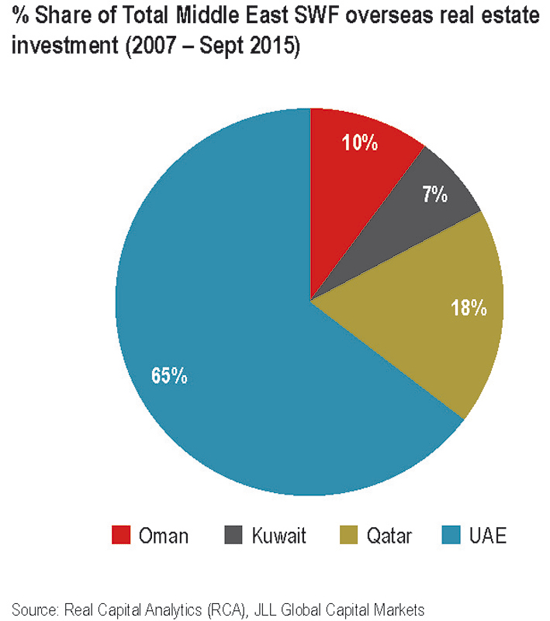
Despite lower oil prices, JLL’s data shows that Middle East SWF’s remained active purchasers of global real estate during 2015. A total of 38 deals worth $6.5bn were transacted over the 9 months to September 2015. While the number of overseas transactions has declined from the 74 deals seen in 2013, the value of investment has remained high and is likely to exceed that experienced in 2014. The volume of investment is expected to decline in 2016 as we enter a prolonged period of lower oil prices that will cause sovereigns to reconsider their objectives and strategies.
Craig Plumb added, “While some SWF’s will retain their existing mandate to invest globally, we expect more funds will be diverted into local real estate through direct real estate purchases and via funds and external managers. This will provide an important source of additional capital for real estate markets across the Middle East. Some funds will continue to focus on trophy hotel and commercial buildings but more attention is likely to be focused upon emerging locations and alternative sectors of the real estate market in future years.”
Some of the decline in SWF offshore investment is likely to be offset by private investors from the Middle East who are becoming more active purchasers of overseas property.
Within the Middle East, levels of real estate investment have declined in 2015. Data from the Dubai Land Department (DLD) shows the number of real estate sales has declined by around 26 percent in the year to September 2015 compared to the same period last year. . The pattern of investment has also changed, with the fall in the number of residential sales being partly offset by an increase in the value of land sales. Lower oil prices and the stronger US dollar have combined to reduce the inflow of capital into Dubai’s real estate market over the past 18 months.
The Peninsula